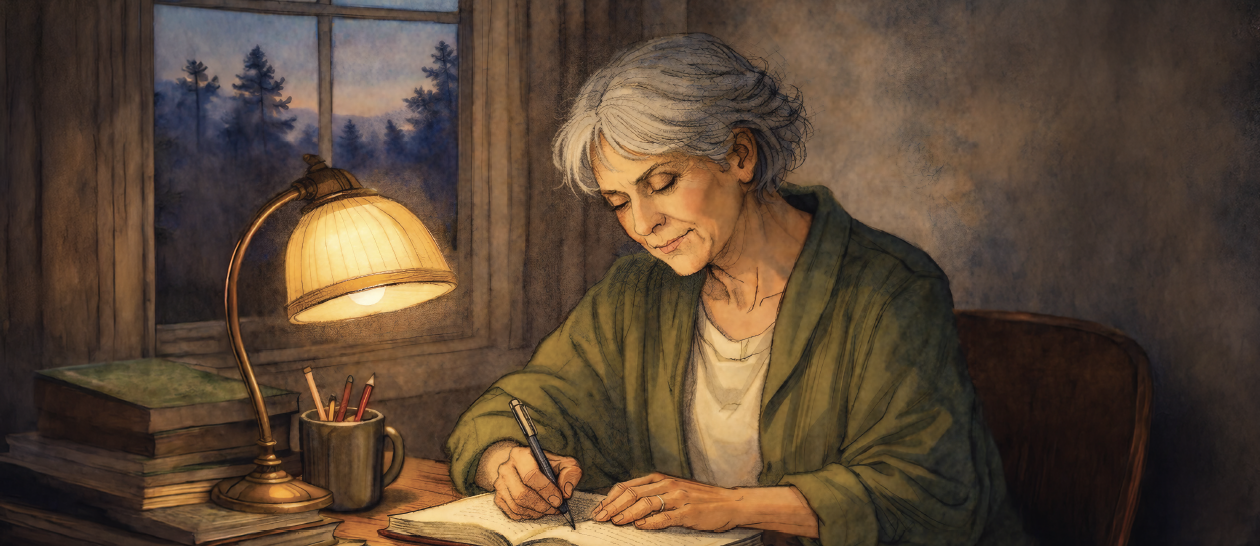
ALANDA GREENE writes about fear, self-doubt, and what it means to claim one’s voice.
It’s not as if I haven’t faced challenges. Climbing a mountain alone in the night, in wilderness where grizzlies and cougars are frequent, to be at the top for sunrise. Sitting by loved ones, holding their bodies in their final breath, the well of grief I thought would drown me. Betrayals that obliterated my ground of trust. Illnesses that brought my own death close. I learned I could face fundamental fears without turning away, hiding, or denying.
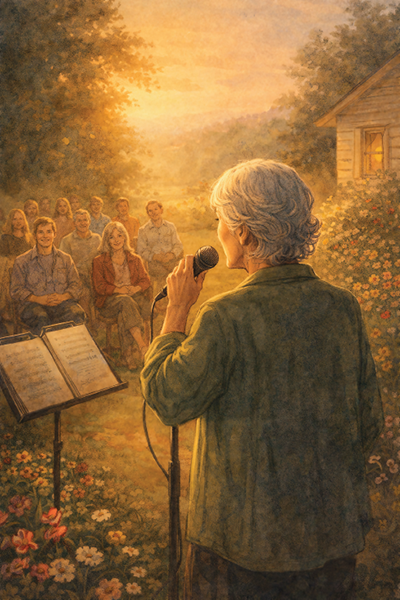
So my terror at being asked to sing solo in a Christmas concert feels entirely misplaced and unexplainable. I mean, really, this is not such a big deal, not compared with legitimate challenges. I live in a small, rural community, maybe 100 people in the audience. Friends and neighbors.
When I turned seventy, in some moment of bravado or delusion, I decided it was time to face new challenges and say yes when asked to do what moved me into uncomfortable places. Observing friends, family, and acquaintances in their ageing process, I saw many choosing what I called the easy route. We’d all reached a phase of having considerable life experience just by living as long as we had. We’d collected a pretty good bag of tricks to handle what came along. No need to take on unnecessary effort anymore. We’d done our bit.
But I noticed that the less people applied themselves to new efforts, the more rapidly their ageing decline seemed to happen. People who continued learning and exerting themselves in various ways appeared to have a less rapid decline, sometimes a hardly noticeable one.
Based on a rather small population study and questionable scientific rigor, I resolved to avoid the easy-street route and the rapid decline. This was my inner pep talk as my seventieth birthday arrived; a promise to myself that I would step up to the plate when opportunities to stretch myself came along.
I would have never made that promise if I’d known I’d be asked to sing a solo, no matter what audience was before me.
I’m fond of singing and look for opportunities to do it. My voice is pleasant and average. I taught for years and sang every day with my class. I sing weekly with friends, guitar in hand. In our small, rural community, choir opportunities come along now and then, and in the last five years, we’ve had a regular “pop-up” choir organized by a former teacher from the big city. I sing alto. And I sing with groups. Not soprano and not solo. For good reason.
I write daily on the subject of the unreasonable fear
that this request has awakened. It is about not being
good enough, not wanting to let others down,
not wanting to be criticized or mocked or judged.
It is about holding back with my voice.
And it is about having the courage,
yet again, to face this fear.
But I need to identify just what, in fact, it is.
“I was wondering,” says Deberah, when she phones me in the late autumn, “if you’d be willing to sing the solo for the part that Anthony usually sings. He can’t do it this year.” I stammer, fumble for the words to say, “Sorry, I don’t think I can do that. I’m not really a solo singer.” One part of my mind constructs a list of reasons why I can’t do it, while another part is busy reminding me of the commitment I’d made to myself at turning seventy, and yet another part agonizes over how much I appreciate what our choir director does, how I really like her, and don’t want to let her down. Instead of the expected response of saying why I can’t do this, a feeble voice speaks into the receiver. “I could try.”
I hang up the phone and wonder how that voice got there. In numb shock, my mind races in a frenetic hamster-wheel panic of words: This is a solo. You can’t sing solo. It’s soprano. You definitely cannot sing soprano. You’re going to have to back out. As soon as she hears you try to sing soprano, she’ll cringe and go find Anthony to beg him on bended knee to please, please come back and sing this part.
This is the beginning of an inner cacophony of anxious voices, and one that tries to counsel the manic, fearful ones.
I think about distracting myself with meaningful tasks like dealing with the mismatched pairs in the sock drawer or finally cleaning the top shelf in the pantry. Anything to escape this terror. And yet, a niggling feeling tells me this is more important than contrived distractions. I retreat instead to my desk, open my journal, and begin to write. I listen and scribe the various voices speaking in my mind.
From that beginning, I write daily on the subject of the unreasonable fear that this request has awakened. It is about not being good enough, not wanting to let others down, not wanting to be criticized or mocked or judged. It is about holding back with my voice. And it is about having the courage, yet again, to face this fear. But I need to identify just what, in fact, it is. Climbing a mountain, loss of trust and friendship, staring at the possibility of my imminent death, and the reality of loved ones’ deaths—these are challenges worthy of fear, worthy of finding courage to face them. But really—singing a solo in the community choir at the Christmas concert? My emotional response feels like an insult to situations that are genuinely challenging.
Yet there in my journal I write the words: this feels really important, really significant, but I don’t know why.
Through the next days, glimmers of insight emerge as to why it matters that I keep my agreement to sing this part. It’s about claiming your voice. There it was on the paper, written by my own hand. What’s this? I ask myself. I have a voice—I write, I speak, I express myself. Sure, sure, says one of the inner voices. But this hides the voice you keep silent.
I begin to track the voices—silent to the outside world—but inside is a chorus eager for a chance to be heard. I resist the temptation to edit and omit. Really? asks one voice. You’re writing THAT?
I’m loosening up old memories, concepts, ideas, fears, restrictions, impositions about how I can express myself. Listen to these criticisms—friends, brother, husband, teacher. I’ve brought them all inside. I’m starting to doubt I can do this.
Several inner voices are happy to corroborate this. A quiet one prompts: You can.
Another is clear. No, you can’t. You’ll let Deberah down. You’ll be an embarrassment to the choir and the band. Your friends will feel badly for you. Your not-friends will be gleeful.
I practice with the choir, and my voice sounds weak; I miss notes, and there’s no volume. I cringe. Deberah suggests I work on my breath. I’m a long-time student of yoga. I thought I knew how to use my breath. But something holds it, contains it, tightens my chest and restricts my throat when I try to sing this piece.
I write more. Okay, I will challenge this concept—the not-good-enough, the don’t-put-yourself-forward, don’t-take-center-stage. Why not? What’s behind that? Something is hiding in the corner of my mind, something about not doing what my sister couldn’t or wouldn’t. Your sister was the one with talent. That’s why she had singing and piano lessons. She was the one who had the good voice. She was too fearful and shy to sing in front of people. It would be wrong for you to step forward. Don’t make others uncomfortable. But this isn’t about my sister. That voice hides a truth that’s even further back in the corner. This is about potential and possibility and all the voices that hold me, and each of us, back.
I can back out at any time, I tell myself over and over. But there’s something to learn. Something that won’t let me quit. It’s about challenging concepts about what I can do. I write. I practice. I wake in the night; my throat is dry and tense.
The concert is close. Sometimes my voice gets the notes. Sometimes it doesn’t. I practice relaxing my throat, letting it open. Words escape when they aren’t supposed to. Sometimes people don’t like hearing them. I see something in all this about giving over authority and power, yet when this idea gets into words on the page or from my mouth, it sounds foolish, not quite right, a bit silly, inadequate.
Inevitably, concert day arrives. I haven’t transformed into a powerful and magnificent singer. But it goes well. The outcome no longer seems so important. I am busy processing the insights of all the voices. Still, I am glad not to mess it up.
The intensity of my fear still feels out of proportion, yet I know something deep and long-carried was loosened, opened, and released. Partially. There’s more to do. When it comes to really meeting the long-held, buried ideas about capability, what it’s okay to do or not do, who holds the authority of my voice—to name just a few—it makes climbing a mountain alone in the dark feel ridiculously easy.
AI-generated images

Alanda Greene
