
DAAJI reflects on how alertness becomes the basis for right action in daily life.
Every individual, in every profession—whether they are a carpenter, homemaker, teacher, or vice president—has a distinct capacity for focused work. Interestingly, this capacity has little to do with the work itself and everything to do with the individual’s awareness and alertness.
A senior vice president of a multinational corporation may preside over a meeting with abundant data and authority yet remain unaware of what is unfolding around her. She may be missing emotional undercurrents, silent tensions, and emerging needs because her mind is distracted by other preoccupations. Conversely, you may see a nurse working in a crowded ER demonstrating a profound situational awareness. Fully present and deeply attuned, she senses subtle shifts: a patient’s breathing, a colleague’s hesitation, a change in tone, and instinctively responds with precision and care. The difference between these two is not intelligence, but awareness: the capacity to perceive, feel, and respond to reality as it unfolds.
A common misunderstanding amongst spiritual practitioners is that concentration is the means and meditation the goal. Many seekers tell me they have to strain to focus, assuming that effort will lead to meditative absorption, often reinforced by instructions such as “focus on your heart” or “don’t think about anything.” Yet, the truth is the opposite: concentration is the natural result of meditation, not its cause.
True concentration arises when dharana (concentration) matures into dhyana (meditation), and dhyana into samadhi (absorption). Concentration cannot be forced; it appears spontaneously when the conditions are right.
The same applies to alertness. Like concentration, it cannot be willed into being. Both are outcomes, not techniques, flowering naturally when obstacles to awareness are removed. All that’s needed is to try to create the right inner conditions that will allow them to arise on their own.
True concentration arises when dharana (concentration)
matures into dhyana (meditation), and
dhyana into samadhi (absorption).
Concentration cannot be forced;
it appears spontaneously when the conditions are right.
Interest Precedes Attention
When you are really interested in something, isn’t it easy to pay attention? There is hardly any effort involved. A sleep-deprived mother sleeps through thunderstorms but wakes when her baby cries softly. A musician can detect subtle nuances that the untrained listener would miss. There are also times when your alertness seems heightened. Imagine yourself all alone, walking in a forest at night. Your ears pick up the crunch of a twig on the ground, your eyes catch the tiniest movements through the trees. Out of natural self-preservation, you don’t miss a thing.
We are effortlessly aware of whatever truly matters to us. So instead of wondering how to become more alert, the real question you should ask is: What am I really interested in?
Attention Yields to Awareness.
Awareness, on the other hand, is something that lives inside us. It is a passive, receptive state of being that arises when effort, striving, and interference fall away—not because interest disappears, but because interest is no longer expressed as grasping or control. Grasping seeks to produce an outcome or secure an experience; surrendered interest simply remains open, without reaching or demand. When the mind stops trying to manage or reach for experience, awareness naturally reveals itself, allowing thoughts, feelings, and sensations to arise and dissolve without resistance. In this openness, experience becomes clear on its own. If one’s heart is oriented toward the Divine, that clarity allows its presence to be felt within and its guidance to be perceived as subtle vibrations—arriving at the mental level as understanding. One committed to living in dharma remains sensitive, within this same clarity, to what their duty is at any given moment.
This is why inner purification is essential. As samskaras dissolve, the heart becomes clearer, and the noise of competing desires quiets, revealing an innate and deeper interest that was previously obscured. With the many pulls of desire reduced, the insistent way of relating to experience naturally falls away. When that inner interest is clear, recognizing what truly deserves our awareness becomes effortless.
Alertness is our Dharma
Dharma becomes clearly visible to an attentive heart—not through effortful focus, but through a wakeful, receptive awareness. Such awareness is free of prejudice, emotional reaction, selfish motives, or dullness. It perceives reality as it is, untouched by desire, fear, or conditioning. From such clarity, right action arises naturally and effortlessly.

A powerful example that comes to mind is from the Mahabharata, when the Pandavas, during their exile, encountered a forest lake guarded by the invisible Yaksha. The younger Pandava brothers ignored the unseen voice that demanded they answer questions before drinking, leading to their downfall. Only the eldest brother, Yudhisthira, paused and listened. He answered the voice’s questions regarding dharma, but his more significant response had already been expressed through his awareness and presence.
True alertness is not forced vigilance but effortless awareness, arising from inner refinement. It is not abstract idealism; it is dharma in motion—seeing clearly and responding rightly. When inner obstacles dissolve, such alertness arises naturally. The other brothers did not fail from arrogance, but from inattention; they heard the warning but dismissed it.
This ancient episode mirrors our present reality. How often do we ignore the subtle inner warning that happens from time to time? How often do our cravings—whether for pleasure, success, or comfort—drown out the call to pause and be aware?
Alertness is what distinguishes true spiritual stillness from dull inertia. A meditator who is quiet but lethargic has merely exchanged one limitation for another. Yet alertness cannot be forced; excessive vigilance only creates tension, not clarity. Genuine alertness arises naturally when consciousness is relaxed and unstrained.
Dharma becomes clearly visible to an attentive heart—
not through effortful focus, but through a wakeful, receptive awareness.
Such awareness is free of prejudice, emotional reaction,
selfish motives, or dullness. It perceives reality as it is,
untouched by desire, fear, or conditioning.
Individual Expression of Alertness
True alertness is simply the mind being fully awake, free from constant distraction. It is reflected in a mind that remains present without strain, allowing experience to unfold without distraction or resistance. It is a relaxed, open awareness, like a clear sky that is open to everything. Experiences are allowed to come and go freely, without being held on to or pushed away.
Alertness by itself is like light spread everywhere. When it aligns with purpose, it becomes focused attention. Here lies the subtle truth: purpose shapes attention, and attention reveals dharma.
But an important distinction follows: if alertness is the core of dharma and every human being is meant to carry out their dharma, does that mean everyone’s disposition must be identical? The answer is “no.” A student’s awareness differs from that of a teacher. A devotee’s search differs from a philosopher’s inquiry. A warrior’s presence carries a different quality than that of a healer. Each role and stage of life calls forth its own expression of alertness. This is not separate from dharma; it is dharma taking personal form—what tradition calls svadharma, one’s unique path.
The Art of Availability
From readiness, availability is born. Steadiness, or sthira, is the foundational quality. It is a living balance that enables calm engagement with life, allowing stability without rigidity. Patanjali’s phrase sthira sukham asanam, often taken in relation to physical posture, actually points to a way of being that is grounded yet relaxed and open to change. Such a state shapes the personality and is essential for receiving and integrating subtler experiences.
Steadiness operates in both the mind and the emotions, each requiring its own clarity. Mental sthira is the ability to keep the stream of thought steady and undistracted, like a flame that does not waver. Genuine mental steadiness is not created by force but arises naturally when inner restlessness has been removed.
Emotional sthira relates to bodily experience and deeply rooted reaction patterns that operate beyond the mind. It cannot be cultivated through mental effort, but through purification of the heart—clearing the samskaras that trigger excessive reactions and gradually replacing reactivity with conscious responsiveness. One may have a disciplined, focused mind yet remain emotionally unstable, as can be seen in many highly intelligent individuals. Conversely, emotional stability can exist even with a restless mind. True spiritual maturity requires harmony and steadiness in both, a balance that cannot be imposed but must unfold naturally.
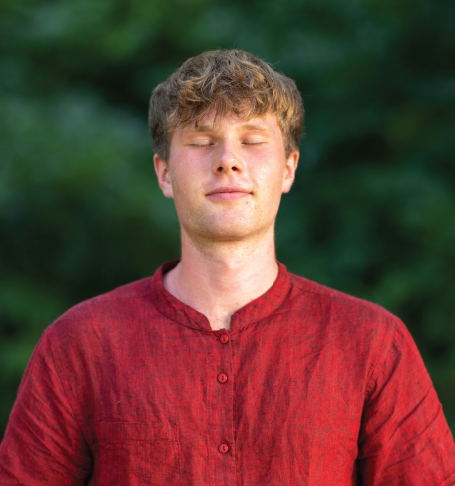
From the awareness that naturally
blossoms as a result of sincere meditation,
life becomes naturally and seamlessly
integrated with one’s dharma.
In Heartfulness meditation, availability is the first requirement. Our role is not to strive for attainment, but to remain present with as much inner steadiness and openness as possible, allowing grace to accomplish what effort cannot. We simply sit with the gentle idea that divine light is in the heart—without force or concentration—aligning ourselves inwardly and remaining receptive. That receptive attitude is one of the most important qualities a seeker can have.
From the awareness that naturally blossoms as a result of sincere meditation, life becomes naturally and seamlessly integrated with one’s dharma. Individuals, relationships, communities, and perhaps even the course of civilization itself are affected. The effort is personal, but its impact is universal. Everyone who undertakes this inner journey contributes not only to their own freedom but to the collective upliftment of humanity. By preparing the field and cultivating these qualities, we ready ourselves to receive a plethora of spiritual gifts, far beyond our imagination.

Daaji
Kamlesh Patel is known to many as Daaji. He is the Heartfulness Guide in a tradition of Yoga meditation that is over 100 years old, overseeing 14,000 certified Heartfulness trainers and many volunteers in over 160 countries. He is an inn... Read More
