
DAAJI traces the path to unconditional joy through contentment—and suggests it may be closer than we imagine.
There is a question that lies beneath every human endeavor, beneath the striving, acquiring, and yearning. It isn’t asked directly very often, but it affects almost everything we do. Why is it so hard to keep joy going when we have so much? Why does it come without warning, stay for a short time, and then leave without warning, as if it belongs to another country and we are only visitors there?
The Taittiriya Upanishad says that ananda [bliss] is at the very core of human existence, deeper than the body, breath, mind, and even intellect: we are joyful by nature. In one reading, the whole spiritual journey is removing everything that obscures that original brightness. And the amazing thing is that this gentle letting go brings happiness in and of itself. We don’t have to wait until we complete our journey to feel free.
∗
Joy, in its truest sense, cannot be forced or manufactured. It is like a flame that moves through us, not something we can artificially create. No practiced smile or rehearsed effort can replicate its authenticity. True joy flows freely, carrying a natural grace that defies imitation. This is why it cannot be summoned by mere intention, and why it cannot be sustained by willpower alone. Enduring, unshakeable joy arises from a balanced and harmonious mind. As the mind settles into harmony, the intensity of passions, cravings, and emotional swings begins to fade. Gradually, even the distinctions between sorrow and pleasure lose their grip, giving way to a steady state of peace and calm in all situations.
Hazrat Inayat Khan, writing with the precision of one who had looked deeply into the heart of human experience, observed that true happiness is not gained but discovered—that what keeps it from our lives is the closing of the heart. When the heart is not living, he suggested, happiness cannot live there either. This is a profound reversal of the assumption most people carry through life, that joy depends on what we receive, what we achieve, what is done for us. But the evidence of genuine seekers across all traditions points in another direction: joy is already present where the heart remains open. The work is not addition but subtraction, not construction but clearing.
Babuji confirmed this from a different angle when he wrote that the various pleasures of the world do not provide lasting satisfaction but change into miseries. Yet beneath this diagnosis lies an insight of striking tenderness: the very fact that we are unsatisfied by worldly pleasures is proof that we once enjoyed something unparalleled, and the taste of it still haunts us. Our restlessness, rightly understood, is not a defect; it is a memory. The soul knows what it came from, and it will not be permanently consoled by anything less.
Modern neuroscience, arriving at this conclusion through a different corridor, confirms that sustained well-being is not a function of external circumstances. Research on the hedonic set point, beginning with Brickman and Campbell’s work on the hedonic treadmill and developed further by Sonja Lyubomirsky and others, shows that after major life events, whether gains or losses, people tend to return to a relatively stable baseline of well-being. External circumstances account for only a fraction of lasting happiness. The dominant factor is internal: the habitual orientation of the mind. A mind that has learned to rest in its own depth, to stop grasping and resisting, finds that the baseline itself rises. This is not a coincidence. It is the same truth the Yoga Sutras articulated centuries earlier: santosha [contentment] brings supreme joy.
∗
Enduring, unshakeable joy arises from a balanced and
harmonious mind. As the mind settles into harmony, the
intensity of passions, cravings, and emotional swings begins
to fade. Gradually, even the distinctions between sorrow and
pleasure lose their grip, giving way to a steady state of peace
and calm in all situations.
Yoga Sutra II.42 says that santosha is the basis for real joy. This is the ease of a tree whose roots go deep enough that no storm disturbs its canopy, and the ability to find fullness in the present instead of in a future that keeps getting further away. An open heart that never rests will eventually become anxious. When it doesn’t feel full, even small gifts can be hard to give. That is why compassion needs to be balanced with contentment. We should live like children who give freely without thinking about it, just for the joy of giving.
When santosha grows, it spreads like seeds planted in the heart that one day grow into a huge forest. From this inner wealth comes a quiet joy that spreads to the world around it. This teaches us that when we don’t have any needs, other people feel comfortable around us. There is no stress, no noise, just acceptance. The HeartMath Institute’s research on heart coherence has shown that when people feel real gratitude and happiness, it changes the heart’s electromagnetic field in a way that can be felt by people nearby. The radiance of a saintly presence, described in ancient traditions, may well have a biophysical signature we are only beginning to detect. When we are content, it spreads and changes the quality of the space we live in.
∗
For hundreds of years, people have puzzled over a line from the Isha Upanishad: “Tena tyaktena bhunjitha” [enjoy by giving up]. It seems strange: how can someone enjoy something that they have given up? The misunderstanding comes from how people think about renunciation. Tyaga means letting go of the feeling of ownership over things, which is very different from giving them up. A subtle detachment comes over us when we stop holding on to things we like or defining ourselves by them. It brings a deeper and more lasting peace.
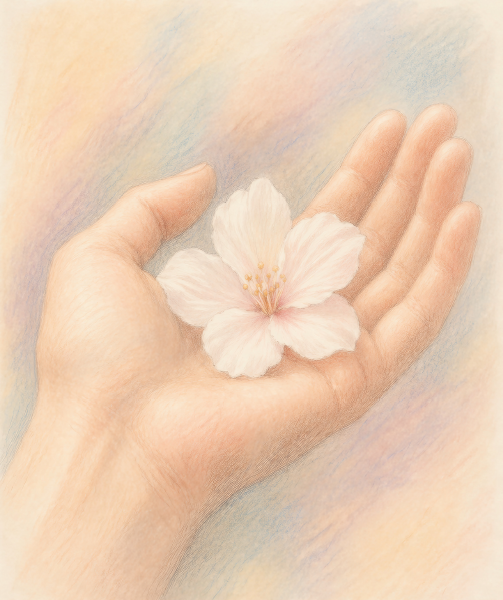
Consider someone who holds a flower tightly in their hand, versus someone who holds it lightly in their palm. The first is afraid of losing it. The second loves it. The open palm is the real tyaga. The enjoyment is more intense because the clinging has gone away. Studies on what psychologists call savoring, or the ability to fully enjoy positive experiences without clinging to them, support this idea: not being attached to outcomes actually makes positive emotional states last longer and feel better. When you hold joy lightly, it grows. The Upanishads and the scientists arrive at the same door from opposite sides.
∗
When santosha grows, it spreads
like seeds planted in the heart that
one day grow into a huge forest.
From this inner wealth comes a
quiet joy that spreads to the
world around it.
In a November 2003 message from Whispers from the Brighter World, Babuji spoke of the link between joy and spiritual practice in a way that few other teachings do.1 He said, “Let joy flower inside you, and offer it like a bouquet to Divinity.” Joy is the delicate connection between the spiritual heart and the physical heart. It brings peace and happiness to the person. Joy is a strong force that should be grown. A heart that wants to love cannot ignore it. It is a key part of the sadhana [practice]. It doesn’t help to show a sad face or love someone when you’re sad.

This lesson goes against what most people think. We often think of joy as the reward for spiritual growth, like the fruit that comes after years of hard work. Babuji puts it first as a condition and as a way to do things. Joy is one of the things that gets us there. When you do things with joy and a sincere heart, you make progress in practice. A mind that is really engaged is a lighter mind, and a lighter mind goes further. We should do everything with a smile on our faces. Even if you feel limited or weighed down, you can reach great heights through regular, heartfelt, and joyful practice. Babuji communicated again in March 2006: “Let this hymn of joy rise in you—that which you cultivate with delight, making you forget the trials and tribulations of the world. Meeting this inner call also entails evoking subtle forces capable of strengthening the being, in its most elaborate structures.”
∗
Babuji once said that the only person who is truly happy is the one who is happy under all circumstances. He told each abhyasi to work on the very spiritual skill of cheerful acceptance, which is both a sign of growth and a means of growth. In defeat, you feel helpless: “I can’t change this, so I give in with heaviness.” Cheerful acceptance, on the other hand, means that you are open to whatever comes your way and welcome it as it is. When that kind of happiness is really present, everything starts to change. Fear often grows when you fight it, but it can be understood and worked through when you accept it. What we resist remains standing in our way. What we welcome becomes our guide.
This is the deeper meaning of saranagati [surrender]. It makes you feel like a Beloved is holding you and taking care of you. Someone who has this kind of trust goes through life with a sense of lightness and gratitude. In a whisper message, Babuji expressed that surrender means being completely available and accepting. It is the cost of everything coming together and making sense in a useful way. Research on the brain’s resting state corroborates this at the physiological level: a mind in an accepting, non-reactive state produces diminished activation in areas linked to rumination and anxiety. The body calms down, the heart rate variability increases, and the organism reaches what is effectively its best operating state. The scientists and the mystics both talk about the same homecoming, but in different ways.
∗
When you share happiness, it grows. Joy brings more joy. Joy brings grace. The devotional traditions describe the highest form of devotion as one in which the devotee feels the happiness of others as their own—para sukha sukhi—and is sad when others are sad—para duhkha duhkhi. It is natural to want to celebrate with someone when they are happy. But jealousy often comes up instead. That jealousy makes the mind uneasy, breaking inner peace and creating vibrations that do not settle. The critic believes they are better than everyone else, and the idea that “no one is better than me” takes hold. How can there ever be peace in a heart like that? The best way to show thanks for everything we have is to share our own happiness and feel the happiness of others.
Babuji once said that the only
person who is truly happy is the one
who is happy under all circumstances.
He told each abhyasi to work on
the very spiritual skill of cheerful
acceptance, which is both a sign of
growth and a means of growth.
Why are we so good at showing our sadness, pain, and anger but so bad at showing our happiness and love? In times of trouble, almost everyone talks to God. We ask and beg. But what happens to our memory of the Beloved when we are happy and full? You can also give joy to others. We can share that feeling with God, just like we share our sadness with a cry from within. Mirror neurons, which fire both when we act and when we observe others acting, indicate that when we truly celebrate someone else’s happiness, we are participating, and the heart that celebrates adds to its own reserves.

Sharing happiness does not divide it; it multiplies happiness. The Bhagavad Gita describes the one who delights in the welfare of all beings—sarvabhuta hite ratah—as attaining dissolution in God.
∗
And here we return to the flame. At the opening of this reflection, joy was described as a flame that moves through us, not something manufactured but something that passes. Silently, the question was planted: if joy is our natural state, why does it feel so elusive? The answer has been unfolding across every movement of this inquiry. Joy does not feel like home because we have furnished the interior of our lives with so much that obscures it, with demands, comparisons, resistances, and the quiet but constant insistence that things must be other than they are. The flame was never extinguished. We simply stopped sitting near it.
When you share happiness, it grows.
Joy brings more joy. Joy brings grace.
Our spiritual journey is a gift, the very first gift we receive from the Divine, tied to our very existence, and to life itself. To be alive is an opportunity to grow. What is the best way to honor this immense gift? If we live it fully and joyfully, simply appreciating the fact that we are here, we are already on the right track.
When santosha deepens into saranagati, when contentment opens into surrender, joy ceases to be a passing mood and instead becomes our ground. It no longer arrives and departs but underlies even grief, difficulty, and the ordinary Tuesday afternoon with its unremarkable demands. The seeds sown in the heart have by then grown into something that provides shelter. And from that shelter, joy flows outward without effort, touching others, inviting them toward their own original luminosity, doing so not by instruction or persuasion but simply by being what it is.
If we offer love without conditions, our joy too can become unconditional. When the heart rejoices in wonder and gratitude, this state of joy itself becomes a bridge to Divinity. Let joy flower inside you, as Babuji said, and offer it like a bouquet. Not because you have been asked to, nor even because it is prescribed, but because when the heart is genuinely full, offering becomes as natural as breathing. And when joy is offered upward with love, it completes its circuit and returns, deeper than before, steadier than before, less like a visitor and more like home.
∗
1 Whispers from the Brighter World, messages received through intercommunication from elevated souls.
AI-generated images

Daaji
Kamlesh Patel is known to many as Daaji. He is the Heartfulness Guide in a tradition of Yoga meditation that is over 100 years old, overseeing 14,000 certified Heartfulness trainers and many volunteers in over 160 countries. He is an inn... Read More
