MEGHAN STEWART explores how nonviolence starts at home, showing how emotional intimacy, regulation, and repair shape how families navigate conflict.
While exploring nonviolence in a conflict studies course, I began to notice how often nonviolence is discussed as a principle rather than a lived practice. In theory, it is easy to agree that violence causes harm and that peace is something we should strive for. In everyday life, especially within families, nonviolence shows up in subtle ways, through tone, timing, interpretation, and the meaning we assign to one another’s behavior. This realization prompted me to look more closely at the relationship among nonviolence, parenting, and developmental psychology, and at how peace is cultivated not only in societies but also within bodies and relationships.
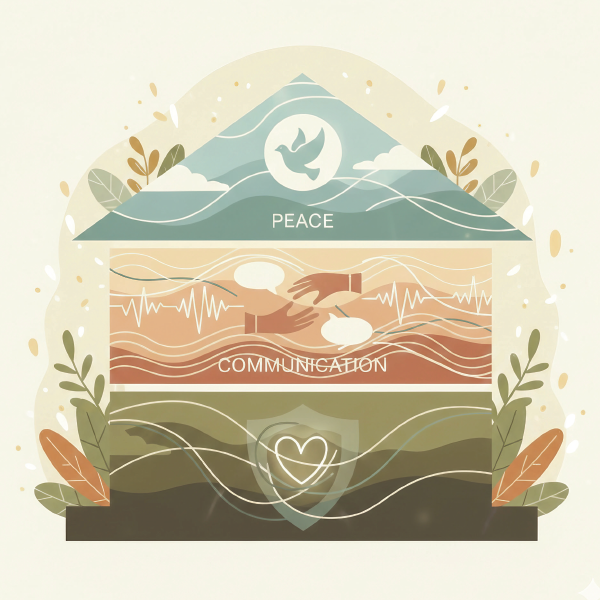
Peace, as it is understood in conflict studies, is not limited to the absence of war and overt harm. Peace exists across multiple relational layers: within ourselves, between individuals, within families, communities, and institutions. These layers are interconnected. As we observe through Mindfulness practice, what is carried internally often shapes how we respond externally. From a developmental and social learning perspective, parenting is one of the earliest and most influential contexts in which relational patterns are modeled, absorbed, practiced, and carried forward.
From a developmental perspective, this interconnectedness matters deeply. The parts of the brain responsible for emotional regulation, impulse control, and executive functioning continue developing well into young adulthood. Children are therefore not equipped to manage intense emotional states independently and rely on caregivers to help them settle, orient, and recover. This can be interpreted to mean that regulation is learned through relationships long before it becomes an internal capacity.
When children express strong emotions, withdraw, or push limits, they are revealing where support is still needed. Noticing this can gently shift how parenting moments are held, moving attention away from managing behavior and toward the relational safety and emotional intimacy that allow regulation to take root. This shift in attention opens a different way of being with children. Rather than rushing into interpretation or correction, there is room to pause and wonder what might be unfolding beneath the surface. Essentially, there is room for connection before correction.
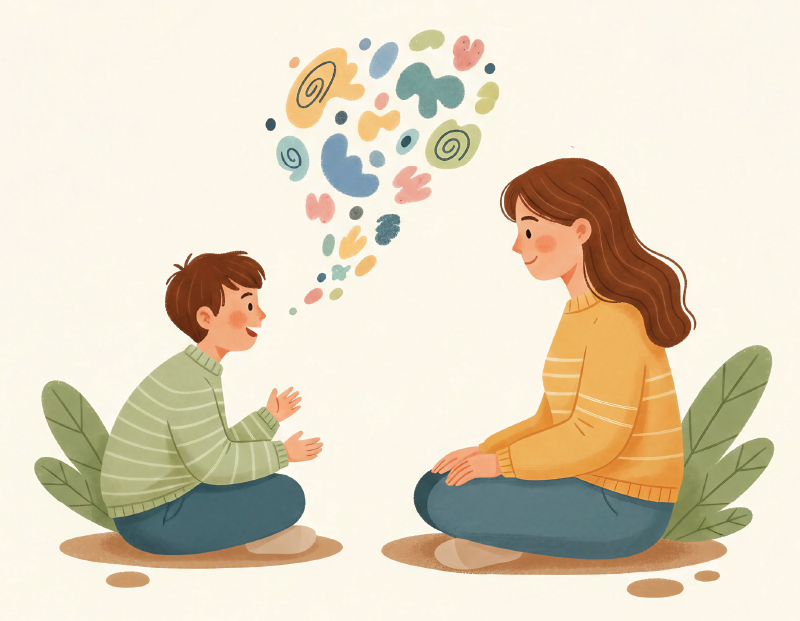
In family life, emotional intimacy grows through the repeated choice of connection, as parents remain present with a child’s inner experience while staying grounded in themselves. Children learn whether their inner world is welcome through repeated, ordinary interactions. When emotions are met with steadiness and curiosity, children learn that feelings can be expressed without threatening connection. When emotions are met with dismissal, urgency, or judgment, children adapt in order to preserve relationships, sometimes by hiding parts of themselves, sometimes by amplifying them.
There is a gradual way that emotional rules take shape in childhood, not through instruction but through experience, as children attune to the responses around them and begin to organize their inner lives around what seems to preserve connection. Within this landscape, different expectations often settle around different caregivers. Fathers may come to feel that steadiness means withholding emotion, while mothers may sense that distress is acceptable so long as it does not take the shape of anger or frustration. These patterns are rarely intentional, yet over time, they influence which emotions are given room to breathe and which are quietly managed in the background.
bell hooks, an African American feminist writer and educator known for her work on love, power, and relational healing, writes that “children need to be raised in environments where they can learn that love is an action, where care, responsibility, respect, and knowledge are practiced” (hooks, 2015, p. 142). In her reflections on revolutionary parenting, she names how domination within parent–child relationships, even when subtle or well intentioned, can erode emotional safety. Emotional intimacy grows when children experience adults as emotionally available rather than emotionally controlling.
I remember being in a parenting course grounded in the Circle of Security framework when the facilitator shared something that still offers me pause. Children who need love the most ask for it in the worst ways. She went on to explain that when children feel afraid, hurt, overwhelmed, or unsafe, the behaviors that emerge do not always look like a request for connection. They may look like defiance, withdrawal, or disregard.

Another observation that surfaced among parents in that room was the common belief that children “just want attention.” Sitting with that idea more closely, it became clear how often attention is mistaken for the need underneath it. In most cases, it is rarely about attention itself. It is almost always about connection.
It often looks something like this:
A mother is sick at home, depleted, and asking her teenage son to walk the dog. He ignores the request. Later, when she raises it again, he responds sharply, saying, “Not everything is about you, mom.” In her body, there is a tightening. Her chest feels hot. Thoughts arrive quickly, shaped by exhaustion and long-standing fears. She notices a familiar story forming: doing everything, not being appreciated, being the strict parent while his father is the fun one. Before there is space to pause, her response comes out charged, listing sacrifices and responsibilities. The exchange becomes adversarial.
Moments like this are familiar to many parents, arising when tired bodies, unspoken fears, and competing needs converge. Eventually, the moment shifts, allowing the son to share his overwhelm and need for rest, and the mother to meet him there with an apology of her own. She notices that her reaction had less to do with the request itself and more to do with quiet stories about scarcity, comparison, and adequacy that were already present. What initially felt personal becomes understandable.
As the moment opens, the pull of judgment becomes easier to recognize, how quickly experience can be shaped by stories about what something means or what it says about us. With a little more space, attention drifts back toward what is present: the body, the room, the relationship. Contemplative practice supports this return, offering a way to stay with sensation, notice thought as thought, and allow emotion to move without rushing toward response.
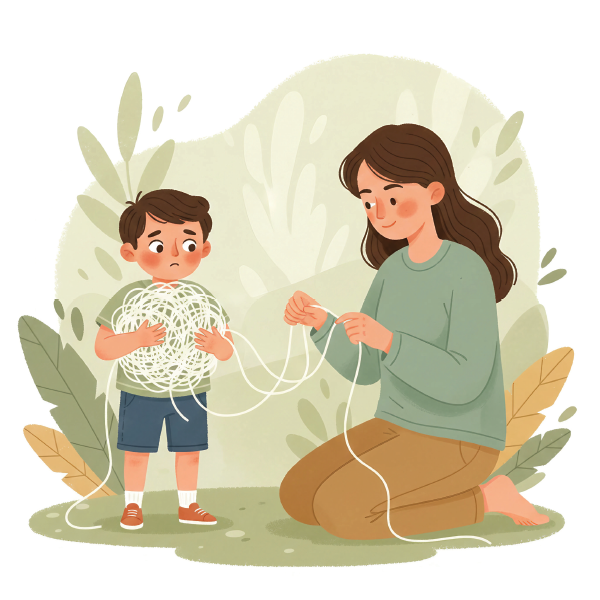
Developmental and attachment research consistently show that children learn regulation through emotionally responsive caregiving. When caregivers remain present and engaged, even during moments of rupture, children’s nervous systems learn how to return to balance. Over time, this becomes internalized as resilience and emotional flexibility. Secure attachment is shaped through repeated experiences of repair rather than constant harmony.
This is often where nonviolence takes root in parenting, through the patterns children witness and internalize for meeting needs. When guidance and boundaries remain steady, emotions no longer need to intensify to be taken seriously. Children begin to learn strategies for expressing needs that are less fear-based and more grounded in relationships.
Developmental and attachment research consistently show that
children learn regulation through emotionally responsive caregiving.
When caregivers remain present and engaged, even during moments of
rupture, children’s nervous systems learn how to return to balance.
Caring for oneself as a parent becomes integral within this landscape, as parents also navigate stress, fatigue, and inherited emotional patterns. When parents respond to their own reactions with harsh self-judgment, the nervous system remains activated, making presence harder to access. Compassion toward oneself supports regulation because the nervous system settles when it feels acknowledged rather than corrected, and this settling directly shapes a parent’s capacity to remain emotionally available to their child.
Practices oriented toward kindness and care help parents stay with their own discomfort long enough for choice to re-emerge. Noticing fatigue, fear, or frustration with gentleness allows these experiences to move without solidifying into shame or defensiveness, shifting the inner dialogue from:
“…something is wrong with me for feeling this, to this is what is
present right now, and I can stay with it without needing to fix or justify it.’’
Over time, this creates more space for repair and reduces the tendency to personalize a child’s emotional expression.
My own relationship to this deepened through Vipassana practice. Learning to remain present with unpleasant sensations without fixing or escaping them built a steadiness that now supports my parenting. That steadiness allows me to hear emotion without immediately turning it into a story about myself. It makes it easier to respond rather than react, and to return to connection after moments of rupture.
Practices oriented toward kindness and care
help parents stay with their own discomfort
long enough for choice to re-emerge.
A simple reminder continues to guide me: nothing is about me unless I make it about me. This perspective restores proportion. Children’s emotions are not tests of worth. They are signals of development and invitations for guidance within the relationship. bell hooks reminds us that loving parenting involves resisting domination while remaining accountable to the responsibility of care (hooks, 2015). When adults can hold authority without control and presence without collapse, families become places where nonviolence is quietly practiced through attention, repair, and emotional honesty.
Over time, children learn less from whether a parent responds perfectly and more from what happens next. When parents can return to presence and care for themselves along the way, emotional intimacy becomes easier to maintain, and peace is built through the small, repeated ways families repair and stay connected.
To learn more about Meghan Stewart’s work, visit
www.mindfulnessmeghan.com
References:
hooks, b. (2015). Revolutionary parenting. In Feminist theory: From margin to center (3rd ed., pp. 133–147). Routledge.
Menakem, R. (2017). My grandmother’s hands: Racialized trauma and the pathway to mending our hearts and bodies. Central Recovery Press.
Santrock, J. W. (2020). Child development (2nd Canadian ed.). McGraw Hill Education.
Siegel, D. J., & Bryson, T. P. (2012). The whole-brain child: 12 revolutionary strategies to nurture your child’s developing mind. Bantam Books.
Stewart, M. (n.d.). Vipassana takeaways. Mindfulness Meghan. https://www.mindfulnessmeghan.com/blog/vipassanatakeaways

Meghan Stewart
Meghan Stewart is a certified Mindfulness Trainer and Teacher through United Mindfulness based in Ottawa, Canada. A multiracial Black woman of Jamaican heritage and a mother of two, her work integrates contemp... Read More
