
Gratitude begins with recognizing what we have received and deepens as we learn to transform life’s difficulties into opportunities.
BY DAAJI
Have you seen how quickly gratitude runs out? The lights go out for 20 minutes, and suddenly we discover what electricity means. A blocked nose makes you appreciate breathing. And when we stub our little toe, we find out this forgotten little guy, who got next to no thanks for a long time, is apparently a key member of the walking department.
Why must we lose something before we recognize its value?
Maybe saying thanks matters less than deeply recognizing what we are thankful for. This is beautifully encapsulated in the Sanskrit word kṛtajñatā: kṛta, that which has been done, and jña, knowing or recognizing. Gratitude begins with an awareness of what has been done for us.
When we look closely, we find something humbling: very little of what we call “mine” is ours alone. Picture a normal cup of tea. Someone grew the tea. Someone picked it and processed it. Someone carried it. Rain fell, soil helped, sun shone for free. Thousands of visible and invisible contributions came together so we could casually say, “My cup of tea.” But if the tea comes five minutes late, this philosophical outlook is liable to vanish.
Such is the ego’s arithmetic. It keeps a very accurate record of what we have done for others and a rather inaccurate one of what others have done for us. Maybe someone was kind to us a hundred times and spoke harshly once. What do we remember at bedtime? Usually that one sentence. We replay it, edit it, add extra dialogue that was never said, and by midnight we have made a whole movie out of 12 seconds of conversation.
Gratitude begins with an awareness of what has been done for us.
Gratitude makes amends for this strange accounting. It brings to mind the mother who cared for us when we were ill, the father who carried burdens without showing them, the teacher whose reprimand proved useful later, the friend who stood by us when nothing could be gained, and thousands of other people whose silent contributions made our lives possible. How glibly we talk of people after they have passed away. What are you waiting for? Flowers given to living hands have a different scent.
Nature goes even further in this lesson. Picture a mango tree. A mango tree receives soil, water, sunlight, perhaps some cow dung, and gives us sweet mangoes in return. Have we ever seen a mango tree asking for mango juice to keep itself going? A coconut tree doesn't need coconut water before it produces coconuts; a cow doesn't need milk before it produces milk. Nature takes the common things and makes them better.
Maybe this is where gratitude touches spirituality. It’s not just a question of “What has life given us?” The question is, “What are we turning it into?” If life gives us appreciation, does it automatically bring humility? If it gives us wealth, do we become generous? If it provides knowledge, can it become wisdom? And when life offers us disappointment, criticism, failure, or humiliation, then what?
Anyone can be thankful for mango juice. Spiritual maturity starts when we learn what to do with the manure.
In the fifth maxim, Babuji Maharaj asks us to take miseries as divine blessings for our own good and be thankful. This doesn’t mean pain is pleasant. No matter how much we spiritualize these experiences, loss is loss, betrayal is betrayal, and sickness is sickness. The question is different: what is this experience taking away or awakening in us?
When you fail, you rob yourself of a pride that success would have built. A difficult person, however, may reveal impatience cleverly hidden from ourselves. Rejection can show us how much we need approval. Loss can show us how tightly we held onto something that was never meant to be ours forever. Perhaps our enemy has been an unconscious party to our education.
This does not mean you put up with injustice or stay in harmful circumstances. Let us think wisely. But once we have done what needs to be done, must we carry bitterness? Someone can hurt us for five minutes, and we can replay the injury for 15 years. Somewhere along the line, we have to ask: who is carrying on the injury now?
Here, cleaning is valuable. We’re not rewriting history or pretending that nothing happened. We’re allowing the emotional weight of the event to dissipate. The sting may be removed, but the memory will stay. Maybe one day we’ll look back and say, “That hurt, but it changed me.” Sometimes we may be grateful for that change later on. The wound has turned into a window.
Another kind of gratitude often comes many years later: gratitude for the prayer that was not answered. We’ve probably all wanted something desperately at one time or another: a relationship, a position, an opportunity, a particular outcome. We prayed, and nothing happened. At the time, we asked ourselves, “Why doesn’t God listen?” Years later, we look back and say, “Thank God that didn’t happen.”
The closed door may have saved us or led us to something we couldn’t see then. This should humble us in our prayers, for we often pray to the Infinite and give Him remarkably specific instructions. “Lord, I am fully yielded to you. Please arrange these seven matters as per my specifications.” Maybe we don’t always seek Divine Will; sometimes we seek Divine cooperation with our will.
As gratitude matures, so does prayer. It starts with “Give me what I want,” moves to “Help me understand what is needed,” and ends with simple presence.
Gratitude also humbles the ego, because it undermines our claim of authorship. We say, “I did this by my hard work.” And of course effort counts. But who gave us the body, the intelligence, the education, the opportunities, the teachers, the health and circumstances that made the effort possible? Our heart beats about a hundred thousand times a day without sending us a bill. The sun rises; it doesn’t look at our credit rating. Those who have never planted a tree still get oxygen from trees.
As gratitude matures, so does prayer. It starts with “Give me what I want,” moves to “Help me understand what is needed,” and ends with simple presence.
When we recognize this, we don’t have to cultivate humility artificially. Gratitude says, “Look how much has been given,” and the ego says, “Maybe I was not doing everything alone.”
I like the image of an ancient village well, its stone rim grooved by the rope pulled over it thousands of times. The stone is hard, the rope is soft. But even the soft thing will wear away the stone if it keeps pushing against it, again and again.
There is a story about an old woman who came to a well like this every morning. She would draw the first pot of water and pour it back into the well before drawing the water she needed. A little boy watched her and thought, “Why did she waste that first pot?” Much later in his life, he understood. The wee pot of water was not required for the well. She sent it back so that her hands would remember where the water came from.
Perhaps that’s the way of gratitude. Does God require our thanks? One little “thank you”—what can it add to the Infinite? God does not need the prayer; we do. It keeps the heart from forgetting where the water comes from.
We are thankful first for something: family, health, success, help, an answered prayer. Then thankfulness grows, and we give thanks even for what is denied, or perhaps taken away. In spiritual practice, sometimes nothing special happens externally, but the heart still feels full after meditation. There is nothing but gratitude.
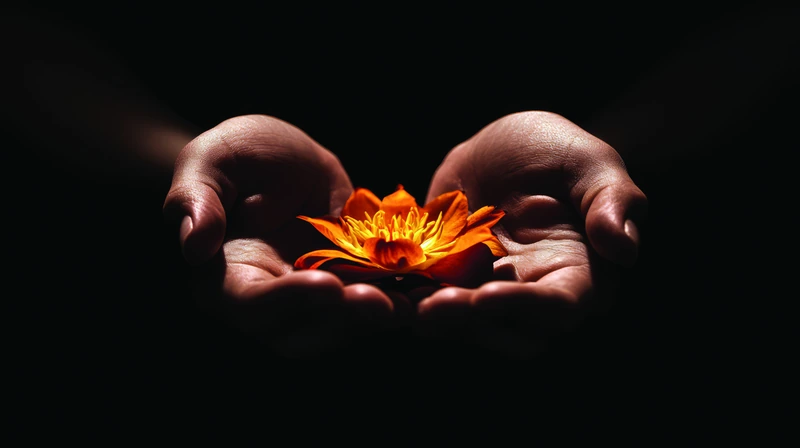
Around this time, gratitude doesn’t depend on anything that happens in life. It becomes an independent, inner state, ripening naturally into remembrance and love.
How does a flower thank the sun? By flowering. How does a tree thank the earth? By bearing fruit. Perhaps our greatest gratitude is not expressed in words, but in what we become. If meditation makes us more loving, if cleaning impressions [samskaras] lightens yesterday’s resentment, if prayer reduces our demands and enlarges acceptance, and if remembrance of God makes our presence gentler, then gratitude is already expressing itself through our life.
Perhaps the more profound question is not, “Have I been given enough to be grateful?” We have too many reasons to count. The real question is, “What has life given us, and what are we doing with it?” The mango tree receives common water, sunlight, soil, even manure—and gives lush sweetness without fanfare. Maybe we too can learn to do that.
And then there is something more fundamental. Let’s think about the life force for a moment. It has been with us since we came into this world, supporting every breath, heartbeat, movement, thought, and experience. It doesn’t ask for recognition, doesn’t announce its presence. We do not know how long it will stay with us, yet how often do we even stop to notice it, let alone be grateful for it?
Perhaps gratitude begins there: in remembering that before we own, achieve, love, or pray, life itself has already been given. And perhaps the best way to say thank you is to live in such a way that this gift is not wasted.

FROM DAAJI
Daaji is the global guide of Heartfulness and president of Shri Ram Chandra Mission.

Daaji
Kamlesh Patel is known to many as Daaji. He is the Heartfulness Guide in a tradition of Yoga meditation that is over 100 years old, overseeing 14,000 certified Heartfulness trainers and many volunteers in over 160 countries. He is an inn... Read More
