
RUBY CARMEN weaves an ancient Irish tale of Dagda and the magical harp, whose music heals, transforms, and protects the Tuatha de Danaan.
Let me tell you a story, a story of a magical harp and of a people from ancient Ireland, far, far away in the West. Going back to a time that is almost forgotten, and only just remembered.
The guardian of this magical harp was known as Dagda,1 a chieftain, some say, and a god-like figure of immense power and goodness. He was god-like with both immense power and goodness, in equal measure. His magical gifts included a pot known as the cauldron of abundance!
The harp was so beautiful, crafted from sacred oak and covered in jewels and gold. Yet it was the harp’s celestial music that held its real power. The harp's magic was this: it could heal the warriors' sorrows after their many battles. On listening to the sacred notes of the harp, the warriors would forget their woes and suffering.
When Dagda played the strings of the harp, he could bring the seasons into order, and its music readied the warriors for battle.
At this time in Ancient Ireland, there were many battles fought. During one such battle, the harp was left unguarded, and the enemies of Dagda stole the harp away—such a precious gift, a great treasure of the Tuatha de Danaan.2
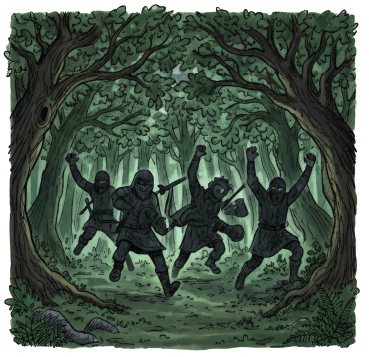
The enemies of Dagda sped away with the harp through the thick, dense, green forest and found an empty, abandoned banquet hall. The folk began to celebrate their victory; they had the magic harp now, perhaps Dagda would be less powerful without his harp, without this magic. After some merry-making, the heavy doors of the hall burst open, and a keen stillness covered the entire hall. Dagda had come for the harp.
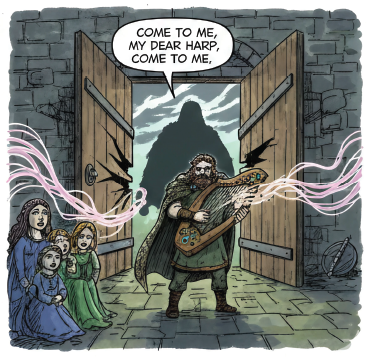
He uttered the words, in a booming voice like the western winds on a winter’s morning: “Come to me, my dear harp, come to me.”
The magic harp obeyed and flew from the center of the banquet hall into the immense and impatient hands of Dagda.
Dagda played a few chords on the harp, soft and solemn. Every note reverberated in the hall, covering each and every person there, men, women, and children. The music it created sounded akin to a wail, no, it was a wall of tears! The sound was so sad and pierced their hearts to such an extent that the women and children began to sob, choking back tears so overcome with emotion, with woe. The menfolk, witnessing their loved ones so distraught, also grew heavy with sorrow.
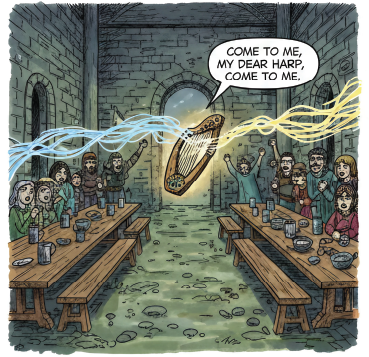
The clever Dagda had another string to his bow—or rather his harp! He played a note that, instead of sadness, stirred up uncontrollable laughter in all the men who were his enemies. They were unable to resist the laughter, and they laughed and laughed until they could no longer stand up, let alone raise their weapons against Dagda.
The weeping women looked on at their menfolk in disbelief, and before they could open their mouths to speak, to admonish them, Dagda’s harp played one more note, one more chord so soothing like a mother’s lullaby. It was the sweetest, softest sound imaginable, radiating joy and beauty. The effect was that everyone present fell into a deep sleep. It was the music of sleep itself. The children crawled into their mothers’ laps, and all slept so soundly, and with this, Dagda left the hall with his magical Harp.
It was indeed the magical Harp that saved the Tuatha de Danaan and Ancient Ireland from their enemies. And still today, the harp is a symbol of modern Ireland, a symbol of cultural identity and pride.
REFERENCES:
1 The Dagda is a powerful, fatherly Celtic god in Irish mythology, chief of the Tuatha Dé Danann, known as the “Good God,” and associated with abundance, fertility, strength, magic, wisdom, and Druidry.
2 Translation from Irish: “folk of the goddess Danu,” also known by the earlier name Tuath Dé (“tribe of the gods” or “divine tribe”), are a supernatural people in Irish mythology. Many of them are thought to represent deities of pre-Christian Gaelic Ireland.
AI-generated images

Ruby Carmen
