DR. JAYARAM THIMMAPURAM speaks with GAYATHRI K about the science of sleep, its impact on our well-being, and practical habits to support better rest.
G: Dr. Jay, could you please explain what sleep is and the various stages it involves? Please also highlight why each of these stages is crucial for our overall health and well-being.
JT: Thank you so much for your questions. Sleep is a topic that is very dear to my heart and something I enjoy. If given the option to do anything at all, I would probably get a little more sleep.
Looking at what sleep is, it’s a temporary, reversible pause. It is a state where wakeful awareness is temporarily suspended. We may have a different kind of awareness during sleep, but at least the wakeful awareness, especially of the surroundings, is paused.
Sleep is also a state of recuperation and rejuvenation for the body, the mind, and all its cells. Whatever chores need to be taken care of, sleep is when the cells get to do them. So sleep is one of the most wonderful gifts of nature. If we utilize that gift properly, it contributes significantly to our physical, mental, emotional, and spiritual well-being.
Coming to the stages of sleep, if you observe anyone falling asleep with their eyes closed, you will see that their eyeballs start to move slowly from side to side. This goes on for some time, and then they begin to move fast. This phenomenon occurs in repeating cycles and continues throughout sleep.
If we have the opportunity to observe their brain waves, we can see distinct patterns that each individual goes through during the sleep cycle. In the initial phase, the brain is a little relaxed. It further relaxes into what we call stage one sleep, where you have theta brain waves. In stage two, we have theta waves with K-complexes. Stage three is one of the deepest stages of sleep, and we have delta waves. Progressively, the waves tend to slow down. Delta waves are the slowest of the waveforms.
Once we cross these three stages of sleep, we enter another state where we start to have dreams. We call it the REM (rapid eye movement) stage. The first three stages are when our eyeballs move slowly or in non-rapid eye movement. Later, when we dream, the eye movement is rapid.
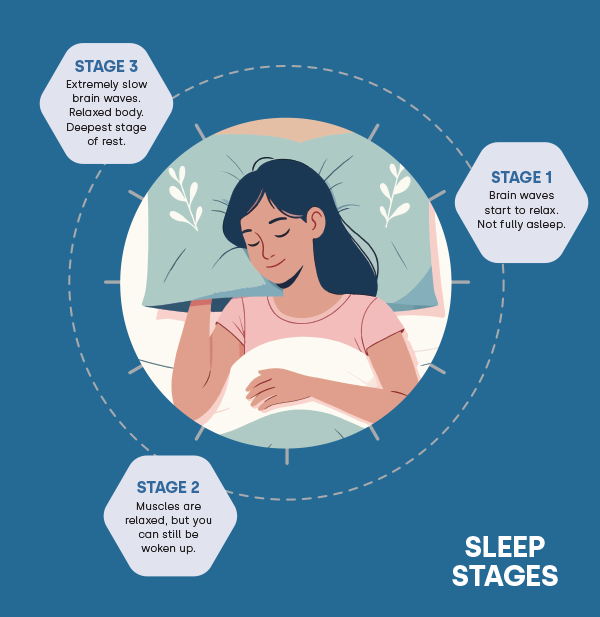
Each stage has a role to play. Stage one is when the brain waves start to relax a little bit, but we are not fully asleep. It is easy to wake us up. In stage two, your muscles are relaxed, but you can still be woken up, though it may not be as easy as stage one. Stage three is characterized by extremely slow brain waves and a very relaxed body. It is probably the deepest stage of rest that we can get.
In that deepest state of rest, our immune system gets stronger, and our growth happens. Anything related to the repair of the body is done during stage three sleep, the deepest stage of sleep. Moving on to the dream stage, many theories have been put forward about why we dream. However, we do know that this phase plays a vital role in emotional processing. Taken together, these stages of sleep play a crucial role in our health and well-being.
G: In recent years, there has been a significant increase in the number of people reporting difficulties with insomnia. What do you believe are the key factors contributing to this rise?
JT: To me, the majority of the cases of insomnia are acquired and are related to lifestyle. We need to understand that, as babies, we didn’t have any sleep issues. As kids, we didn’t have any sleep issues. As teenagers, we start to realize that we have some control over sleep, and we try to use it, spending time on activities that may or may not be necessary, compromising sleep.
When we start compromising sleep consistently, when we try not to use nature’s gift, there comes a time when we cannot repay it. Sleep debt is not something we can easily pay back. For each night of sleep that you lose, it usually takes at least two nights to recover. So if we look at it that way—the compromise on sleep that we carry over many years and probably decades—the body can take care of only so much. Once it crosses a limit, it becomes very difficult for the body to cope. That’s when we start to see the manifestation of sleep problems. Other conditions may be genetic, and addressing those issues is very difficult.
From a lifestyle point of view, if we can establish good sleep hygiene from a young age and understand the benefits of sleep from an early age, when our minds are still open to good things, we can largely address sleep problems.
If we look at the prevalence of insomnia, it is definitely on the rise. At least one-third of people have some form of sleep issue. If we can improve one aspect of our lives that will have a positive effect on everything else, it is sleep. You improve your sleep, and it will have a positive ripple effect on every aspect of your life, whether physical, mental, emotional, or spiritual.
In that deepest state of rest, our immune system
gets stronger, and our growth happens.
Anything related to the repair of the body is
done during stage three sleep, the deepest stage of sleep.
G: Given your demanding profession as a doctor, do you find it challenging to get enough sleep?
JT: Yes, especially when we have so many stresses and strains that we go through in our day-to-day lives. There are so many anxieties we all go through, and these worries affect sleep. It is almost as if the computer program keeps running in the background even when we are sleeping.
It somehow prevents us from getting that deep, restful state. To me, unless we let go of the anxieties and worries before we go to sleep, they will continue to affect our sleep. Most healthcare professionals are prone to sleep issues. In a study we conducted during the COVID-19 pandemic, around nine out of ten healthcare professionals had sleep issues.
G: How do you manage anxieties and worries? Would you be willing to share any strategies or tips that could help other healthcare professionals who may be struggling with similar feelings of anxiety or grief?
JT: All of us go through emotional issues, emotional turbulences during the daytime. These emotional issues—let us consider them as emotional files. Some of these emotional files we process, and some we do not. We push them under the carpet, and we go to bed.
When we go to bed and sleep, it is almost as if there is an office assistant within each of us. This office assistant goes through all these files and says, “You have processed this file, you have processed this file. You have not processed this file—what do you want to do with it?” You wake up, you don’t know what woke you up, and you cannot fall back asleep.
One practice that has helped quite a lot, not only for me but also for my colleagues, is Heartfulness. While meditative practices such as Heartfulness show significant benefits for participants, there are other factors one should be cognizant of.
For example, sleep hygiene stands as a foundation. Going to bed and waking up at fixed times should form the framework. This includes the weekends. It should form the base on which everything else rests. If we do not have a good sleep cycle and good sleep hygiene, no matter what we do, it will be very difficult to improve our sleep quality.
The second thing that can help one fall asleep and stay asleep is that the core body temperature has to drop by at least one or two degrees. So, keeping the room a little cooler is helpful.
Staying away from electronics is a significant challenge, but necessary. Somehow, we have to do it because electronic equipment influences our brains. The sensory stimuli we get from electronics stimulate our brains, making it difficult to unwind. If we cannot unwind, it is very difficult to fall asleep.
There was a study looking at the onset of sleep when using electronic equipment, especially phones, which delays the onset of stage three sleep by one hour. If it delays stage three sleep by one hour, imagine the quality of sleep that you would get. It is not going to be great.
These are simple tips one can try to improve sleep. In addition to the above, the Heartfulness practices we have used with our participants have also led to significant improvements in their sleep patterns—especially the practice of cleaning, or letting go of the stresses and strains of the day.
Before going to bed, scanning the day, identifying areas where we can improve, and acknowledging that these are the areas I need to work on can help us fall asleep and stay asleep. Because when we do that, we are sending a signal to the “office assistant.” This office assistant knows that we are aware of the areas we need to work on, and perhaps allows us to have a good night’s sleep. Please make sure you work on the areas you need to improve for the office assistant to trust you.
If we can improve one aspect of our lives
that will have a positive effect
on everything else, it is sleep.
You improve your sleep, and it will have
a positive ripple effect on every aspect of your life,
whether physical, mental, emotional, or spiritual.
G: Those tips were incredibly insightful! How do you think sleep deprivation impacts our daily relationships and family dynamics?
JT: Sleep deprivation profoundly affects our emotional state. It can affect how we interact with our friends and family members. Sleep deprivation can lead to irritability. It’s a matter of common observation.
Imagine a night when you have slept well: you are a better person, and you interact well. Take a night when you have not slept well: people don’t want to come near you; they want to run away from you. If you want a good relationship, you need that rest. Rest for the mind is extremely important for maintaining a good relationship—not only with others but also with yourself.
Sleep deprivation profoundly affects our emotional state.
It can affect how we interact
with our friends and family members.
Sleep deprivation can lead to irritability.
It’s a matter of common observation.
G: Please share your research findings on how Heartfulness meditation helps improve sleep.
JT: In our hospital, we studied the effect of Heartfulness practices on patients who have insomnia. If you look at these patients or talk to them, you realize there is a lot of fatigue. You notice a lot of exhaustion in these patients. There are many side effects of sleep deprivation, including heart problems. Even our lifespan is shortened if we can’t sleep very well.
So we took these patients with chronic insomnia, and we offered simple practices of Heartfulness for eight weeks. We measured their insomnia scores at the beginning and the end of the study. It’s called the Insomnia Severity Index score. When we offered these practices for eight weeks, we saw a significant reduction in their insomnia scores from a mean of 20.9 to 10.4—more than a ten-point drop.
A lot of these patients reported something very interesting. They said, “Dr. Jay, we were only able to sleep for four hours before. Now we can sleep for seven hours, eight hours. Our dreams have come back.” As their sleep depth and quality improved, they began processing their dreams more effectively.
G: That is wonderful. We know that getting better sleep and rest helps us work better and be more active during the day. So if you see it the other way, what we do during the day, will it influence our night? Do we need to make lifestyle changes to improve our sleep?
JT: Yes. Absolutely, whatever we do during the day will affect us at night. Physical activity is very important. Starting your day with some physical activity and exposing yourself to the sun early in the morning can help reset your circadian rhythm.
Dietary habits play a role. The timing of our food has a role. The nature of the food that we eat has a role. Our emotional state has a role. Our mental activity during the day has a role. Whatever happens during the daytime influences the nature and quality of sleep we get at night.
It is important to plan our day in a structured way. Bring some structure to your day around which the rest of your activities happen. Set a fixed wake-up time. Have a fixed bedtime. Have time for breakfast. Have time for lunch and have time for dinner.
Do not have your dinner too close to bedtime. Do not exercise too close to bedtime; it will affect your sleep. With exercise, our core body temperature increases, and it takes time for it to go down. Washing your hands, washing your feet, or taking a shower before bed can improve your sleep. As the water evaporates, it removes heat, and the core body temperature drops. That can also improve your sleep.
In the end, the way we live our day is the way we prepare for our night, and the quality of that night colors everything that follows.

Jayaram Thimmapuram
