
by Daaji and Elizabeth Denley
RISHI RANJAN offers a chapter-by-chapter reflection on The Heartfulness Way, Book 2, outlining its practical approach to inner transformation and realization.
The Heartfulness Way, Book 2, is a compelling guide to personal transformation written by Daaji, the global Heartfulness Guide, in conversation with Elizabeth Denley. This book empowers readers to transcend mental and emotional barriers, overcome fears, and challenge conditioned beliefs, unlocking happiness, balance, and their highest potential. Daaji outlines a straightforward, practical approach—using meditation, relaxation, and other contemplative practices—that integrates easily into daily life. These practices foster inner qualities like love, compassion, and gratitude, guiding readers toward a deeper purpose and enduring peace. This journey is open to anyone ready to expand their awareness and pursue self-realization.
The Heartfulness Way, Book 2, is not merely a book to be read; it is an experience to be lived. It is not only for understanding but for awakening. Picking up where the first volume left off, Daaji continues his illuminating dialogue, this time with Elizabeth Denley. The result is a seamless, intimate conversation that feels as if the reader is sitting in the presence of a wise and humble teacher, exploring the subtler layers of consciousness and the ultimate purpose of human existence in a simple manner. The book starts with a profound statement: “Philosophy is thinking, Yoga is doing, and Realization is undoing.” The chapters take us along this trajectory, from thinking to doing, and then to undoing. This volume will not only make us understand but also awaken the Reality inside us. The book’s core strength lies in its ability to bridge the gap between ancient spiritual wisdom and the practical realities of modern life.
The Heartfulness Way, Book 2, provides a clear roadmap for anyone aspiring to move beyond life's limitations and find true balance and happiness. The first chapter, “Starting Point: Our Beliefs,” illustrates how belief carries the seed of unknowing; in the absence of knowing, we rely on belief. Life, then, is a story we narrate to ourselves, shaped by these beliefs. They serve as stepping stones, forming the lens through which we engage with the world. Next, the book discusses our connection to the Divine, which emerges not from preconceived beliefs but through subtle experiences—through osmosis and empathetic resonance, as we feel a spiritual presence permeating our consciousness. Introducing this topic in the first chapter is apt, since we need inner openness when confronted with new meaning from beyond our belief systems. A classical illustration of this contrast is found in the figures of Arjuna and Duryodhana: although both had access to Krishna’s guidance, only Arjuna was willing to move beyond his fixed assumptions. This difference in receptivity reveals how transformation depends not on proximity to wisdom, but on openness to it. The chapters that follow build upon this foundational perspective.
With this openness, we are ready to move into the next chapter, “Journey and Destination.” Here, Daaji leads us through discussions of goal setting and intention, evolution and freedom, and paradoxes, revealing a complete map of the spiritually transformative journey. We arrive at real freedom when we are free from all conditionality—Babuji called this “freedom from freedom.” Daaji clarifies that resolving life’s suffering does not mean escaping pain and misery, but rather finding freedom from its root cause by reconnecting with our original balanced state.
Now we have inner openness from the first chapter and, from the second chapter, some idea of what this transformation is that we have to become and be. With that foundation, we come to the next chapter, “Approach and Attitudes,” which lays out the principles we should inculcate for this journey of transformation. Willpower is a limited resource, but interest is unlimited. First and foremost, we should be interested in our own transformation. If we are interested, we will create a field around us that will help push us forward. Our thoughts will naturally flow upwards. With this heightened awareness, we will start getting restless. Restlessness is awareness of a fine nature. It is a key ingredient for our approach. Letting go, confidence, heartful communication, zero footprint, and moderation are some of the other beautiful topics in this chapter.
Having a suitable approach and attitude prepares us to receive divine impulses in our hearts. Now comes the next chapter, “Love and Support.” Daaji beautifully writes, “A person whose soul is able to transmit the impulse of God is a true master, and a person whose soul receives the impulse is a seeker or disciple... when the soul of a seeker is thirsty for those impulses, even when that thirst is subconscious, the Master will appear seemingly by chance.” This chapter is a true revelation. It provides important information on how to connect with the Master. He writes that the heart-to-heart connection is immediate as soon as you think of the Master!
After building a foundation of love and support from the Guide or Master, we are now wholeheartedly ready to accept the fourth chapter's topic, “Methods and Training.” Here, we transition to discussing simple methods for meditation, prayer, and journaling, as well as the need for inner purification. The main purpose of this training is to simplify and purify your lifestyle so that you can expand your consciousness into higher realms. The result: the removal of impurities and complexities from your heart and mind, the development of moderation in the use of your senses and faculties, the refinement of your character, and ultimately, the expansion of your consciousness.

Daaji clarifies that resolving life’s suffering
does not mean escaping pain and misery
but rather finding freedom from the root cause of suffering
by reconnecting with our original balanced state.
Adopting these “Methods and Training” gradually prepares us for the next chapter, which focuses on building trust and faith. In this new chapter, Daaji explains three means of attaining knowledge and describes the process of developing faith in the Master. He describes true faith as the “lively link connecting the mortal and immortal,” a link that develops through the medium of the Masters and their transmission. Daaji discusses the transformation that occurs when true faith is developed, noting that a simple person of faith cannot demand anything. Instead, such a person sails through life with gratitude, joy, and a generous heart. For them, making a demand would feel like a violent act.
When we develop faith as a “lively connection,” the next stage is to make it a permanent characteristic of our hearts. This is our next chapter: “Establishing a Constant Connection.” Because of this constant connection, we maintain a balanced inner state. In this state of near-perfect balance, our consciousness keeps spinning like a top, creating a beautifully integrated state. Once it becomes permanent, it is called Constant Remembrance, which naturally prevents the formation of samskaras, or impressions. We remain in a state of flow. How does this help us in our day-to-day lives? While remaining connected within, we don’t withdraw from worldly responsibilities; we meet them with greater skill because we are more centered and balanced.
Beautifully, with this constant connection, we start sailing in the realms of Realization, or Undoing. We are now ready for the next chapter, in which we transcend “The Heart: The Realm of Emotions and Qualities.” Daaji explains the “five Cs” (contentment, calmness, compassion, courage, and clarity) and the “five Ds” (discontentment, disturbance, displeasure, discouragement, and delusion), how we develop the spectrum of sympathy, empathy, and compassion, and how we move from “me to we.” When samskaras control our lives, we rely on states of external fulfilment to experience “C” states. Otherwise, we remain in “D” states. As we remove samskaras through purifying spiritual practices, experiencing “C” states no longer depends on satisfactory experiences. Daaji also explains the need for character development, which allows us to hold the inner states gifted on the spiritual journey; it is spiritual evolution that promotes the development of fundamentally human qualities.
Having completed the chapter on the heart, we now move to the next chapter, titled “The Mind: Learning to Yield.” This transition marks a major step in “undoing,” as the focus shifts to yielding and letting go of the layers of identity we have created. The process of yielding the “I” culminates in its total absence, where we no longer exist for our own sake. This journey of yielding leads us to the beautiful condition of sharanagati. Sharanagati is not a state of defeat. Rather, it is the feeling of being under the care and protection of a beloved. It brings joy. Such is the state we enjoy upon reaching sharanagati.
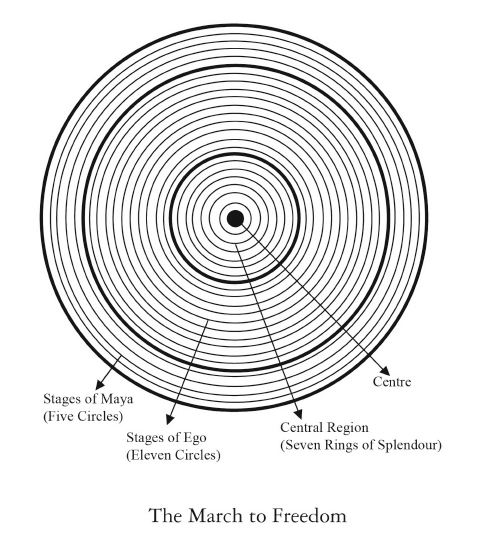
We are now arriving at “Destination: Realization and the Center.” How have the previous chapters helped us in this last stage of undoing and realization? The mind yields and the heart is vacuumized, so that the divine essence may flow unto us. Then we are ready for realization. Daaji explains our connection with the Universe, the science of the Center, traditional Yoga, the current era, and the state of samadhi.
Daaji explains our connection with the Universe,
the science of the Center, traditional Yoga,
the current era, and the state of samadhi.
The Heartfulness Way, Book 2, closes with the following promise:
“So Daaji, does this distilled, simplified approach of
Heartfulness affect the length of time it takes to attain realization?
“Yes, this is now possible within one lifetime—or even
a part of it. God-realization is possible for anyone who
has a craving and an interest. Practice sincerely and
authentically with the help of a master of caliber.”
The Heartfulness Way, Book 2, is a compassionate, insightful masterpiece. It equips seekers with the tools and wisdom to realize their ultimate potential. Its strength lies in its profound simplicity and in its emphasis on experience as the true measure of spiritual growth. Daaji offers a practical, heart-centered approach to life’s deepest questions. He provides a beacon of hope for a world grappling with stress and a lack of purpose. Ultimately, he guides us back to the stillness and transformative power of the heart.
Reading this book felt like the ocean whispering to the waves, with the realization that the waves and the ocean are just expressions of the same water.

Rishi Ranjan
Rishi Ranjan is India Head and General Manager for a multinational cloud services company, with over 28 years in senior IT leadership. A Heartfulness Trainer for nearly three decades, he shares practical spiri... Read More
