
The Carbon Net Zero Campus initiative combines renewable energy, water and waste management, ecological restoration, and community participation to turn schools into living laboratories for sustainability.
BY VIJAYAKUMAR KIDAMBI
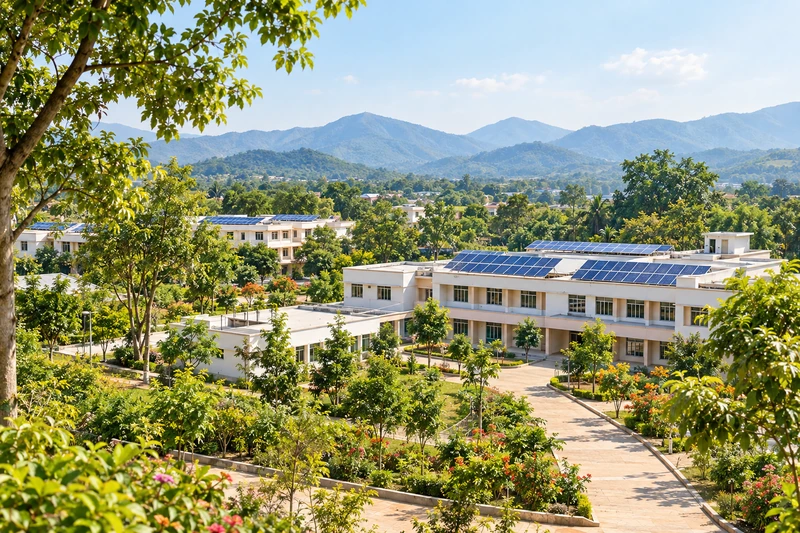
When Forests by Heartfulness launched its Carbon Net Zero Campus initiative in May 2026 in India alongside the Government of Andhra Pradesh, it committed to two goals: to transform hundreds of Welfare Residential Institutions into carbon-neutral and biodiversity-rich campuses; and to nurture generations of sustainability champions by turning the campuses themselves into places of environmental learning.
When designing the end-to-end process for Carbon Net Zero Campus, Forests by Heartfulness ensured the local community would support ongoing campus maintenance. In July 2026, over 400 participants—including local and government officials—took part in a Train the Trainer program to begin eco-management of local campuses. This approach lets neighbors work together to keep campuses green while giving more people the chance to deepen their knowledge of climate and sustainability.
The carbon problem
Creating local sustainability experts began by clarifying the why and the how: why rising carbon emissions are a critical problem and how net-zero carbon campuses offer a positive solution.
Global temperatures and sea levels are rising, biodiversity is declining, food and water security are under increasing pressure, and extreme weather events are becoming more frequent. These issues are all exacerbated by carbon emissions, which are produced by industry and power plants, transportation, buildings, waste management, and fugitive emissions from fossil fuels.
While each issue seems immense, many practical solutions are already within reach.
Capacity building and community engagement
Each campus in the Carbon Net Zero Campus initiative is designated a Living Laboratory, where students and faculty members take a hands-on role in campus sustainability and maintenance. Forests by Heartfulness has set up a four-tier engagement framework that allows all members of a campus community to be actively involved in biodiversity maintenance:

Students:
learn net-zero and sustainable practices,
participate in hands-on projects,
and develop environmental responsibility

Classrooms:
integrate sustainability into subjects and
encourage peer and project-based learning

Principals and teachers:
establish policies and green campus practices
and monitor their implementation

Community:
extends knowledge and sustainability culture
beyond the campus and into the
local community and economy
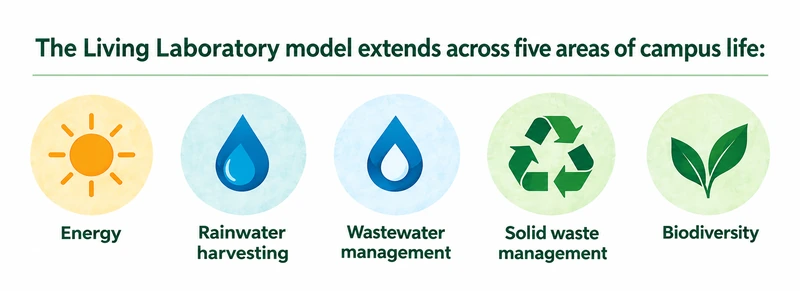
The Living Laboratory model extends across five areas of campus life: energy, rainwater harvesting, wastewater management, solid waste, and biodiversity.
Energy independence
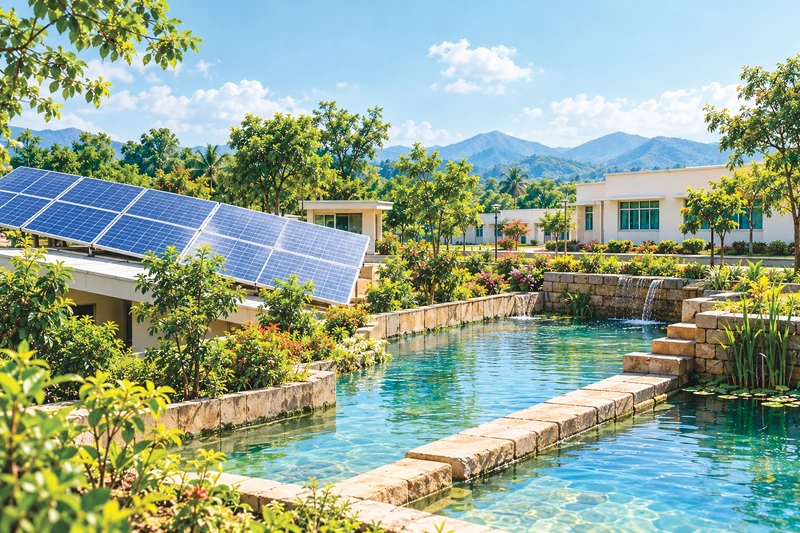
In just one hour, the sun provides enough energy to meet the world’s energy needs for a full year. Solar energy is one of the most practical ways for campuses to reduce their dependence on fossil-fuel-based electricity.
- Solar energy is essential in combating climate change for several reasons:
- Grid electricity largely comes from fossil fuels like coal
- As schools adopt digital learning, electricity demand increases
- Higher electricity costs leave fewer resources available for education
- Every unit of grid electricity used adds to a school’s carbon footprint
- Solar lowers costs, reduces emissions, and supports net-zero campuses
Forests by Heartfulness addresses these needs through rooftop solar photovoltaic (PV) panels and metering systems.
Rainwater harvesting and wastewater recycling
When captured, stored, and recharged correctly, harvested rainwater provides several environmental, financial, and biological benefits, including greater water security through reduced dependence on tankers and borewells, groundwater recharge, flood and waterlogging control, resource recovery to support gardens and planting, and overall climate resilience.
To capture sufficient rainwater, Forests by Heartfulness employs three methods:
Rooftop harvesting: rainwater that flows from building roofs
through gutters or pipes to storage tanks or recharge structures
Surface runoff harvesting: rainwater from open campus
surfaces directed into percolation pits, trenches, or ponds
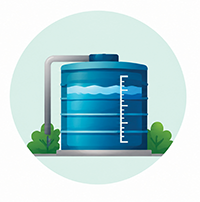
Storage and recharge: captured water is stored for non-potable
use or sent to recharge structures to replenish groundwater
Graywater and blackwater management
Many schools use freshwater for drinking, sanitation, kitchens and hostels, landscaping, and other essential needs. On many rural campuses, the resulting wastewater includes graywater and blackwater, which can contaminate groundwater, cause stagnant water, and pose health risks if not properly managed.
Forests by Heartfulness uses a unique treatment process that treats graywater and blackwater and safely reuses them for potable and non-potable uses or discharges them safely. The treatment process includes four stages:
- Primary Treatment: septic and biological action
- Secondary Treatment: dissolved air flotation
- Advanced Filtration: reverse osmosis and ultraviolet (UV) treatment
- Recovery and Use: recycled water for parks and landscaping, with dissolved oxygen progressively increased and pollutants removed until the water is safe for reuse.
Solid waste management and circular economy
Each day, a school can generate 45–50 kg of solid waste, including food and kitchen waste, paper and plastic, sanitary waste, and garden waste.
When this waste is not properly managed, it can contribute to water and air pollution, mosquito and fly infestations, unpleasant odors, and other environmental problems.
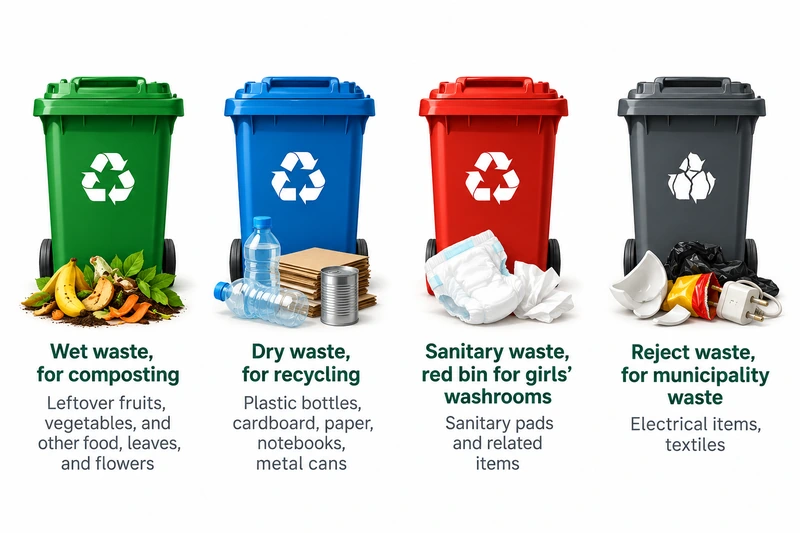
Forests by Heartfulness uses a four-bin system:
Greening of unused spaces
One of the main goals of the Carbon Net Zero Campus initiative is to move beyond conventional tree planting and adopt a scientific, site-specific approach by planting native and indigenous species that support local land, soil, water, and climate conditions.
With this approach, climate advocates empathize with the native land and understand the biodiversity it needs to thrive for generations to come.
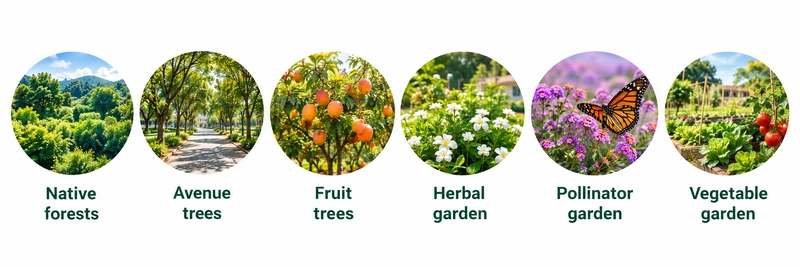
The planting strategy combines several complementary approaches:
- Ultra-High-Density Planting: dense, forest-like native plantings for carbon sequestration, biodiversity, and microclimate benefits
- Periphery Plantation: boundary planting as windbreak, shade, dust/noise barrier
- Fruit and High-Value Timber Plantation: food, biomass, carbon capture, future timber
- Avenue Trees: shaded walkways along paths and roads
- Herbal Garden: Indian medicinal plants for education and health value
- Mosquito-Repellent and Immunity-Boosting Garden: hygiene and air quality
- Pollinator Garden: flowering plants supporting bees and pollination
- Butterfly Garden: entrance plantings for biodiversity and aesthetics
- Nutrition and Vegetable Garden: hands-on food-growing experience for students
The solution is in our hands
The Forests by Heartfulness team is applying these solutions across selected campuses within the Carbon Net Zero Campus initiative, encouraging students, teachers, and local community members to reflect on easy steps they can take and share with others to reduce the harmful impacts of continued carbon emissions.
By involving local communities in making campuses more sustainable, we are reminded how essential, and how easy, it is to work together to create tangible, long-term, sustainable change.
FROM FORESTS BY HEARTFULNESS
Forests by Heartfulness nurtures and protects native, endemic, and endangered plant species through expert-guided nurseries, plantation drives, long-term monitoring, and community participation.
REFERENCES:
- Intergovernmental Panel on Climate Change, “Summary for Policymakers,” in Climate Change 2023: Synthesis Report, ed. H. Lee and J. Romero (Geneva: IPCC, 2023), 1–34, https://www.ipcc.ch/report/ar6/syr/summary-for-policymakers/; Shobhakar Dhakal et al., “Emissions Trends and Drivers,” in Climate Change 2022: Mitigation of Climate Change, ed. P. R. Shukla et al. (Cambridge: Cambridge University Press, 2022), 215–294, https://www.ipcc.ch/report/ar6/wg3/chapter/chapter-2/.
- U.S. Department of Energy, Office of Science, “DOE Explains…Solar Fuels,” accessed August 26, 2026, https://www.energy.gov/science/doe-explainssolar-fuels.
- Central Electricity Authority, CO2 Baseline Database for the Indian Power Sector: User Guide, Version 21.0 (New Delhi: Government of India, Ministry of Power, November 2025), 1–2, https://cea.nic.in/wp-content/uploads/baseline/2025/12/User_Guide_V_21.0.pdf.
Vijayakumar Kidambi
After spending 38 years working in the upstream oil & gas industry, Vijayakumar Kidambi pivoted into sustainability work, with involvement in Forests by Heartfulness activities. Vijay has been a Heartfulness practitioner for more tha... Read More
