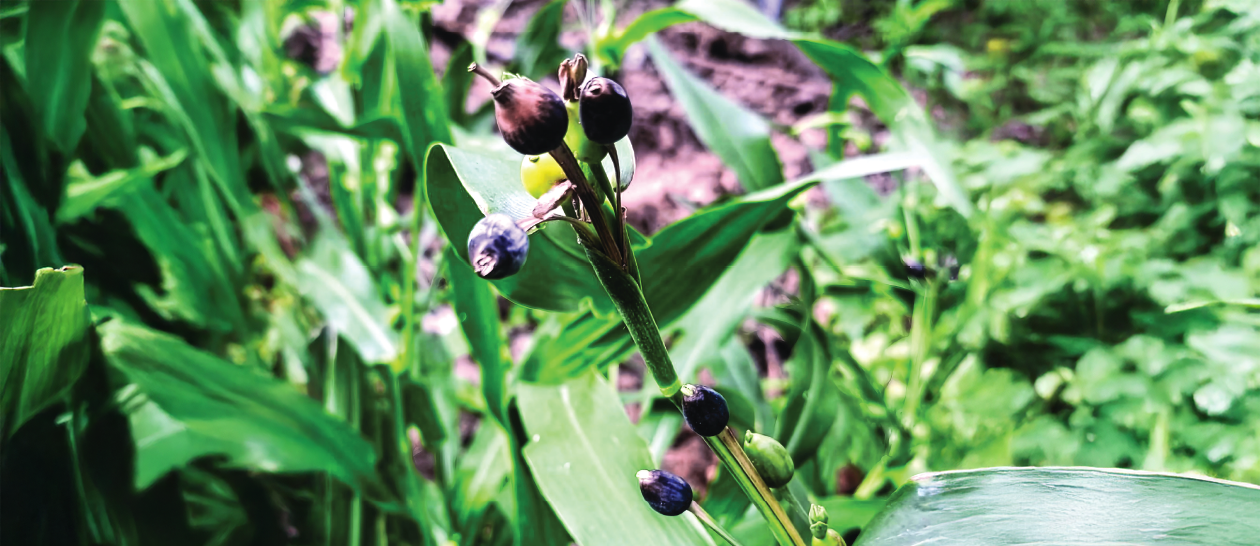
Ecologist B. RATHINASABAPATHY reflects on how a humble grass carries stories of suffering, sustenance, beauty, and devotion.
The Bead That Remembers
Among grasses that carpet our planet, Job’s Tears (Coix lacryma-jobi) stands out for producing perfectly formed, pearl-like beads that resemble tears. Named after the biblical figure Job, known for deep suffering and unwavering faith, the plant’s scientific name refers to the lacrimal glands of the eye—the producers of tears.
Across cultures and continents, these tear-shaped beads—known as David’s Tears, Mary’s Tears, Christ’s Tears, and simply Tear Drops—symbolize the same universal truth: that sorrow can be transformed into strength, beauty, and devotion.
A Grain That Nourishes the Body
Native to tropical Asia, Job’s Tears has been part of traditional diets for centuries. Known also as Adlay or Adlai, its grains sustained communities long before the rise of commercial cereals.
History Rooted in Simplicity
Agnes Arber, in her classic work The Gramineae, records that a Chinese general introduced the grain to China in the 1st century A.D. He brought back cartloads after discovering its popularity in Tongking. Farmers in Java, Celebes, and the Far East cultivated it on the margins of rice fields.
A Versatile and Nutritious Food
Several soft-shelled cultivars exist. These are prized for their sweet, high-protein kernels. Across Asia, Job’s Tears is:
- Boiled like rice
- Parched or roasted
- Ground into flour and baked into bread
- Cooked into soups and porridges
- Brewed into traditional beverages—zhu in India and Ma-Yuen in Japan
This humble grass demonstrates its value by feeding the poor, sustaining culture, and showing that nature often conceals abundance in simple forms.
Nature’s Perfect Bead
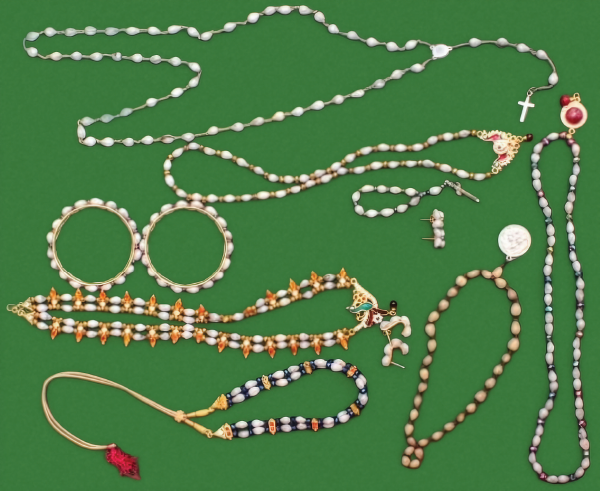
If Job’s Tears nourishes the body, it also nourishes art. People around the world, in places such as Central America, Africa, and Southeast Asia, use these dried beads to create necklaces, rosaries, bracelets, and other traditional ornaments.
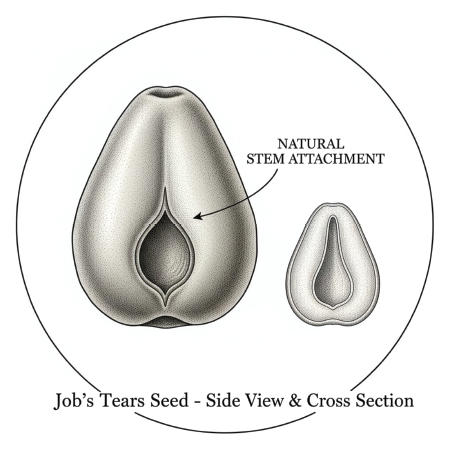
What truly defines the beauty of Job’s Tears is its natural design for craftsmanship. Unlike almost any other seed, they possess a natural hole through their center. This biological hollow makes them incredibly easy to string into ornamental pieces without drilling or complex tools.
They are naturally polished and perfectly perforated by nature. Their coolness and gentle sheen seem to say, “Beauty need not be manufactured.” While the natural white beads can be dyed into bright colors, the original pearl-grey remains most beloved. Often, the best art grows by the wayside, prepared by nature for the artisan’s hand.
Job’s Tears in Music: The Rhythm of the Earth
One of the most striking uses of the beads is found in African shaker gourds.
Hundreds of beads are woven into a loose net over a hollow gourd. When played, the beads hit the gourd in a cascade of earthy, ancient, and living sound. It is music born of seeds, an expression of the world’s natural heartbeat.
Tears as Symbols of Devotion
The tear-shaped bead naturally draws spiritual associations. In many cultures, Job’s Tears becomes an object of prayer, reflection, and meditation.
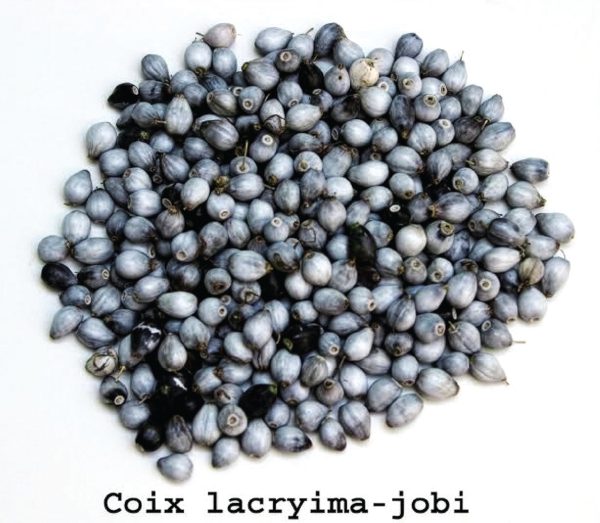
The tear-shaped bead naturally draws spiritual associations.
In many cultures, Job’s Tears becomes an object
of prayer, reflection, and meditation.
A Bridge to Contemplation
The shape of a tear invites introspection. It reflects:
- The suffering we encounter
- The compassion we cultivate
- The grace that guides us beyond sorrow
Each bead on a rosary marks a sacred moment of remembrance. The beads of Job’s Tears show the rhythm of human experience—joy, pain, surrender, and transcendence.
Mother Teresa: A Living Rosary
The contemplative style of a rosary finds its spiritual parallel in Mother Teresa’s life.
In the Roman Catholic tradition, the rosary is prayed in reflection of three divine mysteries: the Joyful, the Sorrowful, and the Glorious. Mother Teresa’s life beautifully embodied all three. Her serene smile held the joy that grows from service.
Her deeply lined face and contemplative eyes bore the sorrow of having witnessed immense human suffering. Her folded hands, entwined with the rosary, surrendered the glorious to a realm beyond human grasp.
Like the beads she held, Mother Teresa turned every tear into compassion and every sorrow into light.

A Spiritual Reflection for Heartfulness
In Heartfulness, we speak often of purity, simplicity, and inner surrender.
Job’s Tears symbolizes exactly that.
- Purity—in its naturally polished, unaltered bead.
- Simplicity—in its humble presence as a grass that nourishes both body and spirit.
- Surrender—in its tear-like shape that carries pain into the realm of prayer.
Just as Mother Teresa used her rosary to align the heart with the Divine, Job’s Tears reminds us that nature provides tangible tools for contemplation. Every bead—whether as a necklace, rosary, or seed ornament—becomes a small universe of remembrance, grace, and gratitude.
Tears That Become Light
Job’s Tears teaches a profound lesson:
What starts as a tear can become nourishment, beauty, rhythm, and prayer.
From Asia’s rice fields to prayerful hands’ rosaries, from the music of African gourds to Mother Teresa’s silent strength, these humble beads teach that transformation is key in both nature and spiritual life.
A tear is not an end. Rather, it is often a beginning—a symbol of hope and transformation, and a renewal in nature, devotion, and the human heart.

Every bead—whether as a necklace, rosary, or seed ornament—
becomes a small universe of remembrance, grace, and gratitude.

B. Rathinasabapathy
B. Rathinasabapathy is an ecologist with 37 years of experience in forest restoration, biodiversity conservation, and environmental education. He has led ecological projects across India, including the Western... Read More
