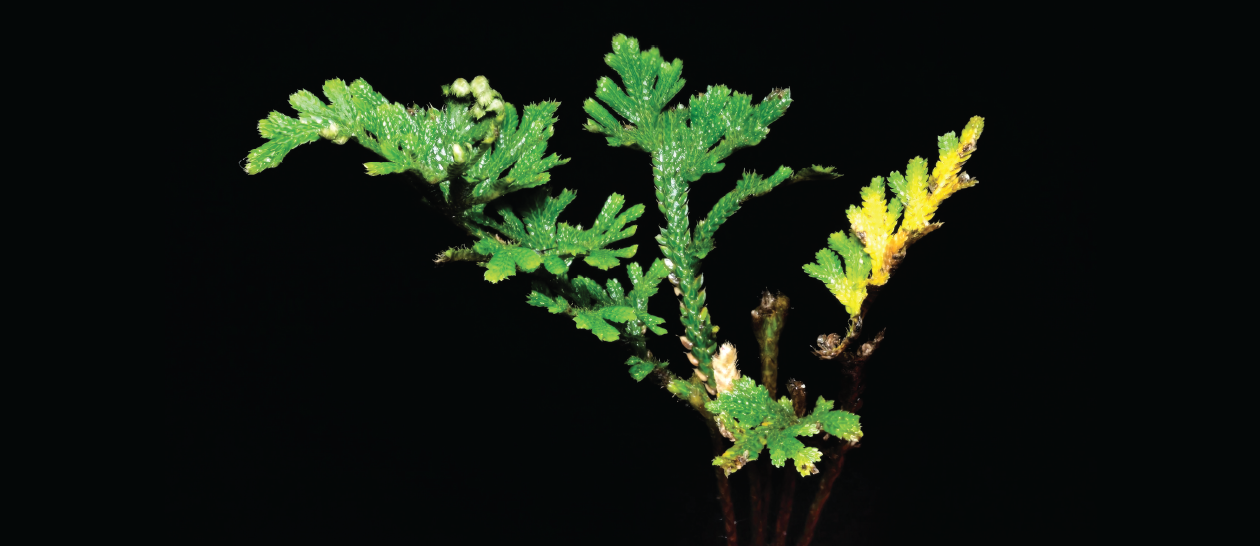
DR. ANANTHANENI SREENATH traces the botanical, medicinal, and mythological journey of Sanjeevini, the life-restoring herb of the Ramayana.
Sanjeevini, a sacred herb known for its remarkable life-restoring and medicinal properties, is featured prominently in the ancient Indian epic, the Ramayana. The non-flowering plant, scientifically identified as Selaginella bryopteris, belongs to the family Selaginellaceae and the phylum Pteridophyta. It is known for its extraordinary ability to revive after drying out, a characteristic similar to that of bryophytes.
Sanjeevini’s historical significance, medicinal uses, and modern research have captivated interest for centuries, from the time of the Ramayana to the present day. Growing mainly on rocky slopes and outcrops where water collects, it is used in Indian traditional medicine to treat a wide range of ailments. Its unique ability to restore consciousness and alleviate various health issues—such as fever, paralysis, and skin diseases—has made it an invaluable herb in indigenous healing practices.
The meaning of Sanjeevini is “that which revives life,” a sacred and divine herb that, according to the Ramayana, revived the life of Lakshmana, Lord Rama’s brother.
It is a non-flowering plant that belongs to the phylum Pteridophyta, positioned evolutionarily between bryophytes and angiosperms. Bryophytes are unique in their ability to revive immediately upon the addition of water, even after being separated from the soil and drying out. In contrast, angiosperms and most pteridophytes, once detached and dried, do not return to life simply by adding water, even if they are immersed.
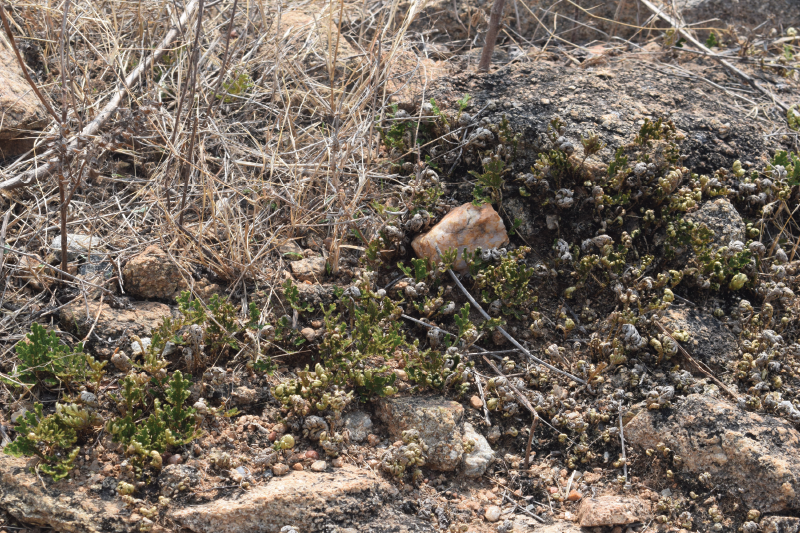
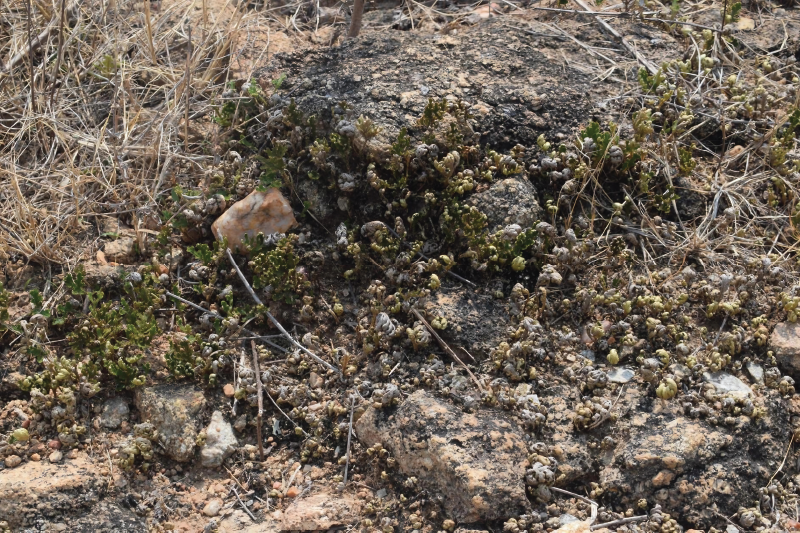
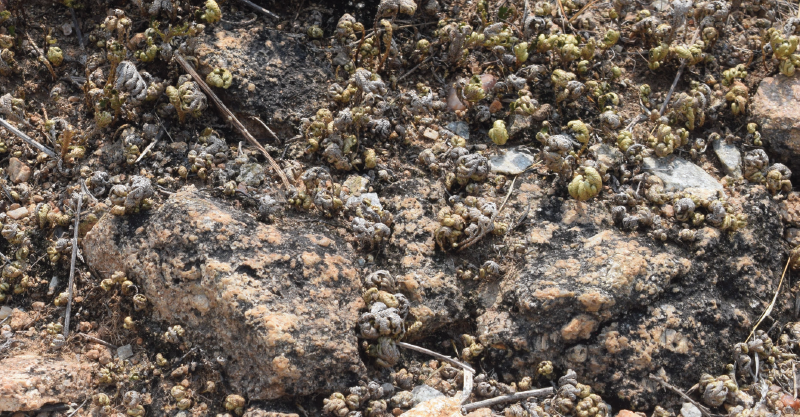
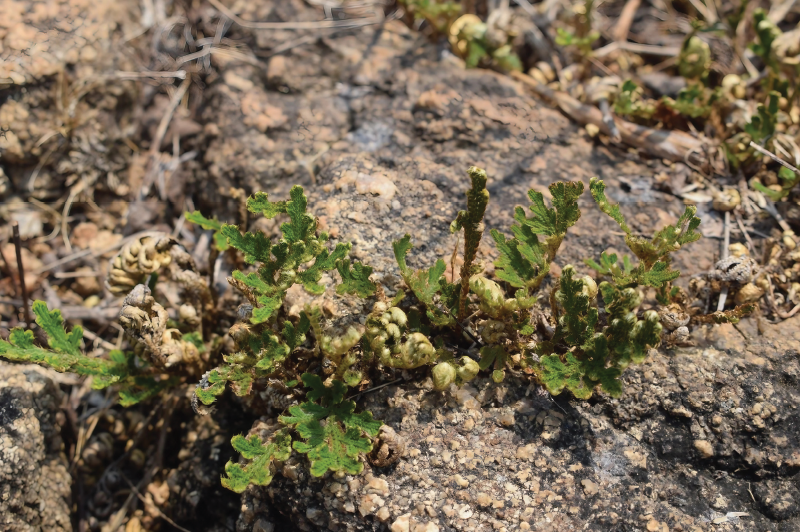
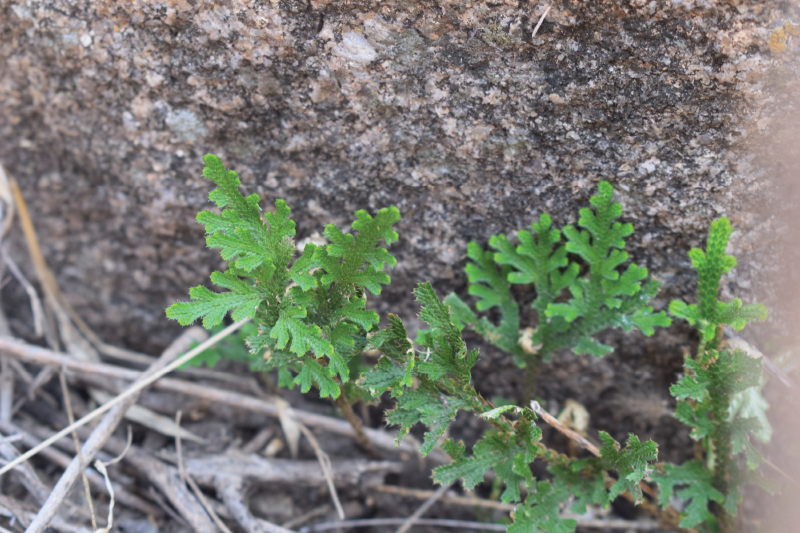
Even when Sanjeevini appears dry and lifeless (Image 2), it revives upon exposure to water (Image 3). This resurrection ability, common in bryophytes, inspired the naming of this plant in the family Selaginellaceae as Selaginella bryopteris (Sanjeevini). It has now been documented on hillocks near Kanha Sarovar, close to Kanha Shanti Vanam, and in other microhabitats where rainwater collects and remains for some time.
Description
Sanjeevini, scientifically known as Selaginella bryopteris (Image 3), is renowned for its extraordinary medicinal and rejuvenating properties, documented in the ancient Indian medical texts Charaka Samhita and Sushruta Samhita.
It is widely distributed across the upland regions of India, where tribal communities collect and sell it in places such as Srisailam, Ahobilam, Tirupati, Haridwar, and Varanasi, all prominent pilgrimage centers.
In the Ramayana, the herb is first mentioned and described by Sushena to Hanuman, and is located in the Dronagiri mountain range in the Himalayas of India. Over the years, extensive research, along with current field studies, has shown that Sanjeevini occurs in various regions across the country. It is also frequently mentioned in connection with the Dronachalam region in the Eastern Ghats of southern India, which some devotional traditions link to the same north—south route between the Himalayas and Sri Lanka described in the epic.
This plant primarily thrives on shaded rock faces and in narrow crevices near natural water sources, growing on fine clay deposits on rocks and in rocky fissures (Image 1). It is highly adaptable and can survive in a wide variety of climatic and moisture conditions. The plant is a procumbent to decumbent herb with a bifurcately branched stem, bearing alternate leaves at about a sixty-degree angle, and two rows of smaller leaves along the lower part of the stem.
Uses and Benefits of Sanjeevini
The Adivasi (indigenous) Chenchu tribes of the Nallamalai region in Andhra Pradesh refer to Sanjeevini as pitta adugu. They traditionally burn its incense and prepare a tonic from it as a powerful immunity-boosting medicine for newborn babies.
Sanjeevini is used to rapidly revive unconscious patients and to reduce high fever. Across India, it is a key ingredient in traditional medicinal formulations used to treat a range of conditions, including nervous weakness, low sperm count, constipation, enteritis, indigestion, fever, miscarriage, anemia, kidney stones, paralysis, skin diseases, bone fractures, jaundice, toothache, blood-clotting disorders, diarrhea, asthma, ulcers, back pain, and for general blood purification.
To quickly restore vitality and energy in patients suffering from diarrhea who are exhausted and weak, immediate relief is said to be obtained by giving a powder of the dried herb mixed with cow’s milk.
Sanjeevini in the Ramayana
In the Yuddha Kanda of the Ramayana, during the war between Rama and Ravana, a fierce battle takes place between Lakshmana, Lord Rama’s brother, and Meghnath (Indrajit), Ravana’s son. During this fight, Lakshmana is struck by a poisoned arrow. When he falls unconscious and his life is in danger due to the potency of the poison, Rama calls upon Sushena, the Ayurvedic physician in the monkey kingdom.
After examining Lakshmana, Sushena advises that specific herbs must be brought before sunrise in order to treat him. However, these herbs are not available locally and must be collected from the Dronagiri mountain range of the Himalayas. When Rama asks who can travel such a distance and return in time, Hanuman steps forward and says, “I will go and bring them.”
Sushena instructs Hanuman: “Go immediately to the peaks of Dronagiri mountain and bring back these four herbs: Sanjeevini (the herb that restores life), Vishalyakarani (the herb that neutralizes poison and removes arrows), Sandhanakarani (the herb that mends broken bones and joints), and Savarnakarani (the herb that heals wounds and restores the skin and its radiance).” He explains the properties of each herb and gives Hanuman clues to help identify them in the field.
Hanuman quickly reaches Dronagiri and begins searching for the herbs. After an extensive search, unable to identify them precisely, he lifts the entire mountain and carries it back to Lanka. Because there is not enough space in Lanka to set the mountain down, Hanuman asks Sushena to come up to the mountain to collect the herbs.

The meaning of Sanjeevini is “that
which revives life,” a sacred and divine
herb that, according to the
Ramayana, revived the life of
Lakshmana, Lord Rama’s brother.
Sushena gathers the herbs, prepares the medicine, and uses it to treat Lakshmana and the other wounded warriors. Lakshmana and the rest of the warriors recover. As Hanuman returns the mountain to its original place, parts of it are said to have fallen in different locations—some in Lanka, and larger portions in the Eastern Ghats in southern India, close to the Nallamalai mountain ranges.
Conclusion
Sanjeevini remains a revered plant in both ancient and contemporary medicinal practice. Its life-restoring abilities, as described in the Ramayana, and its many therapeutic uses in traditional medicine highlight its significance in Indian culture and healing.
Modern research has confirmed its widespread presence and promising benefits, making it a valuable subject of ongoing study. The story of Sanjeevini’s collection by Hanuman, as narrated in the Ramayana, not only underscores its mythological significance but also reinforces its continued relevance in the natural world.
Reports of Sanjeevini in places such as the Dronachalam region and Kanha Sarovar—sites that later tradition aligns with Hanuman’s journey from the Himalayas to Sri Lanka—underscore both its symbolic and medicinal importance. As research into its properties advances, Sanjeevini remains a testament to the enduring connection between ancient knowledge and contemporary science.

Sreenath Ananthaneni
Dr. Sreenath is a Conservation Scientist (Taxonomist) at Forests by Heartfulness, Kanha Shanti Vanam. With a Masters and Ph.D. in Plant Sciences, his research has reported over 180 new bryophy... Read More
