
JOSEPH ROBINSON reflects on the tension between longing for peace and reaching for more—and what lies beyond that divide.
I, and most of the people I know, live with a kind of subtle tension. On one hand, there is the sincere desire to be more present, more grounded, less stressed. On the other hand, there is the nearly universal pull to have more, to do more, to become more.
In my own life, this tension has produced no small amount of suffering. My younger self dismissed ambition as shallow—until I found myself broke. As an adult, I am painfully aware that in the rush to push forward, I am sacrificing opportunities to nourish and deepen the relationships that matter most.
Trying to understand this conflict, I eventually realized that while these desires appear contradictory, they both arise from looking at our lives and concluding, “This is not enough.” If we felt truly fulfilled, there would be pressure to neither improve our circumstances nor to escape them. We would simply inhabit the present moment. In this way, the desire for “more” and the desire for “peace” are twin responses to the feeling that our life, as it is, is incomplete.
In response, my first instinct was to pathologize striving as a kind of spiritual immaturity, but that idea didn’t survive much scrutiny. As a father and provider, I’m not sure the impulse to hustle is so maladaptive, and anyway, problems of scarcity are obviously real. When money is tight, relationships are strained, and when our habits have become confining, the impulse to dream bigger, get our act together, and work harder isn’t neurotic—it’s necessary. Moreover, where would spirituality be without this “drive for more”? Without some internal unsatisfactoriness, how would anyone ever rise above their hedonic tendencies and commit to something larger?
The obvious problem with all this is that if we look closely, most of us can find a voice inside that is never satisfied, no matter what we achieve. This voice flows from our shame, or the belief that something is wrong with us—not for what we’ve done, but for who we are. This shame is one of the deepest and most isolating pains we feel, and our attempts to repress or outrun it tend to distort our lives in powerful ways. And when that distortion meets our natural drive to grow, our striving can easily become just another expression of “I am not enough.”
The obvious problem with all this is that
if we look closely, most of us can find a voice inside
that is never satisfied, no matter what we achieve.
This voice flows from our shame, or the belief that something
is wrong with us—not for what we’ve done, but for who we are.
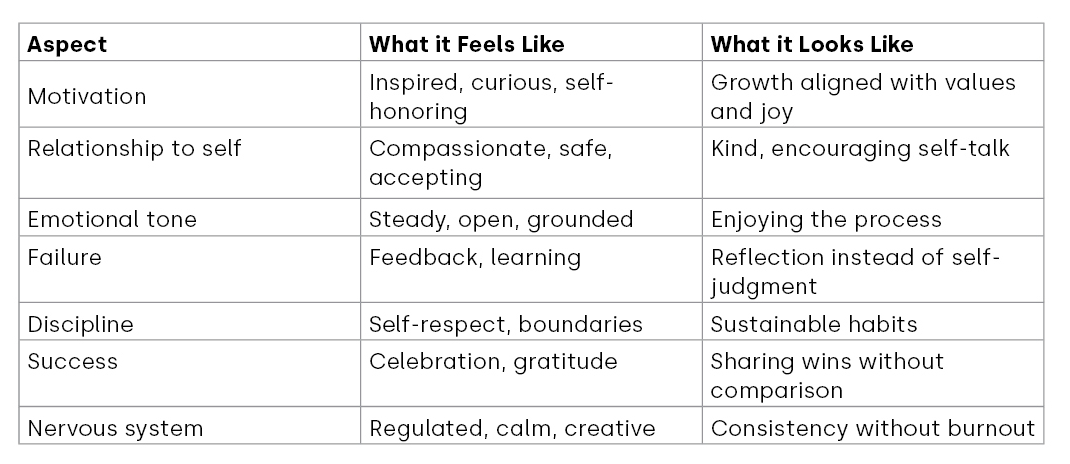
If we cannot tell the difference between authentic striving—a way of honoring our potential—and neurotic striving—the hustle to outrun “I am not enough”—it is easy to spend years, decades, a lifetime running after something that is not actually the answer. As someone with plenty of experience on this front, I say this with compassion. Hopefully, you find the following distinctions as useful as I do:
Authentic Striving
“I am already enough. Growth is how I express my fullness.”
Neurotic Striving
“I am not enough yet. Growth is how I earn love or safety.”
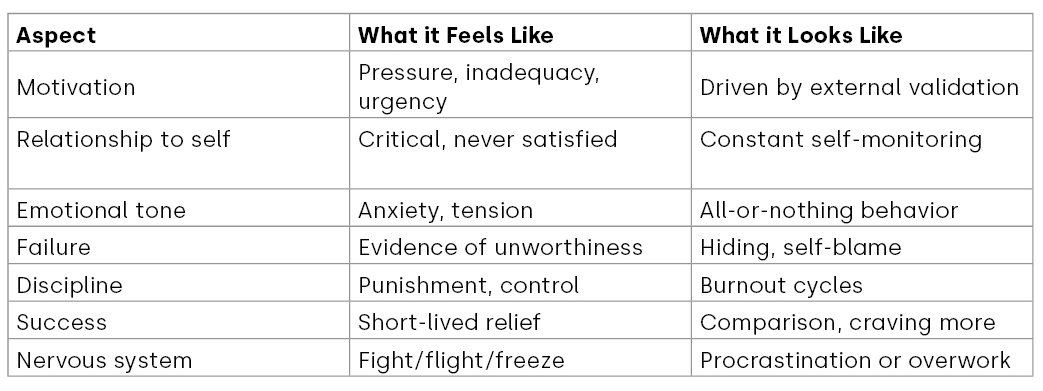
Recognizing the difference is an act of profound honesty. And if that second voice feels familiar, I’ve found two practices to be especially healing:
Santosha: the practice of contentment
Santosha, the second niyama (five observances) found in the Yoga Sutras of Patanjali, is an inner attitude that affirms:
“Nothing is missing in this moment.” “I can meet life exactly as it is.” “My okay-ness is not dependent on improvement.”
Santosha is sufficiency, equanimity, and non-resistance. It does not require gratitude or positivity. It simply asks us to stop resisting reality and to cultivate contentment in the present moment, regardless of circumstance.
For many of us, it is hard to even comprehend this attitude because it stands in direct opposition to the sense of insufficiency that so many of us feel. In addition, we are so accustomed to identifying with thoughts and contracting around discomfort that the idea of allowing experience to unfold without interference feels foreign.

To cultivate santosha,
I’ve found this mantra to be beneficial:
“I am enough. This moment is enough.”
But by practicing santosha, we become much more aware of the experience of contraction and the particular ways it tends to play out in our lives. Armed with this awareness, when the feeling of “not enough” shows up, we can notice it for what it is and perhaps resist the impulse to numb or manage it through control or striving.
To cultivate santosha, I’ve found this mantra to be beneficial: “I am enough. This moment is enough.”
Gratitude—The Heartfulness Way
As Erich Fromm observed, freedom from something—in this case, the distortions of shame—is only half of the solution. To truly purify ambition, our drive to grow must be yoked to a higher goal. As a practitioner of Heartfulness, I understand that goal to be developing an authentic relationship to Being.
Because Being is relational, Daaji teaches that true spirituality isn’t about conquering or extinguishing the self; it’s about expanding the heart to the point that the self-centeredness at the core of how we relate to the world dissolves.

To help with this task—and strengthen me in my daily struggle with selfishness—I find it healing to contemplate our fundamental dependence on everything: we have received so much from parents and ancestors; from mentors, communities, and social institutions; from culture, language and inherited wisdom; from the biosphere; and ultimately from a Cosmos that makes consciousness, growth, and love possible. What do we owe others for the privilege of not being alone? What do we owe existence for the privilege of being supported so completely? When I ask these questions, the answer explodes in my heart—gratitude. Lifted up by that heart fullness, I forget my narrowness and remember that I am here to serve, which is the essence of bhakti—devotion expressed through action. In the words of Rabindranath Tagore: “I slept and dreamt that life was joy. I awoke and saw that life was service. I acted and behold—service was joy.”
Conclusion: Returning to the Beginning
The tension we began with—the longing for peace and the longing for more—softens when we learn to discern the source of our striving.
Santosha addresses the wound of insufficiency directly: it teaches us to rest in the present without needing life, or ourselves, to be different. Gratitude completes the arc, turning our impulse to strive outward, transforming ambition into a form of service and growth into a quest to connect more authentically to the world.
Together, these practices reveal that presence and aspiration are not opposites. When rooted in enough-ness and oriented toward devotion, striving becomes an expression of being fully alive. Peace is not the absence of growth, and growth is not the enemy of peace. They meet in the heart that remembers:
Nothing is missing—for Love was always there. And yet there is always room to serve more deeply.
This is the Heartfulness Way.
Santosha addresses the wound of insufficiency directly:
it teaches us to rest in the present
without needing life, or ourselves, to be different.
Gratitude completes the arc, turning our impulse
to strive outward, transforming ambition into
a form of service and growth into a quest
to connect more authentically to the world.

Joseph Robinson
Joseph Robinson is a Heartfulness trainer and yoga teacher who has been exploring the role that somatic practices can play in transformation for close to 20 years. He is a husband, father of two, and currently... Read More
