
A Dialogue on Compassion, Wisdom, and Spiritual Unity
THE VENERABLE GESHE DORJI DAMDUL, in conversation with PURNIMA RAMAKRISHNAN, explores why compassion without wisdom remains incomplete—and how Buddhism's ancient wisdom and the Heartfulness tradition share a common aim of spiritual growth: dissolving the illusion of separation.
Purnima Ramakrishnan: Namaste, Geshe La. Thank you for joining us for the consecration of the descendant of the Mahabodhi tree.1 We are very happy to welcome you back to Kanha Shanti Vanam. After the Global Spirituality Mahotsav, this must feel like a return.² How does it feel to be here again?
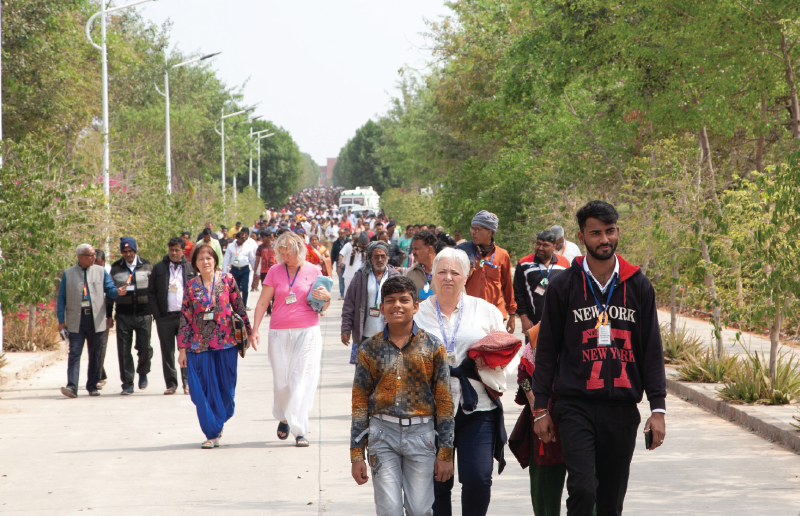
Geshe Dorji Damdul: It is extremely healing and peaceful to be here. I learned that the space is close to 2,000 acres. It is like a huge town built with the blessings of Daaji. When you enter the campus, you feel you are in a very different world. The moment you come here, you sense oneness. There is an intense feeling of coming back home.
PR: At the Global Spirituality Mahotsav, many traditions came together. You spoke there, and I sensed a deep resonance between Heartfulness and Buddhism. How do you see that relationship?
Geshe Dorji Damdul: In fact, if I am not too presumptuous, I would say that if someone fully understands Heartfulness and then encounters the Buddhist tradition, they may feel, “This is actually Heartfulness.” And someone from the Buddhist tradition who comes to Heartfulness and observes it—even just by looking at the demeanor of Daaji—they may feel, “This is Buddhism.”
In a way, I would say that whatever tradition one follows, we must keep in mind that the goal and the means should not be mixed up. The goal and the means are not the same! For example, Christianity, Hinduism, Islam, Judaism, Sikhism, Bahá’í, and Buddhism—all traditions—evolved in different locales and at different times. Each adopted its own means to reach the goal. But the goal is one.
The goal is that there should be no fighting, no discrimination, no bullying. Everyone should feel joy, happiness, and peace. When someone is falling, others should be there to lift that person up. This is the goal of all religions.
The problem is that when people go to extremes—fundamentalism or fanaticism—they begin to identify with the means itself. They see the religion as the ultimate end. They forget the goal, and then they fight.
PR: So, religion is a means, not an end!
Geshe Dorji Damdul: Yes. The goal of all religions is to create harmony and peace in the world. But that peace is sometimes disrupted in the name of religion. When you come here to Heartfulness, you see that anyone who follows Daaji embraces others—there is no pushing. That is something very precious.
The goal is that there should be no fighting,
no discrimination, no bullying.
Everyone should feel joy, happiness, and peace.
When someone is falling, others should be there to
lift that person up. This is the goal of all religions.
During the Global Spirituality Mahotsav, when I felt this ambiance of Heartfulness and listened to Daaji’s address—in the presence of four to six million people—I could see the beauty, warmth, and embracing nature in him.
I spoke to the people who invited me and suggested that such great visionary leaders—driven by compassion—should come together. For example, if Mahatma Gandhi were alive today, I would work very hard to bring such great minds together—to strive for harmony and real peace, not just peace in words.
What is the proof that it is possible? Just come to Heartfulness. Here, people feel oneness. When such great minds come together, no doubt the world will become very different.
PR: You spoke about a shared goal across traditions. That brings to mind the Heart Sutra: “Form is emptiness, and emptiness is form.” In Heartfulness, Babuji Maharaj spoke of our journey toward nothingness. Do you see a connection there?
Geshe Dorji Damdul: You picked up the heart—and then Heartfulness. Heart and Heartfulness.
Let us think of two mothers. Both mothers have intense love for their child. The child wants to become a Nobel laureate in physics.
One mother knows physics very well—relativity theory, quantum physics, quantum entanglement, all these concepts—thoroughly. The second mother loves the child just as much, but does not know physics at all. Although she loves the child deeply and wants the dream to come true, she is helpless. She does not have the wisdom to guide the child to the fulfillment of that aspiration.
In the case of the first mother, the heart is supported by knowledge. Because she has both love and wisdom, the child reaches the culmination of the aspiration—perhaps even becoming a Nobel laureate.
This is Heartfulness: when compassion is guided by wisdom, the heart becomes full.
From that point of view, I see the Heart Sutra in it. When it says, “Form is emptiness, and emptiness is form. Form is not other than emptiness, and emptiness is not other than form,” it is telling us how to make the heart full—how to guide the heart through wisdom.
Babuji Maharaj said that everything goes into emptiness as a goal. This has deep meaning. The Heart Sutra says, “form is emptiness” and “emptiness is form,” like two sides of the same coin.
Form here means dependent origination: how things arise depending mutually on one another. Nothing exists independently. “Empty” means empty of independent existence.
Why do conflicts and fights happen? Because we feel independent from one another. We do not care about others because we think we are separate. This attitude is ignorance. It is the illusion that you are independent from me, and I am independent from you.
Albert Einstein called this an optical delusion—the sense of division between “you” and “I.” He suggested that to overcome this delusion, we must expand the circle of compassion and recognize our interdependence.
So again, compassion, when guided by wisdom, becomes whole. It embraces everyone. That is Heartfulness.
COVID-19 taught us this very clearly. Even powerful nations and their rulers—kings, prime ministers, presidents—were not independent. If you close your borders entirely to protect yourself, your economy collapses. If you open them, the virus spreads. You cannot protect yourself unless you understand that we are interdependent. Protecting weaker countries protects you as well.
This is the wisdom needed to make the heart full. It should not remain confined to a small circle. It must extend to all human beings, all animals, the environment, the whole world.
So when the Heart Sutra says, “Form is emptiness,” it helps dissolve destructive emotions—craving, greed, anger—because we see there is no independent self.
And when it says, “Emptiness is form,” we see that forms do exist—but in mutual dependence. From that understanding, empathy, affection, compassion, and joy arise.
“Form is emptiness”: destructive emotions dissolve.
“Emptiness is form”: constructive qualities grow.
This is the essence of the Heart Sutra. Destructive emotions are reduced, and compassion expands to embrace all living beings on Earth—including the environment.
From that point of view, I see the Heart Sutra in it.
When it says, “Form is emptiness, and emptiness is form.
Form is not other than emptiness, and
emptiness is not other than form,”
it is telling us how to make the heart full—
how to guide the heart through wisdom.
PR: When you spoke about compassion expanding, I was reminded of ripples—how one act touches another, and then another.
That brought to mind the mantra om mani padme hum. I once heard it described as the “jewel in the lotus,” with compassion arising when the lotus of the heart blooms. In Heartfulness, we pray for the collective evolution of humanity—especially through our nightly prayer.
There seems to be resonance here. Could you speak about this mantra and its meaning?
Geshe Dorji Damdul: This is beautiful. Even the phrase “collective evolution of humanity” is so powerful.
Om mani padme hum is the mantra of the Buddha of Compassion—Avalokiteshvara. In Chinese tradition, this presence appears as the female Quan Yin. In Tibetan Buddhism, which descends from Nalanda in India, it manifests in male form as Avalokiteshvara.
Om is shared across Hinduism, Buddhism, and Jainism. It is composed of A-U-M, symbolizing body, speech, and mind.
What is to be awakened? The evolution of body, speech, and mind—what some may call perfect consciousness.
How do we evolve toward that? Through the jewel—mani.
The jewel symbolizes compassion. Just as a wish-fulfilling gem answers aspirations, a good heart fulfills our deepest wish—to be happy and to help others be happy. Even physical and mental well-being are strengthened through compassion. This is mani.
But compassion alone is not enough. It must be guided.
Padme—from padma, the lotus. The lotus grows in mud but remains unstained. Wisdom arises in ordinary human beings, yet when directed properly by a qualified guide, it remains pure. Wisdom is what allows compassion to become full.
And then hum—this signifies the inseparability of heart and wisdom. They must not operate in isolation. They must function together, individually and collectively.
Destructive emotions are reduced, and
compassion expands to embrace all living
beings on Earth—including the environment.

When compassion is limited to “my group,” it is incomplete. True Heartfulness must extend to the whole world.
Daaji is also working in this way. This land, this 2,000 acres, is not for himself. It is for all who appreciate Heartfulness. That is something we must learn.
PR: You spoke about leaders shaping people—not creating followers but shaping hearts. Could you elaborate?
Geshe Dorji Damdul: One thing we must learn from great teachers—Daaji, Raji Ji, His Holiness—is this: when a leader has a truly good heart guided by intelligence, transformation happens.
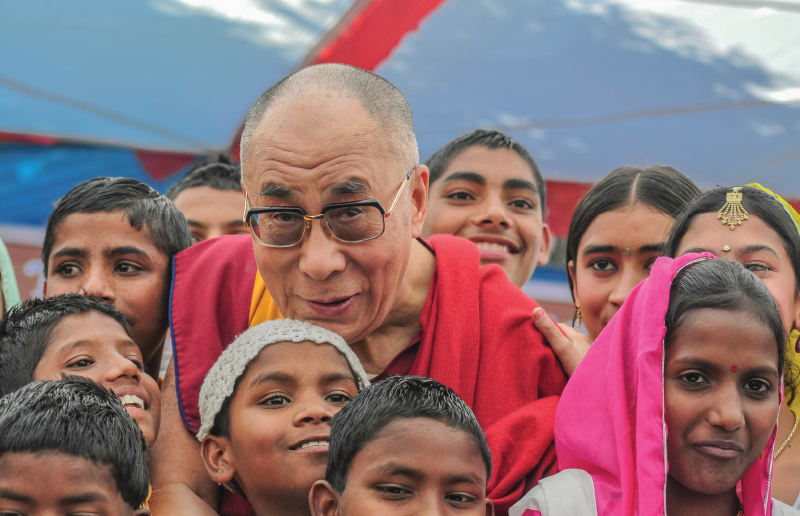
When I come to this ashram, I do not feel like an outsider. People embrace you with natural smiles. They are not forced. They are pure.
How does this happen? They are not all born from one mother. It is because of the wisdom given by the guide—Daaji—and his two teachers. His Holiness is another extraordinary example.
This is what is required: a leader with vision for the larger good and a heart of compassion. When those two are united, people change. The followers begin to reflect that same heart and vision.
It becomes like a ripple effect—a chain reaction. It expands until there are no “others” or “enemies” left. Everyone becomes “us.”
In many situations, anger leads to retaliation. “You hurt us; we will hurt you.” Hatred fuels more hatred. But under wise leadership, a different path is possible.
His Holiness has often said that allowing anger to dominate is a failure. Instead, we must be practical. What can be done, we do. We go for the Middle Way—a win-win approach. Not, “We will punish you; we will kill you.” There should be no attitude like that.
When I look at history, I see how one person can transform millions. One leader can reshape a society. Here, too, in Heartfulness, I see people smiling—and that influence comes from one person, Daaji Ji. World leaders should learn from figures like Daaji Ji and His Holiness: compassion guided by wisdom. If that combination governed nations, trillions of dollars spent on warfare could be redirected toward human flourishing.
PR: When you spoke about how one person can influence many, I was reminded of something Babuji Maharaj once said: “I do not create disciples, I create masters.” Visionary leaders do not create followers—they awaken others to the same vision and heart.
As we conclude, may I invite you to share your closing thoughts?
Geshe Dorji Damdul: India is an amazing country. It has produced great masters from many traditions—Jainism, Hinduism, Buddhism. Then, Mahatma Gandhi, Vinoba Bhave, and here we have Daaji. These are extraordinary figures.
His Holiness the Dalai Lama often says that wherever he travels, he speaks of India as the land of ahimsa.3 He promotes India to the world for its profound spiritual heritage and the values it can offer humanity.
This is what is required: a leader with vision for the
larger good and a heart of compassion.
When those two are united, people change.
The followers begin to reflect that same heart and vision.
It becomes like a ripple effect—a chain reaction.
It expands until there are no “others” or “enemies” left.
Everyone becomes “us.”
The world today is deprived of these qualities. His Holiness serves as an ambassador of India in this sense.
I remember him saying, “My body has survived on Indian rajma dal, and my brain has survived on Indian Nalanda philosophy—psychology, metaphysics, and logic.” In that way, he considers himself a son of India.
So what I am saying is this: great leaders like His Holiness the Dalai Lama, Mahatma Gandhi, and Daaji are products of this land. People—both leaders and citizens—can learn from them.
PR: Thank you, Geshe La. It has been an honor speaking with you. We hope to welcome you again to Kanha Shanti Vanam!
Geshe Dorji Damdul: Thank you. It is truly my honor to visit this center. It is a beautiful place. You enter—and you feel peace.
I have been observing the smiles. One smile, two smiles—you can find that anywhere. But here, across this 2,000-acre campus, you see only smiles. They are contagious, very beautiful. It is amazing!
1 The Mahabodhi tree refers to the sacred fig tree in Bodh Gaya under which Siddhartha Gautama is believed to have attained enlightenment. The tree at Kanha Shanti Vanam is a descendant of that original tree.
2 The Global Spirituality Mahotsav was an international meeting of spiritual leaders and traditions held at Kanha Shanti Vanam in 2024.
3 Ahimsa: A Sanskrit term meaning non-violence or non-harming—an ethical principle in Indian traditions that calls for compassion and refraining from harm in thought, word, and action.

Venerable Geshe Dorji Damdul
The Venerable is the Director, Tibet House, Cultural Center of H.H. the Dalai Lama, New Delhi. He is the former official translator to H.H., teacher of comparative studies of modern science and philosophy, aut... Read More
