
In February 2026, DAAJI received a series of thought-provoking questions from Dr. ICHAK ADIZES about the Heartfulness prayer. Their exchange explores the nature of wishes and expectations, the meaning of “Master,” and what it means to remain open to transformation.
BY DAAJI
The first question: on wishes, desires, and expectations
The Heartfulness prayer says, “We are yet but slaves of wishes putting bar to our advancement.” I am not clear which word is legitimate here: is it wishes, wants, or expectations that block our way to God, which is love?
Let’s assume it is all three—wishes, wants, and expectations—that undermine love. But what is blocking India’s development? I think it is that we should stop expecting. Wanting and wishing are okay; we can surrender those more easily, whereas expecting has a component of control. We expect the other party to behave in a certain way or for something to happen, in which case we are subconsciously wishing to control God. It is okay to wish and want. In fact, that is what drives development. But it is not okay to expect.
Daaji: Let me first lay out the prayer so we can see its structure clearly:
O Master!
Thou art the real goal of human life.
We are yet but slaves of wishes
putting bar to our advancement.
Thou art the only God and Power
to bring us up to that stage.
It is okay to wish and want.
In fact, that is what drives development.
But it is not okay to expect.
There are six lines, and nothing extra. Every word carries the weight of centuries of inner exploration. Now, let us enter.
Line three: “We are yet but slaves of wishes”
Notice what this line does not say. It does not say, “We have wishes that block our way”; it does not say, “Wishes are bad”; and it does not say, “Stop wishing.” It simply says that we are slaves of wishes.
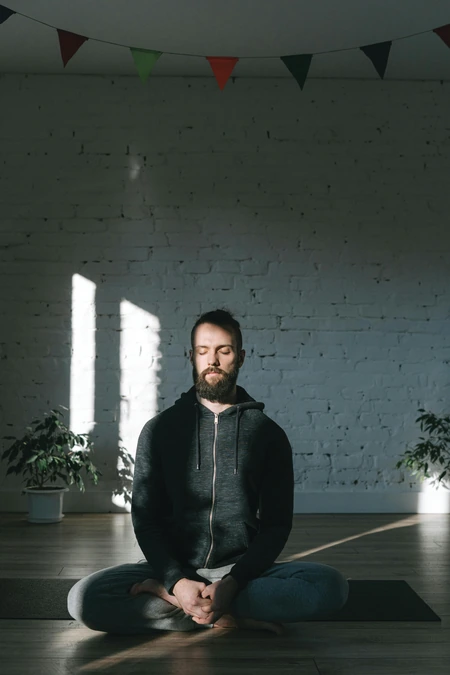
The focus is on enslavement, not on the wishes themselves. That is precisely why the words “yet but” appear. These two small words carry an ocean of meaning. “Yet” speaks of time and potential; we are slaves for now, not forever. “But” adds a qualifier; we are merely slaves, not hopelessly so. Together, “yet but” is both an honest diagnosis and a quiet promise. It says, this is your present condition, not your permanent one.
When I wish a better life for my children, it is simply natural and how it must be. A parent who does not wish well for a child has something missing in their heart. The wish itself is life-affirming. It is the sap of being human. Even the wish for liberation is a wish. The aspiration for selfless service contains an aspiration. The breath wishes to flow, and the heart wishes to love.
But when that natural wish becomes an obsession, something changes. The parent who wishes well for their child begins scripting that child’s entire life. A wish for the child’s happiness curdles into a demand for the child’s compliance. And now the very person you are wishing for becomes nauseated. The wish that began as love has become a cage, not just for you, but for them too.
This is the progression the prayer warns against:
Wish, which matures into
Desire, which hardens into
Expectation, which escalates into
Demand, which calcifies into
Insistence (“It is my right”), which collapses into
Isolation and Guilt.
The prayer catches the development of bondage at the first stage, wishing, rather than waiting for expectation, which is already the third station down the line. It doesn’t even wait for desire, which has already gained momentum. Instead, it prevents escalation at the very first whisper, the wish, the seed before the tree.

The prayer catches the development
of bondage at the first stage, wishing,
rather than waiting for expectation.
Babuji’s precision here is that of a master gardener who removes a weed at the root before it sends out runners. You suggest we keep wishing but stop expecting. That is like saying, “Let the seed germinate, let it take root, let it begin to grow, but do not let it flower.” By the time you are trying to manage expectations, you are already deep in the garden of desire, pulling at branches while the root system spreads underground.
The Science Behind the Capture
Neuroscience has illuminated this progression with remarkable precision. At the University of Michigan, Professor Kent Berridge and his colleagues spent decades investigating the distinction between “wanting” and “liking.” Their discovery overturned the fundamental assumption that dopamine, the famous neurotransmitter, mediates pleasure, because it does not.
Dopamine mediates wanting, not liking. The brain systems that drive pursuit are distinct from those that support enjoyment. The wanting system, driven by dopamine in the mesolimbic pathway, is robust, powerful, and easily sensitized. The liking system, involving tiny “hedonic hotspots” that generate actual pleasure, is small and fragile.
This means we can want something intensely without liking it. We can pursue something compulsively without enjoying it. Every smoker who reaches for a cigarette while knowing it gives no real satisfaction understands this. Every person who scrolls through social media for hours, feeling worse with each passing minute, has lived this neuroscience firsthand.

Seen through this lens, the slave of wishes is caught in a sensitized system of wanting. An arising wish readily triggers the pursuit mechanism. Wisdom has little space to intervene, and the soul little space to choose. The wanting system has captured the organism.
A free person experiences the same wishes, but differently. The wanting may arise, but there is space around it. In that space, the person can observe, “A wish has appeared,” so that wish does not automatically translate into pursuit. It can be noted, felt, and released. The person remains the master of attention, not its servant.

This is the witnessing state: the wish arises, it is seen, and it passes. Nothing is fought, and nothing is grasped.
The ancient tradition captured this distinction in a verse a neuroscientist could have written:
इच्छा शुद्धा भवेद् यस्य सा मुक्तिः परमा मता ।
कामना बन्धनं प्रोक्तं मुक्तिस्तस्याः परित्यजेत् ॥
Iccha shuddha bhaved yasya sa
muktih parama mata
Kamana bandhanam proktam
muktis tasyah parityajet.
When intention remains pure and unattached,
that itself is supreme liberation.
Desire that binds is bondage; freedom comes
from releasing its grip.
A pure wish is fine; it is natural, and it is life itself moving. But when desire takes possession, when desire becomes the master of the one who desires, this is bondage. The Heartfulness prayer addresses that transition point. It says, notice where you move from having a wish to being had by a wish.
The second question: on the word “Master”
Daaji, the word “Master” is a problem. Are we praying to be like you? I doubt that is what you want, because it would then become a personality cult. Chariji told me that the true Master is God. But then that creates a new problem: do we pray to be like God?
The answer, I think, is that we all want to be happy, and it is expectations that undermine happiness. And what is happiness? Total integration. And what is total integration? Love.
God is love, so could the prayer be written as, “Love, you are the ultimate goal. It is expectations that undermine love, and love is the way to get to love, because love is a muscle”? What do you think?
Daaji: Now to the question that troubles many modern minds: why do we address the prayer to “Master”? Does this not create a personality cult? Let me offer an analogy that may illuminate.
A pure wish is fine; it is natural, and it is life itself
moving. But when desire takes possession, when
desire becomes the master of the one who
desires, this is bondage. The Heartfulness prayer
addresses that transition point. It says, notice
where you move from having a wish to being
had by a wish.
An analogy from the Adizes methodology
Imagine, for a moment, that the Adizes methodology for organizational transformation is universally adopted, so every corporation, government, and school uses it. It becomes a household name. Children grow up learning the principles of integration, mutual trust and respect, and complementary teams. And because the methodology works, because it genuinely produces healthier organizations and happier people, everyone naturally begins to admire Dr. Adizes. His name becomes synonymous with integration itself. Now, from the outside, this might look like a personality cult. “Everyone adores Dr. Adizes!” a critic might say. “This is hero worship.”
But when we look deeper, what are people actually admiring? Not the man’s personality, preferences, or quirks; they admire what the methodology produces in them. They are admiring the state of integration they experience when they apply the principles. You would be the first to say, do not worship me. Instead, understand the methodology, apply it, and become integrated yourself. That is the whole point.
Now, suppose someone powerful, perhaps even a head of state, takes exception to the methodology, not because they have studied it thoroughly and found it lacking, but because it threatens their existing way of operating. Their ego resists the change the methodology demands. They make noise, create controversy, and politicize what is simply a tool for human flourishing. What would we say? We would pray that they understand the methodology completely before making noise, not because Dr. Adizes needs defending, but because an incomplete understanding, combined with a powerful platform of being a top leader, can cause harm to millions who would have benefited. The methodology stands or falls on its own merit.
This is exactly the situation with the word “Master” in the prayer. The Master in Heartfulness is not asking to be worshipped. Babuji was unequivocal on this point. He said, “I do not make slaves, I make masters.” The goal is not followers; it is for every practitioner to become a master themselves. A real master only produces masters. This is the litmus test that separates authentic spiritual guidance from a personality cult.
When we say, “O Master!” we are not bowing to a personality. We are orienting toward the state of consciousness the Master embodies as a realized being. We are saying, this is what a human being can become, and this is what I aspire to become. It is not about personality, style, or mannerisms. It is about inner condition, the realized state, and the consciousness he has uncovered. It is the difference between worshipping a doctor and following the treatment, between idolizing a coach and practicing the drills, or between venerating the map and walking the territory.
How the bridge works
So, why do we need a person at all? Why not simply orient toward God directly, toward Love directly, toward the Absolute?
Here is the paradox every genuine spiritual tradition faces. The Absolute is infinite, formless, and beyond conception. How do we as finite beings relate to the Infinite? A cosmic force cannot look into your eyes. A philosophical concept cannot wipe your tears. An abstract principle cannot sit across from you and transmit something from its heart to yours.
Carl Sagan explored this paradox in his science fiction novel, Contact. When Ellie Arroway finally meets the alien intelligence, it appears as her deceased father, not because the intelligence is her father, but because that form allows meaningful connection. The Infinite understood what the mystics have always known: relationship requires a form the heart can embrace.
When we say, “O Master!” we are not bowing to a
personality. We are orienting toward a state of
consciousness that the realized being of the
Master embodies. We are saying, this is what a
human being can become, and this is what I aspire
to become. It is not about personality, style, or
mannerisms. It is about inner condition, the realized
state, and the consciousness he has uncovered.

Dr. Giacomo Rizzolatti’s discovery of mirror neurons revealed a neural mechanism of resonance between observer and observed. When we watch another person act, some of the same neural circuitry involved in performing that action becomes active in us. The brain is wired for this kind of resonance. What neuroscience demonstrates at the neural level, Yogic Transmission accomplishes more profoundly at the level of consciousness itself.
When you sit with a realized being or hold them in your awareness, something transfers. It is not their personality, nor their opinions. It is their inner condition. Consciousness awakens consciousness. Realization calls to the potential for realization within you.
The Master does not stand between the seeker and the Divine. Rather, the Master serves as a living bridge, helping the seeker become receptive to the Divine.
And we walk this living bridge on our journey to the Infinite.
Babuji himself wrote with characteristic humility, “I only try to invoke God’s blessings by means of prayer through the medium of my Master. Thus, I can in no way be called a Master in this respect. I may, however, be only a helping factor in the spiritual growth.”
A genuine master does not claim the role. A genuine master is a doorway, not a destination; a ladder, not a throne. Once you have reached the roof, you do not worship the ladder, but while climbing, you would be foolish to kick it away.
The question of a cult
A cult operates through fear, dependency, control, and the suppression of questioning, whereas love does the opposite. Love liberates. Love makes you more yourself, not less. Love encourages questioning, because truth has nothing to fear from inquiry.

When the relationship between seeker and guide operates through love, it cannot be a cult. Love is incompatible with fear, coercion, enforced dependency, and the suppression of questioning. A cult produces identical copies, whereas love produces unique expressions. A cult demands uniformity, whereas love celebrates diversity. A cult tells you to remain as you are, dependent on me, whereas love tells you to become what you are meant to be, even if that means outgrowing me.
We must give credit to the goal we had at the beginning. God, the Master, and Love do not ask to be worshipped; they ask that you become like that.
A personal encounter and what stands between
The question of the Master also has a practical dimension: the role of personal encounter in transformation.
It is easy to absorb the concept of love intellectually, and easy to grasp a management methodology on paper. But to reach the heart of any transformative philosophy, we must absorb its lessons with love, acceptance, and a willingness to be changed by what we encounter.
Here is where the real resistance lives, not in the methodology, not in the prayer, and not in the concepts of God, Master, and Love. The resistance lives in what stands between the integrated self and the non-integrated self, between the evolved self and the present self, and between what we are and what we could become.
Between them stand two things:
1. The static state that does not want to move or change.
In Sanskrit, this is called तमस [tamas], the inertia that resists all transformation. It is comfortable where it is; it has arranged the furniture; and it does not want anyone rearranging the room, even if the room is a prison. The inconvenience of change and transformation is real. Growth hurts. The caterpillar’s dissolution inside the cocoon is not a metaphor for comfort.
2. The individual ego that distorts vision.
The ego does not see clearly. It sees through the lens of “what does this mean for me?” that bends every truth into something self-serving.
These two forces, inertia and ego, conspire to make us interpret the prayer as a threat rather than an invitation, so that “O Master” sounds like subservience rather than aspiration. They interpret “slaves of wishes” as condemnation rather than an honest diagnosis. And they interpret “Thou art the only God and Power” as helplessness rather than the most courageous surrender a human being can make.
Now, a personal encounter with the Master cuts through both. When you sit with someone who has realized what the prayer describes, the messages of ego and inertia are disproved. The heart recognizes what the mind resists.
Babuji conveys to us that “the Master can do everything, yes; he can do a lot, but not in spite of yourself. The absence of will and perseverance delays your progress. Work on yourself! Be malleable!”
This is not cult language. It is the language of transformation: be willing to change, and be willing to be changed. Learn to distinguish genuine discernment from resistance to change. Do not mistake your comfort for contentment.
The heart of the matter
You have conveyed that love is the goal, the path, the means, and a muscle. This is beautiful and correct. But a textbook description of a muscle has never made anyone stronger. We must lift, we must practice, and practice requires structure, guidance, and yes, a relationship with one who has already traveled the path.
The prayer provides the structure and the exercise. The Master provides the living example. And love, which is both the fuel and the destination, grows stronger with each day of sincere offering.
Expectations alone do not undermine love. It is enslavement to any movement of the mind that pulls us away from the present, from the heart, from the Real. Expectations are a symptom while the prayer treats the cause.
The prayer is not a cage. It is the key.
The prayer provides the structure and the exercise.
The Master provides the living example. And love,
which is both the fuel and the destination, grows
stronger with each day of sincere offering.

A note on India’s development
One more thing: you connect expectations to India’s development. I would frame the issue somewhat differently. What holds India back, or any individual or nation, is not authentic detachment, but the counterfeit of detachment: inertia dressed in spiritual clothing.
Krishna pushes Arjuna to act with full vigor while remaining inwardly free, not to renounce action. The surgeon with the steadiest hands has released the fear of failure. The clearest leader is unclouded by personal ambition. In Heartfulness, detachment and practice are not opposites; they are partners: freedom and engagement, surrender and dynamism—like the lotus, rooted in mud while flowering in sunlight.
In closing
The prayer is not asking us to become wish-less beings, hollow and unmotivated, drained of ambition and vitality. It is asking us to become free beings, fully alive, fully engaged, fully loving, and fully free.
The difference between a slave of wishes and a free person is not the absence of wishes. It is the presence of awareness. Let me share some more of Babuji’s wisdom: “Freedom and feeling cannot remain together. If freedom is there in its naked form, the feeling will be away from it.”
The moment we desire the feeling of freedom, we have created another wish that can enslave us. True freedom is not an experience to pursue; it is a state to be lived, so natural that even awareness of it dissolves. With absolute clarity, Babuji declares, “Freedom from freedom is the real freedom.”
FROM DAAJI
Daaji is the global guide of Heartfulness and president of Shri Ram Chandra Mission.

Daaji
Kamlesh Patel is known to many as Daaji. He is the Heartfulness Guide in a tradition of Yoga meditation that is over 100 years old, overseeing 14,000 certified Heartfulness trainers and many volunteers in over 160 countries. He is an inn... Read More
