ART ESSAY
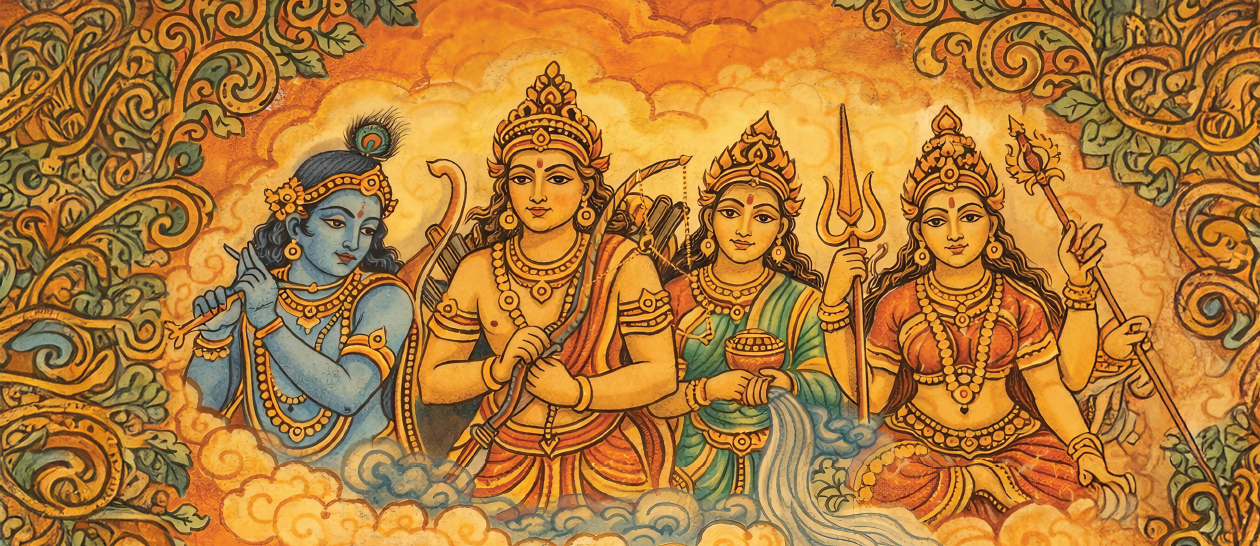
ANUJA CHANDRAMOULI and the journey of transformation through mythology—profile by PURNIMA RAMAKRISHNAN.
“Life is like driving a car. You have to keep glancing at the rearview mirror every once in a while—meaning the past—which is a way of staying connected to your roots. Trying to figure out where you’re from helps you get attuned to your cultural heritage, which is a big part of your identity. Revisiting the ancient world gives you an insight into the present, which you cannot have if you do not look at the rearview mirror while you’re steering through the present, all the while keeping an eye on the future.”
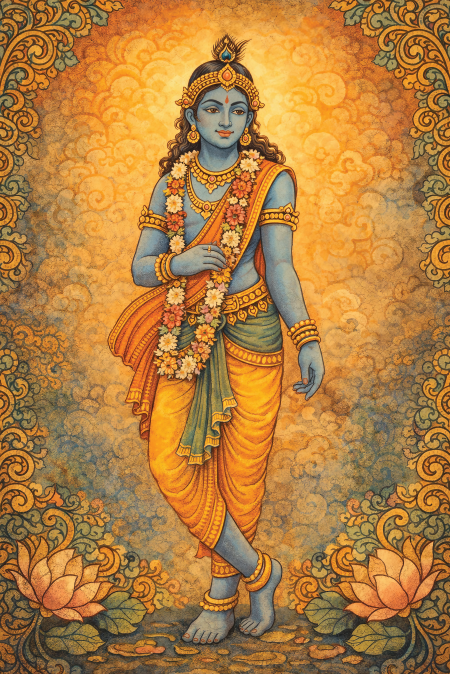
Anuja speaks about mythology. Mythological stories like the Mahabharata, Ramayana, and Puranas shaped my childhood—constant companions at every moment. Lord Krishna was always my favorite, and learning of his death left me deeply saddened.
When speaking with Anuja, author of fourteen books reimagining Arjuna, Mohini, Shakti, and Ganga, I was curious about how ancient narratives could support spiritual seekers like me. As a Heartfulness meditator, I know turning inward requires courage and guidance.
Could these old stories offer another form of guidance, I wondered?
Looking Inward: The Real Journey
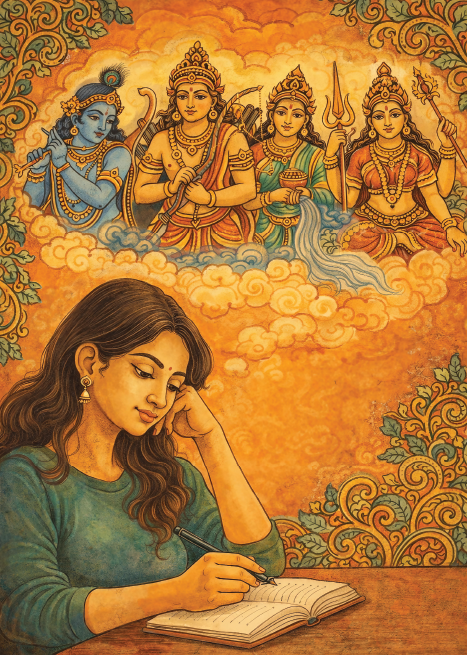
Anuja says that when most people think of journeys, they imagine external movement: flights taken, monuments visited, experiences accumulated. But the journey she’s describing is entirely different.
“Through writing, through engaging with our ancient mythology, you are encouraging yourself to look inward. That is a lot more challenging because it calls for a degree of mental discipline; it calls for finding the stillness at the simmering and always churning core within you and reveling in the periods of quiet contemplation and introspection.”
Mental discipline, stillness at one’s core, and quiet contemplation are some of the same elements we cultivate in meditation practice. When we sit down for meditation, we turn away from the external world and face what’s within. The discipline Anuja describes is almost the same work in a different form.
As Anuja explores these stories, she describes accessing “universal consciousness,” a phrase that stops me in my tracks! In Heartfulness, we refer to consciousness expansion and meditation as means to connect with something greater than ourselves. Here was an author describing a similar state, achieved through immersion in mythology!
Emptying to Receive
Anuja describes her research process in terms that sound almost ascetic. When she begins work on a book, diving into the vast ocean of epic literature, the first thing she encounters is her own ignorance. The material is immense, accumulated over generations. Anuja says that it is humbling and sometimes even overwhelming.
“It’s like scooping out your insides. You’re emptying all of it so that you can fill it with this beautiful store of ancient knowledge, which then reshapes who you are as a person. You’re emptying yourself up to make yourself a worthy receptacle.”
The trick, she says, is to trust the process and to keep returning to the research and the writing with humility. Slowly, you gain insights, you begin to harness what you’re receiving and pour it onto the pages.
“When that happens, a certain healing happens. Because as I mentioned, you’ve been scooped out hollow and once more, you’re shaping yourself reflectively, immersing yourself in the timeless flow of profound truth; you’re surrendering to a greater process, and you emerge stronger from it.”
Characters as Teachers
Anuja has written fourteen books. She calls them her babies, the books she’s carried and delivered with care. But she also calls them her parents, the guides who have helped her grow.
Each character demanded something different from her. Each book required her to reach a certain level of growth before she could do it justice.
From Arjuna: Saga of a Pandava Warrior-Prince, her first book, came the confrontation with anger, that defensive shield we mistake for strength. She had to let go of preconceived notions about this character she’d grown up with. To surrender to this process, she found she had to let go of her own anger.
Anyone who meditates regularly knows what it’s like to meet anger on the cushion. The question is always: will we defend it, or let it go?
Mohini: Facing Discomfort
Then followed Mohini: The Enchantress. This character forced Anuja to confront the inherently ingrained discomfort around sexuality and sensuality.
“As women, there are so many hang-ups we have about sexuality because society either encourages us to be sex objects (as opposed to sexual beings) or the very vision of chastity and repressed sexuality. In Mohini, I realized I was so shy and reluctant to do this character justice. That was the very first time that I used the first person as an author, because I wanted to get closer to this character and stop being so reluctant to engage with someone so confident in her sexual skin.”
Beyond Binaries
Anuja’s most recent book, The Wife and the Dancing Girl (a revisionist take on the Tamil classic, Silapathikaram), tackles another false choice: the “Madonna-whore” complex: the good wife versus the dancing girl.
“I really struggled to write this book because I had a lot of growing up to do. We’re forced to view women as either one thing or the other. But a woman has thousands of faces, and they’re all valid.”
This is what svadharma means, following your own dharma—your own truth.
Shakti: Accessing Inner Strength
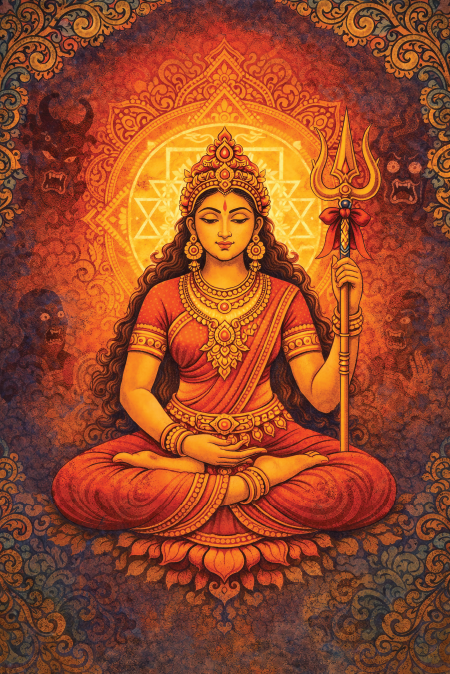
If any single work embodies the transformative power Anuja describes, it is Shakti: The Divine Feminine.
“When you’re exploring the transcendental quality of the Divine Mother, that’s when you realize that the answers you were seeking outside are within you. The greatest lesson the Goddess teaches you is also the simplest: You are enough!”
For Anuja, writing Shakti meant exorcising personal demons, confronting nameless terrors, working through phobias and unpleasant experiences, and trauma accumulated over a lifetime. The book itself became the reward—and not only for Anuja. During the Kerala floods, a young woman reached out to her on Instagram. Stranded, waterlogged, frightened, the girl told Anuja that Shakti had been her source of comfort in those terrifying hours.
“When you’re exploring the transcendental quality
of the Divine Mother, that’s when you realize that
the answers you were seeking outside are within you.
The greatest lesson the Goddess teaches you
is also the simplest: You are enough!”
Ganga: Redefining the Sacred
In her book Ganga: The Constant Goddess, Anuja reimagines the river deity as a woman who follows her heart.
“She refused to stay put in one place and be the dutiful wife. She wanted to truly become a divine lover and partake of a timeless love that will sustain nature in its raw splendor. She chose to live life Goddess-size.”
A Simple Practice
When I ask Anuja how readers can meaningfully engage with these stories for their own transformation, she speaks of interlocking patterns—mysterious connections that reveal themselves only through sustained attention.
What you receive from mythology depends on what you bring to it. The stories can serve many purposes, including pure entertainment. Yet if you keep responding to their call, you may be surprised by how they educate you without your even trying.”
Anuja offers a simple practice: read a few pages every day. The Bhagavad Gita, the Mahabharata, the Ramayana, the Upanishads, your favorite Puranic tales, Tenali Raman stories—or even your own writing! Just read and absorb.
“You’ve been fed this diet of stories as a child, along with mother’s milk and the parupu-sadam (rice and lentils). It becomes a part of your blood and your bones. Just read a few pages, and you absorb and assimilate what is being conveyed. Slowly, with time, you start discerning the mysterious interlocking patterns which convey the deeper truth.”
It is never obvious, she says. It is never simple. And yet it is both obvious and simple! That is the paradox.
Anuja’s daily reading practice parallels meditation: both require showing up, absorbing, and yielding. Over time, the change is subtle but deep; when needed, your inner strength emerges.
Death and the Shamba Revelation
Near the end of our conversation, Anuja shares what she calls her “eureka moment,” an insight that came while working on her book, Abhimanyu.
“The characters in the Mahabharata were all embodiments, divine entities who wanted to be a part of this Dharma Yuddha [righteous war]. They wanted to assist Vishnu’s avatar, Krishna, because he was Bhumi Devi’s worthiest champion. Once a divine entity’s purpose is fulfilled, there is no sense in clinging to this world. They must be released so they can return. Ultimately, liberation is about letting go, especially of the things you love with passionate abandon.”
Anuja speaks of the Yadava massacre, the destruction of Krishna’s entire clan after the Mahabharata war—almost unbearable for her to contemplate as a young child. Shamba, son of Krishna and Jambavati, was blessed by Shiva in his Ardhanarishvara form [Shiva as half-woman]. Shamba was beautiful, like Krishna, and irresistible to women—but also cursed. The sages doomed him to deliver an iron mace that would destroy the Yadava race. On the surface, their loss can feel terrible, yet it is divinely ordained.
Anuja’s insight goes deeper.
Death and destruction, the work of Shiva the destroyer, come with negative connotations, but they are part of the great cycle, whether we acknowledge it or not.
“Stories help us engage with these mysterious patterns. They encourage you. The monsters of the world may be real, but you carry with you what is necessary to deal with all of it, whether it be death, personal demons, or anything else. You will find what you need, provided you are brave and kind.”
The Living Inheritance
As our conversation comes to a close, I return to the image of the rearview mirror. We must glance back to move forward. The past helps us orient toward the future.
As Anuja says, stories are living organisms. They breathe, but they also change with each generation. Something gets added, something gets removed, always according to what is needed. It doesn’t mean the stories are contaminated or diluted. Similarly, we are living organisms, capable of being emptied and refilled, changed, and adapted. As we go, we develop the capacity to confront our demons and discover our strength.
The journey inward is not easy. It requires contemplation and courage. Just as we return to our meditation cushion each day, we can repeatedly return to the wisdom of ancient stories. The practice is the same: showing up, opening your heart, and allowing transformation.
The journey inward is not easy.
It requires contemplation and courage.
Just as we return to our meditation cushion each day,
we can repeatedly return to the wisdom of ancient stories.
The practice is the same: showing up,
opening your heart, and allowing transformation.

Anuja Chandramouli
Anuja Chandramouli is a bestselling author of fourteen books on mythology, historical fiction, and fantasy. Her debut, Arjuna: Saga of a Pandava Warrior-Prince, was one of Amazon India’s top sellers in ... Read More

Purnima Ramakrishnan
Purnima is a UN award-winning writer and blogger. She is a fellow of Journalism by The International Reporting Project of the Johns Hopkins School of Advanced International Studies and the reci... Read More
