
Irish singer and teacher EILISH BUTLER combines the mystical chant of Saint Hildegard von Bingen (1098–1176) with the evolutionary path of Uncovering the Voice, combining her passions of spirituality and music.
To sing Hildegard is to have a direct experience of her spirituality and, subsequently, my own. There is no more direct way to understand and feel Hildegard’s vision of the world than to sing any of her seventy-seven compositions from the Symphonia armoniae celestium revelationem. The Symphonia is Hildegard’s collection of chants comprising antiphons, hymns, sequences, and responsories. It establishes her as the first named composer in the Western world, an extraordinary feat given that she was a woman at the end of the eleventh century.
Whether it happens instantly or incrementally, when I sing Hildegard, I feel the visionary power of her chant opening me up to a new way of being; I enter a process of spiritual exploration in which the voice leads the way. For each singer, this is personal, touching us directly and deeply as only the evolutionary power of love can. Hildegard understood how love can be harnessed and channeled through her chant.
Just as St. Augustine is thought to have said, “Qui bene cantat bis orat [to sing is to pray twice],” by which we might understand that singing amplifies the power of prayer, Hildegard shows us that through harnessing the evolutionary power of love, singing can transform us by revealing to us our natural embodied spirituality. Hildegard’s cosmology centers on the drama of the fall from grace when Adam and Eve were ejected from paradise. For her, chant is a medium for reunifying body and soul and returning humankind to its original perfection or attunement. The world is a hymn of praise to God, in which Heaven and Earth are connected through human beings who sing themselves into a state of oneness with all creation.
I have always hesitated to call Hildegard’s composition “song,” for originating as it did within a monastic context, chant does not have the same performative aspirations as song; rather, it springs from a meditative, prayerful, internalized condition, which aspires to a state of integration with the sacred source of the self. When my meditation guide, Chariji, once said, “I do not discover anything but rather reveal what is already there,” I believe he implied that an effective spiritual practice requires an attitude of service to revealing the true nature of the original condition. Once revealed, this eternal essence—the light at the heart of the human being—has the capacity to guide the soul on its homeward journey to the source.
In the same way, the voice can undergo a process of uncovering, leading to a soul connection with a tonal reality that is beyond our normal perception. In previous centuries, our ancestors named this “the music of the spheres.” By gradually uncovering the layers that obstruct the voice from knowing its true nature and function, not only does the voice become more beautiful and authentic, but it is also capable of connecting us to higher dimensions. In this way, the voice can open the embodied human being to the stream of cosmic wisdom, thereby revealing our innate spirituality.
Singing, especially prayerful singing like chant, can represent an evolutionary path in its own right. It draws on both spiritual science and the esoteric wisdom of uncovering the voice, along with the technical knowledge of the instrument's anatomy and physiology, and can lead to greater awareness and enhanced perception of the music of the soul. Hildegard, the great Mystica, was nine hundred years ahead of us, and her chants call us into alignment with this wisdom. To sing her music is to allow ourselves to be revealed.
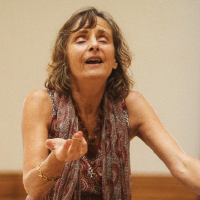
Eilish Butler
Eilish Butler trained in classical singing in the Netherlands, holds an M.A. in Chant & Song from the University of Limerick, and studied vocal pedagogy and therapeutic singing in Germany.... Read More
