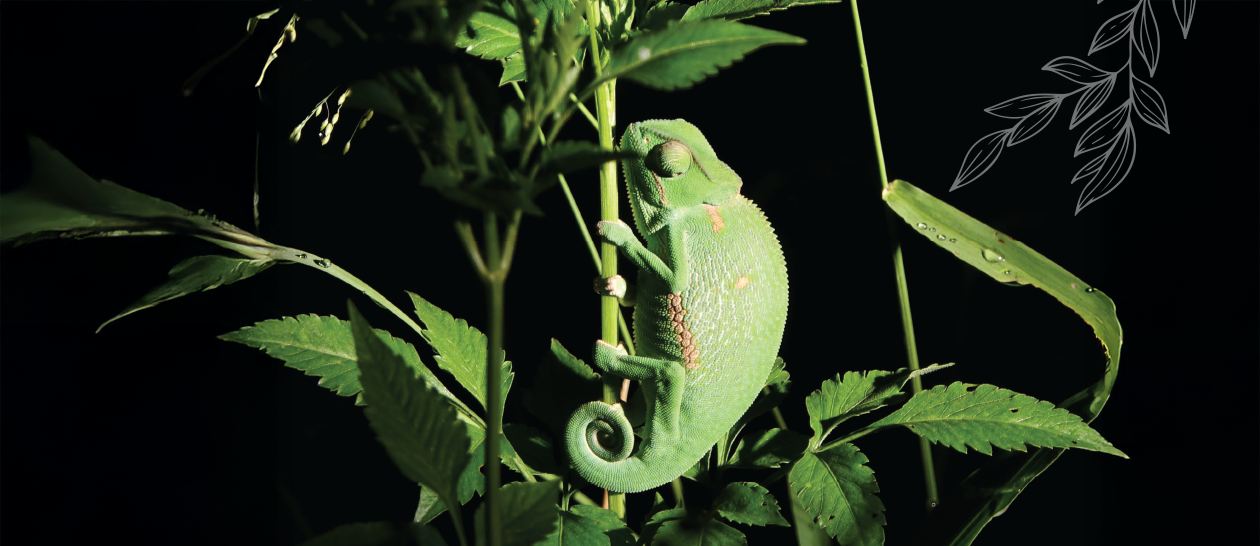
ECOLOGIST B. RATHINASABAPATHY connects the Indian chameleon’s way of being at Kanha Shanti Vanam to spiritual practice—cultivating harmony with place, patience, and focused awareness.
Masters of Disguise
Chameleons are among nature’s most fascinating reptiles, best known for their ability to change color and blend seamlessly into their surroundings. While most chameleon species are found in Africa, particularly Madagascar, they also inhabit parts of Europe and Asia, including India and Sri Lanka. Unlike their forest-dwelling relatives, some species have evolved to thrive in extreme environments, such as the arid Namib Desert, where they have adapted to a ground-dwelling lifestyle.
India is home to just one species—the Indian chameleon (Chamaeleo zeylanicus). This diurnal lizard moves slowly and relies on its exceptional camouflage to evade predators and ambush prey with precision. Beyond its biological marvels, the chameleon symbolizes patience, adaptability, and inner awareness—qualities that resonate deeply with spiritual seekers.
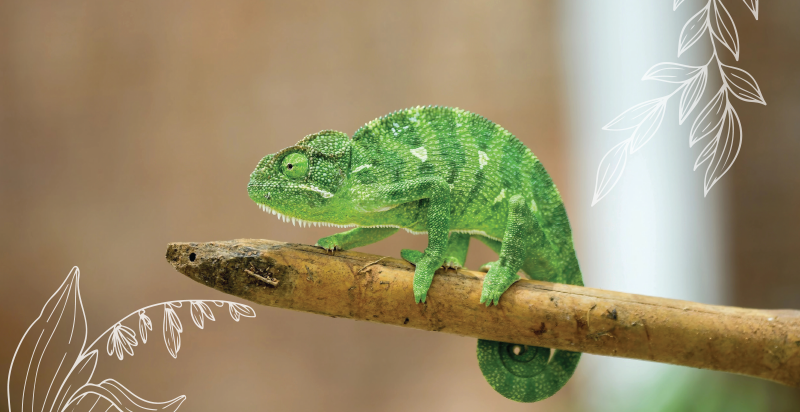
Chameleons at Kanha—A Symbol of Harmony
At Kanha Shanti Vanam, a spiritual and ecological sanctuary dedicated to inner transformation and environmental conservation, chameleons emerge as hidden gems of the dry, thorny scrub forests. After the rainy season, young chameleons can be seen exploring their surroundings, while adults remain more elusive. When sensing danger, they crawl away cautiously before vanishing into the environment, blending perfectly with leaves and branches. Their ability to disappear in plain sight makes them one of the most intriguing reptiles found in mainland India.
Just as the chameleon seamlessly adapts to its surroundings, spiritual seekers at Kanha learn to harmonize with nature, cultivating mindfulness and a deep connection with the environment. Observing these elusive creatures can be a reminder of how stillness, patience, and awareness can transform one’s experience of life.
The Perfect Arboreal Hunter
Chameleons are built for life in the trees. Their long limbs and specialized zygodactylous feet—two toes facing forward and two backward—allow for a firm grip on branches. Their prehensile tails further aid in balance and stability. When moving, chameleons perform a distinctive swaying motion, rocking back and forth to mimic the movement of leaves in the wind. This slow, deliberate gait helps them avoid detection by both predators and prey, mirroring the grace and discipline of a meditative practice.
Observing these elusive creatures
can be a reminder of how stillness,
patience, and awareness can transform
one’s experience of life.
A Deadly Precision Strike
Despite their sluggish movement, chameleons are highly efficient hunters, thanks to their astonishingly fast, projectile-like tongues. The chameleon’s tongue can extend up to 1.5 times its body length, launching at an acceleration comparable to a car going from zero to sixty km/h in a split second. This remarkable feat is powered by an accelerator muscle, which catapults the tongue forward, and a retractor muscle, which swiftly pulls it back with captured prey.
Adding to this efficiency is the chameleon’s incredibly sticky saliva, nearly a thousand times more viscous than human saliva, ensuring that even the fastest of insects—such as grasshoppers, butterflies, and dragonflies—have little chance of escape.
360-Degree Vision for the Ultimate Predator
Chameleons have another extraordinary advantage—their independently rotating eyes. They can scan their surroundings in two different directions at once, covering nearly 360 degrees. However, when locking onto prey, both eyes align to provide precise depth perception, allowing for an accurate tongue strike. Rarely does a chameleon miss its mark, making it one of the most formidable insect hunters in the reptile kingdom.
Nature’s Living Marvel—A Spiritual Perspective
Chameleons are a testament to nature’s ingenuity, blending remarkable adaptations of camouflage, vision, and hunting precision into a single species. Whether swaying gently in the trees or unleashing their lightning-fast tongues, these reptiles continue to captivate and inspire those fortunate enough to encounter them in the wild.
At Kanha Shanti Vanam, where conservation and spirituality merge, the presence of chameleons is a reminder of nature’s delicate balance and resilience. They teach us the art of adaptability, patience, and focused attention—qualities essential not only in the animal kingdom but also on the path of self-discovery. As seekers learn to attune themselves to nature’s rhythm, the chameleon serves as an emblem of mindful living, seamlessly blending into its surroundings while maintaining an unwavering inner purpose.

B. Rathinasabapathy
B. Rathinasabapathy is an ecologist with 37 years of experience in forest restoration, biodiversity conservation, and environmental education. He has led ecological projects across India, including the Western... Read More
