
An Introduction
A new series explores the deeper principles of spiritual practice, showing how a seeker moves beyond a surface-level approach toward spiritual growth and inner transformation.
BY N.S. NAGARAJA AND JOSHUA POLLOCK
A spiritual path is, at its heart, a response to a practical problem: how is the soul to be elevated beyond its present condition? Some paths understand this elevation as an entrance into divine realms after death; others, like the Heartfulness way, understand the journey as unfolding over the course of one’s life. In either case, the path gives form to aspiration through a method—prayer, meditation, contemplative practice, or another discipline. Yet at the heart of any such method are underlying principles—universal in nature—that determine how deeply the method can work. To engage any method deeply and with understanding is to begin engaging these principles.
A method gives spiritual practice its form and direction: how we prepare, how we hold the body, what thought we hold or intention we offer, how we relate to what arises within, and the regularity with which we practice. These elements are essential. But a practitioner may observe them faithfully for years, and still the practice does not open to the depth of which it is capable. Does the limitation lie in the method itself? Frequently, it lies in the depth of our engagement with it. The spiritual principles at the heart of a method become fully alive only when we engage them with sensitivity and understanding. The method then becomes a dynamic catalyst for our transformation.
Why must our participation go this deep? Because what we seek is not within the reach of body or mind alone. Body and mind influence one another in both directions, but each communicates only its own condition. A tense body can disturb the mind, and an agitated mind can unsettle the body. A collected mind can bring balance to the body. In each case, one part of our being impresses its own state upon another. But neither body nor mind can elevate itself beyond its own condition, much less confer the divine nature upon us. Only the Divine is able to confer its nature. The principles articulated in this series describe how a seeker becomes inwardly prepared for the Divine: as one’s practice is undertaken with greater sensitivity to these underlying principles, the seeker’s inner condition becomes increasingly receptive and inviting to the divine influence that alone transforms the being.
This same truth applies when we seek to support another person’s spiritual journey. We do not transform another by personal will, thought, or effort alone. To help another in any real sense, we too must become inwardly aligned with the Divine, so that what moves through us is not merely our own intention, but the divine influence that transforms.
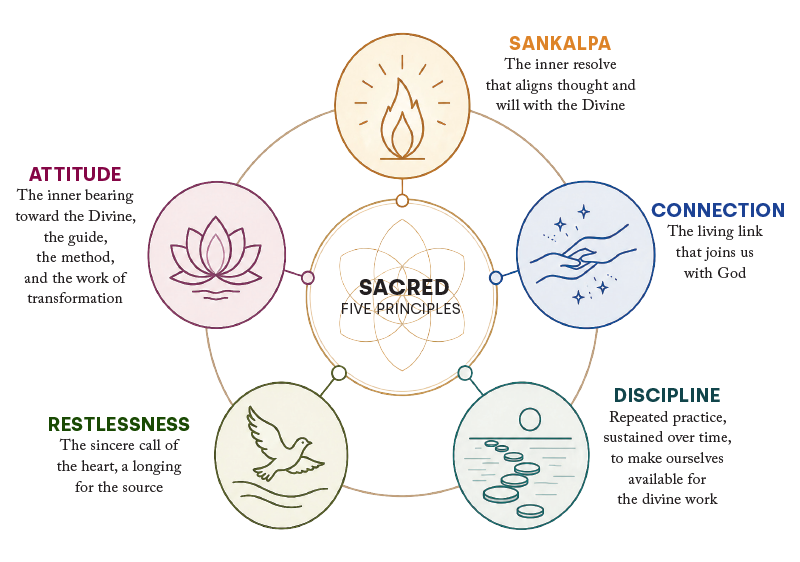
These principles can be gathered under the acronym SACRED—Sankalpa, Attitude, Connection, REstlessness, and Discipline. Sankalpa is the subtle inner resolve by which thought and will are offered toward divine purpose, drawing forth the divine response that alone makes such offering effectual. Attitude, or bhava, is the seeker’s inner bearing toward the Divine, the guide, the method, and the work of transformation. Connection is the living link through which the seeker becomes joined with God. Restlessness is the sincere call of the heart, the raw longing for the Source that gives urgency to the whole endeavor. Discipline is repeated practice, sustained over time, through which we make ourselves available for the Divine to work in whatever way is needed.
Once, there was a gardener who tended a rose garden for many years. He followed every rule of gardening: watering at sunrise, pruning at precise angles, tending the soil with care. The garden was orderly. Yet the roses remained small, scentless, and pale, and the gardener could not understand why.
Then, one day, a master gardener came to visit. He watched the gardener work for a while, then said, “The rose does not bloom for the shears. It blooms for the sun.” The gardener pondered these words for many years.
One morning, it occurred to him that the life in the roses was the same life that moved in him, and a longing arose in him to experience that unity, and with it a wish for the roses: may they know it too. His hands were gentler now, and his listening more attentive; life meeting life in the early morning light.
And so, his daily rounds continued, no longer as a gardener performing his work but as someone visiting old friends. The roses grew vibrant, their fragrance filling the garden.

What was awakened within the gardener awakens in the seeker by the same path. Although this series will take the five principles one at a time, they do not act in isolation. Each will be easier to study separately, but in practice, they continually touch and modify one another. Their deeper relationship will become clearer as the series unfolds and will be gathered together in a final piece.
The five principles are distinguishable at the surface and progressively indistinct at depth. They are like meridians on a globe: separate lines at the equator, converging as they near the pole, and at the pole, no longer five but one. The practitioner who refines any one of them deeply finds its boundaries dissolving into the others, until what was five becomes a single orientation of the whole being. This is the destination toward which all five lead, and into which any one of them, taken to its depth, opens.
The series begins next month with sankalpa.
FROM HEARTFULNESS INSTITUTE
The Heartfulness Institute is a global not-for-profit organization offering heart-based meditation practices for inner well-being and collective harmony.
https://heartfulness.org/global/

NS Nagaraja
NSN is founder and CEO at Sensei Technologies. He has been practicing Heartfulness meditation for 20+ years and is deeply interested in the science of spirituality, software architecture and design philosophies. He also works with Bright... Read More
Joshua Pollock
Joshua Pollock is co-author of The Heartfulness Way, an international bestseller available in twenty languages, and Editor-in-Chief of Heartfulness Magazine. He has also performed as a featured v... Read More
