
Insights from neurophysiology and Heartfulness practice reveal how stress can interfere with compassion and how inner balance can help it flourish.
By DR. KUNAL DESAI
The Paradox
All our human interactions flourish when they are rooted in qualities such as empathy and compassion. Yet consistently expressing these qualities can become difficult when our inner world is burdened by stress, emotional exhaustion, and unrest.
Having practiced medicine for more than two decades, I have had a unique vantage point from which to observe this paradox. Healthcare professionals work in an environment where they repeatedly encounter illness, uncertainty, fear, and others’ suffering. In these moments, empathy and compassion are not simply desirable qualities; they are integral to the very act of caregiving.
Yet caregivers themselves are particularly vulnerable to stress, burnout, and emotional exhaustion. Repeated exposure to the suffering and trauma of others can also contribute to compassion fatigue, a state of physical, emotional, and mental exhaustion.
Here lies a profound irony: those entrusted with caring for others may gradually deplete their own emotional resources. The caregiver may still intend to care yet struggle to access the inner space from which genuine compassion naturally flows.
This raises a deeper question—one that extends far beyond medicine:
Can true compassion flourish when our inner world is filled with turbulence, disturbance, and discontent?
If this is true for caregivers, isn't it equally relevant to every human relationship? Between parent and child, teacher and student, manager and colleague, husband and wife, or simply one human being and another, what we offer outwardly is inseparable from the inner climate we cultivate.
Neurophysiology of Compassion
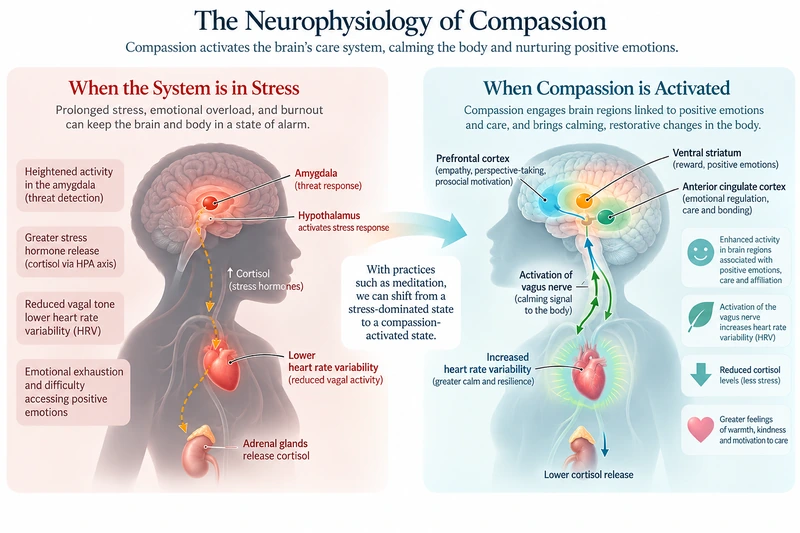
Compassion has a biological foundation and is deeply rooted in our mammalian care system, which enables us to recognize distress, connect with those who are suffering, and respond with care.
It is associated with activation of the calming, parasympathetic nervous system through the vagus nerve, increased heart rate variability, and regulation of the stress response, including cortisol.
But this raises an intriguing dilemma. What happens when this same system is repeatedly exposed to stress, emotional overload, and the suffering of others? Compassion draws on systems associated with connection and positive emotion, while chronic stress and emotional exhaustion can deplete our inner resources.
The very idea of “cultivating compassion” presents an interesting paradox. If compassion is already inherent to our human nature, do we really need to create it—or simply remove what prevents us from expressing it?
An Experiment
We explored this question in a randomized study of healthcare professionals. Participants followed either a six-week trainer-supported Heartfulness program or a self-guided gratitude practice.
After six weeks, participants practicing Heartfulness showed significantly reduced burnout and secondary traumatic stress, along with a trend toward greater compassion satisfaction. Participants also described feeling calmer and less reactive to stress, with improved sleep and less fatigue.
Heartfulness offers an intentional inward pause through meditation, allowing the mind to settle and fostering calmness and inner connection while removing emotional imprints using its unique Cleaning practice. With repeated practice, this inner calm can gradually percolate into daily life, helping us meet difficult situations with greater poise and emotional balance. The resulting inner climate becomes more conducive to the natural expression of compassion.
Spiritual Science as a Bridge
When we think carefully, we appreciate that human emotions and feelings are energy the human system expresses in different forms, such as anger, compassion, empathy, and other qualities.
In Spiritual Anatomy, Daaji describes a subtle system of chakras, or energy centers, mapping the journey of human consciousness. Particularly relevant to our discussion are the five points of the Heart Region. They encompass a spectrum of human experience: contentment and discontentment, calmness and restlessness, compassion and displeasure, courage and fear, and clarity and confusion.
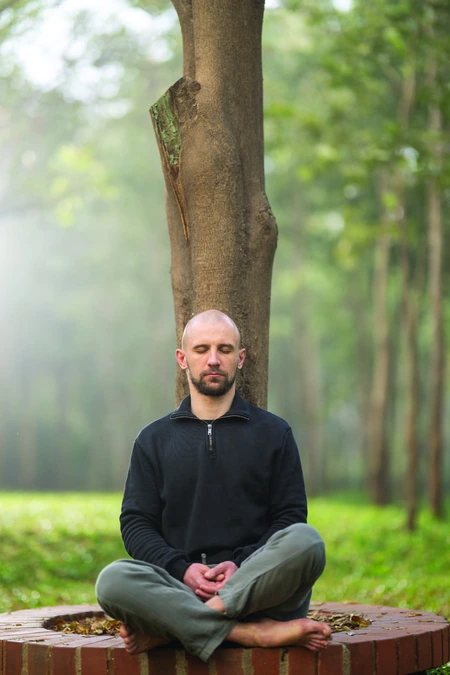
Heartfulness offers an intentional inward pause through meditation, allowing the mind to settle and fostering calmness and inner connection while removing emotional imprints using its unique Cleaning practice.
Seen through this lens, these qualities are not isolated emotions but part of an interconnected inner landscape. Consider someone who remains inwardly discontented and disturbed. Discontent may feed restlessness; restlessness may express itself as displeasure or anger, and fear may further disturb inner clarity. Most of us have experienced some version of this inner state.
Now imagine asking that same person to express compassion toward others continuously. Compassion may still be possible—but it can begin to feel like swimming against the current. Over time, the effort may become exhausting, making it increasingly difficult to express compassion naturally and consistently.
A simple prescription of Heartfulness practices addresses this core aspect, transforming our inner landscape, allowing these energy vortices to naturally flower and support the human qualities of empathy and compassion. When our inner climate is balanced and calm, we become a conduit of compassion in an authentic, effortless way, perhaps accompanied by corresponding changes in our physiology.
Being Present
As a caregiver, one of the most important lessons I have learned is the value of simply being present.
Our feelings are rooted in the present moment. I can remember holding my daughter in my arms for the first time and what I felt—but I cannot fully recreate that feeling now. It belonged to that moment.
Heartfulness practice gradually sensitizes us to this inner dimension, helping us stay connected to the heart and therefore more available to the present moment.
And perhaps being truly present is a prerequisite for compassion to find its true expression.
When our inner climate is balanced and calm, we become a conduit of compassion in an authentic, effortless way, perhaps accompanied by corresponding changes in our physiology.
Simple Practice
Before entering a difficult conversation, meeting a distressed patient or family member, responding to a child, or dealing with someone who has challenged you, pause for a moment and ask:
Do I feel balanced within?
Do I feel calm, or is there any inner turbulence?
Am I truly present?
All these questions can be addressed with a single act of connecting with our heart.

REFERENCES:
- Desai, Kunal, Patricia O’Malley, and Emily Van Culin. “Impact of Heartfulness Meditation Practice Compared to the Gratitude Practices on Wellbeing and Work Engagement among Healthcare Professionals: Randomized Trial.” PLOS ONE 19, no. 6 (2024): e0304093. https://doi.org/10.1371/journal.pone.0304093.
- Förster, Katharina, and Philipp Kanske. “Exploiting the Plasticity of Compassion to Improve Psychotherapy.” Current Opinion in Behavioral Sciences 39 (2021): 64–71. https://doi.org/10.1016/j.cobeha.2021.01.010.
- Patel, Kamlesh D. (Daaji). Spiritual Anatomy: Meditation, Chakras, and the Journey to the Center. Grand Central Publishing, 2023.
FROM HEARTFULNESS RESEARCH
Heartfulness Research studies the effects of meditation from both neuroscientific and qualitative perspectives.
heartfulnessinstitute.org/research/

Kunal Desai
