
How sankalpa becomes a natural mode of thought and aligns our actions with Nature’s work of transformation.
BY N.S. NAGARAJA AND JOSHUA POLLOCK
In this article, the third and final part of our series on sankalpa, we review the method of forming sankalpa, look at some of its applications, and finally suggest that sankalpa is not really a method at all, but an action of Nature to bring forth change—an action in which we are mere participants.
Activity always brings about change of one kind or another. By our actions we impact the world around us. We move our limbs and communicate through speech. We believe the mind's role is to control the body's actions. The mind does not act directly on the world, but indirectly, via the body. Even to interact with another mind, it must first activate the body it controls to produce effects upon the other person’s senses to reach that person’s mind. Mind, then, requires a bodily vehicle to effect any change on its behalf.
The entire working of sankalpa contradicts this commonly held notion. After all, sankalpa creates change directly, without depending on a body to carry it out. It is, therefore, a highly efficient means of producing work.
The practices of Heartfulness, including meditation, cleaning, and prayer, all turn on this principle of sankalpa.
At the beginning of meditation, we silently suggest to ourselves that the source of light within the heart is drawing us inward. This, of course, is a sankalpa.
The cleaning is a little more complex because it involves a few sankalpas, offered in a particular order. The first sankalpa is the suggestion that all impurities and complexities are leaving from the back side of our bodies as smoke or vapor. The second sankalpa is the suggestion that the process is intensifying and accelerating. Third, we suggest that a current of divine energy is entering into our hearts and illuminating every particle of our system. Finally, we suggest that we are now pure and simple, and that the cleaning has been completed effectively.
Similarly, the bedtime prayer consists of three sankalpas—one for every line. That is why we cannot rush through the prayer. If it consisted of mere words, perhaps then we could complete it quickly and be satisfied. But since it is constructed from three sankalpas, we hold on to each one for some time—long enough for its effect to blossom within us and for us to observe how our condition changes.
Sankalpa is also the method we use to stay spiritually connected between these three practices. When, as advised by Daaji, we suggest in the midst of our daily activities that “everything surrounding us is drenched or absorbed in divine remembrance, godly remembrance—the trees, the sky, the birds, persons, the ceiling, the fan, the floor and every particle around us is absorbed in godly remembrance,” we are again taking the help of sankalpa.

When the Master (or a trainer) transmits to us, the Transmission is triggered by sankalpa. The person transmitting forms a sankalpa that pranahuti [Yogic Transmission] is flowing. Depending on the capacity of the mind forming that sankalpa, Transmission can occur.
Sankalpa is therefore the key that unlocks every spiritual condition and the catalyst behind every transformation. That is why, in the first part of this series, we called it “the method within the method.” So, let us review the method:
Sankalpa can be formed for our own inner development or for another’s; the principle of formation is the same. As an example, we may offer the simple suggestion, “May love develop in this person’s heart.” The words give shape to the suggestion, and the heart offers it prayerfully.
After offering a sankalpa to God, we should remain sensitive to the heart’s response. At times, the sankalpa we have formed may not feel quite right, or the heart may feel pulled toward a different suggestion. In such cases, we should follow the heart. The first sankalpa may have reflected our own limited perspective, while the heart receives a hint from above that the work needs to proceed in another direction… remain open to such correction. When this happens, it is perfectly all right to revise the sankalpa and offer it to God.
Once we form the sankalpa, we then continue to rest our attention upon it… It means patiently waiting for the intended effect to emerge. In forming the sankalpa, we knocked upon the door. Now we wait for an answer. We do not keep knocking by repeating the words like a mantra, forcing a visualization, or mentally checking for progress. Patient waiting means remaining receptive until the intended effect becomes perceptible. At first, nothing may be felt. Still, the heart remains open and receptive. We simply wait.
If our attention drifts, we do not form the sankalpa again and again. The sankalpa is already active. Instead, we simply reconnect with it at the level of feeling, with the heart, and resume our patient waiting. Gradually, the intended effect takes form, and we begin to sense the effect. Sankalpa can now be understood in practical terms: a suggestion formed, offered prayerfully, and held through patient waiting.
When, as advised by Daaji, we suggest in the midst of
our daily activities that “everything surrounding us is drenched or
absorbed in divine remembrance, godly remembrance—
the trees, the sky, the birds, persons,
the ceiling, the fan, the floor and every particle around us
is absorbed in godly remembrance,”
we are again taking the help of sankalpa.
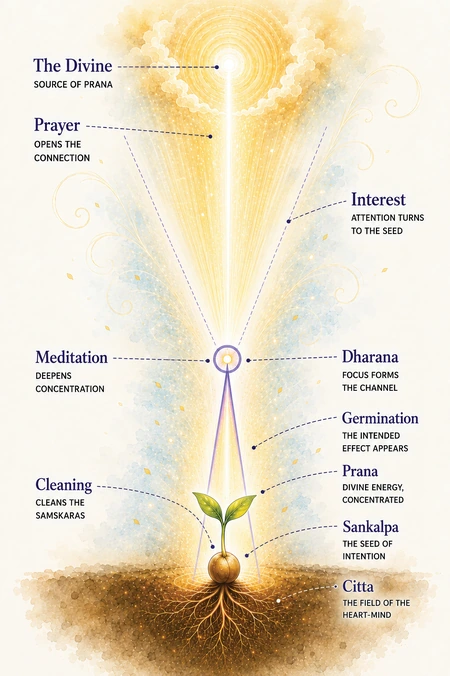
We can picture the working of sankalpa as the growth of a seed. The field is citta, the heart-mind. Clear, open, and receptive, it is like fertile soil. Into this field we sow the seed of sankalpa: the intended condition held in potential, waiting to take form. Practicing Heartfulness cleaning helps keep this soil from becoming crowded with unwanted seeds of intention—the samskaras [impressions].
Taking interest in the sankalpa directs our attention toward the seed. As interest intensifies, it develops into dharana [concentration], forming a steady channel of attention toward the sankalpa. Meditation develops our capacity to form and sustain this channel.
Through this channel, our attention concentrates prana [divine energy] upon the seed. Prana activates and nourishes the seed, and gradually the sankalpa germinates and its intended effect becomes perceptible. The connection established through prayer facilitates the invocation of divine support in the form of prana.
Though we speak of sankalpa as a technique to be performed, as a method to be mastered, it is truly a disposition of mind. As we regulate the mind through meditative practice, we naturally become comfortable with the quality of thought that is used in sankalpa. This quality is unique, as it involves a particular kind of focused attention that is relaxed and nearly effortless. These are qualities of a meditative mind. And for a meditative mind, sankalpa becomes a natural mode of thought. Hence, the meditative mind becomes useful for special kinds of work.
Do you remember from Part I that the prefix san means “with”? This prefix indicates that two forces are in action. It is a joining of our will to the Divine Will and our thought to the Cosmic Mind, and a surrender of our action to divine action. Ultimately, the technique of sankalpa is an aspect of Nature’s work that involves our participation.
In our everyday experience, it may seem that the mind belongs to us alone and is for us alone. But a human mind, regulated through steady practice and oriented toward the highest, divine principle, becomes transformed. No longer a merely personal instrument, it becomes an unfailing tool of Nature. Nature’s impulses descend, spontaneously and unimpeded, into the receptive heart, taking shape as sankalpas and blossoming in natural fulfillment.
Within this grand dynamic of Nature, forming a sankalpa is our small yet critical part to play. It is a simple offering, a duty, and perhaps, a human privilege. The main point, though, is that sankalpa is natural to us. It is innate. Yes, we may struggle with sankalpa at first. And this is to be expected. We are not accustomed to using the mind that way.
Furthermore, the mind has been misdirected, mistrained, and overindulged, day after day and year after year. But with even a little practice, it soon clicks. It just happens, like a baby who suddenly knows how to roll over. We soon begin to discover the mind’s natural, higher function: a universal agent of action and change. A new journey unfolds, and we gradually find our footing on the path to our deepest purpose.
FROM HEARTFULNESS INSTITUTE
The Heartfulness Institute is a global not-for-profit offering heart-based meditation, a yogic practice for inner well-being and collective harmony.
heartfulness.org/global


NS Nagaraja
NSN is founder and CEO at Sensei Technologies. He has been practicing Heartfulness meditation for 20+ years and is deeply interested in the science of spirituality, software architecture and design philosophies. He also works with Bright... Read More
Joshua Pollock
Joshua Pollock is co-author of The Heartfulness Way, an international bestseller available in twenty languages, and Editor-in-Chief of Heartfulness Magazine. He has also performed as a featured v... Read More
