SAM RAPOPORT has always loved the
Great Outdoors, but thanks to COVID and a new friend, he discovers how to
appreciate Nature closer to home, even in his own backyard. It also had an
impact on his own inner world, the Great Inner Space.
I found my favorite T-shirt in a thrift store, faded red with swooping
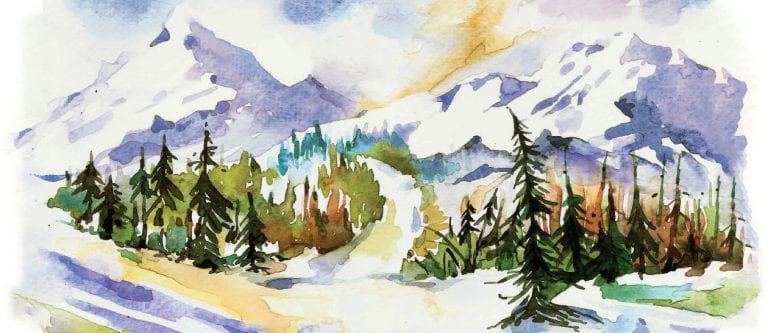
ski-town font “Explore the Great Outdoors,” an outline of snow-capped
mountains looming over a pine forest and a winding road. This was the
iconography of Nature with a capital “N” that I worshipped, as I took
pilgrimages through the breathtaking valleys of Glacier National Park, the
desert canyons of Zion, and the thick woods of the Cohutta Wilderness. In
my mind, Nature was always pristine, always “out there” away from the city
of Atlanta where I lived. Hiking was about trudging through miles of
monotonous south-eastern forest to reach a stunning mountain top view or
swimming hole. Whether it was a river valley or hilltop, North Georgia or
suburban park, the woods in between me and my destination always blended
together: brown, boring, peppered with trees. That is, until I met
Kathryn.
Kathryn ran a nonprofit in Atlanta called EcoAddendum, which focused on
showing residents the value of the ecosystem around them and taking action
to protect it. She took the outdoors club I ran at my university for
nature walks in nearby parks and showed us how to identify native trees by
their leaves, their bark, the sheen of their acorns. She pointed out
invasive species that, if left unchecked, would smother every other plant
in sight and wreak havoc on the entire ecosystem. Armed with snippers and
shovels, trees choked by English Ivy and wetlands covered head to toe in
Japanese Chaff Flower became battlefields in the fight for biodiversity.
Previously uniformly unremarkable terrain turned into a narrative of
diverse microbiomes, of floodplains and upslopes, sunny sides, and
watersheds. Fallen fences and towering oak trees told tales of farmers
living there centuries ago, clearing a pasture for their livestock but
leaving the oak tree, providing shade before air conditioning and acorns
for the pigs to forage.
Just as the natural world around me changed by the day and week and
season, so too did my inner world. Putting myself in the beauty of the
world below my feet and in front of my eyes allowed me to leave
the whirlwind inside my head, if only for the time it takes to watch the
winged fruit of a maple spiral to the ground.
There were oaks older than our Declaration of Independence, older than
borders and nations and steam engines. Steep slopes that prevented farmers
from ever tilling the land, leaving the old-growth soils intact, and
harboring rare species like Trillium and wild ginger that only spread
their offspring on the backs of ants, traveling only meters over the
course of decades. If the soil was disturbed, these sensitive species
would die off, and would never be able to return nor escape to new lands –
ants have a hard time outrunning a bulldozer.
Hearts a bustin’, we learned to love these wild places. Accessible but
irreplaceable, these old-growth forest remnants were right in our
backyards, yet from a surface glance would be indistinguishable from any
other backwoods. I recognized the diversity and beauty of these hidden old
growth treasures, and at the same time, discovered a greater appreciation
for my own backyard. From my lawn, I harvested Plantago, a salve for burns
and bug bites, and not bad in a salad. I foraged for blackberries down the
street, bringing home buckets laden with sweet summer treats for my
neighbors and myself.
That same urge for exploration previously made me upset about visiting
the same space twice: If there were so many amazing things to see in the
world, why would I waste my time on somewhere I’ve already been? A global
pandemic combined with looking through Kathryn’s eyes allowed me to change
that view. Over the course of the past year, I’ve walked the same blocks
of my neighborhood thousands of times and run the same loop through
Piedmont Park dozens and dozens of mornings. I have come to realize that
just as two forests are never the same, a walk through the woods is never
the same twice.
When I was in the mindset of noticing, of slow appreciation, I found so
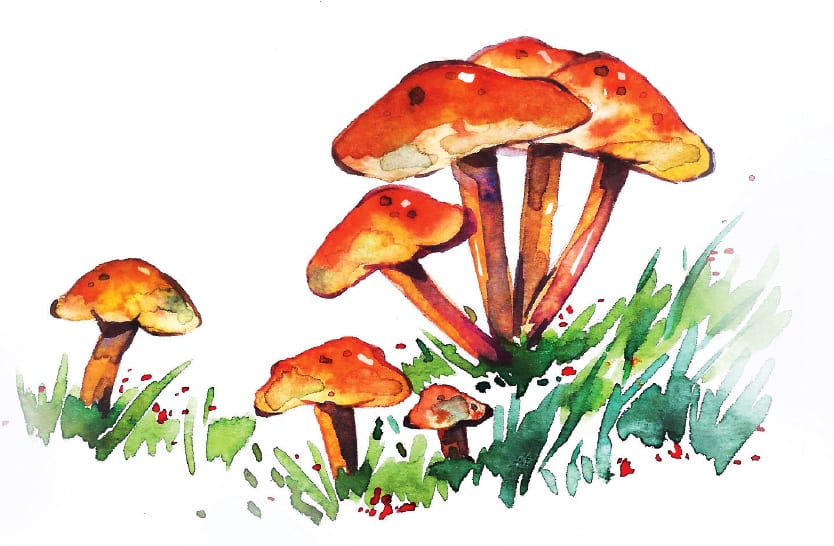
many wonderful joys of life in front of me: A family reunion of mushrooms
after the rain, the slow maturing of my neighbor’s fig tree, the gorgeous
carpet of redbud blossoms on the sidewalk growing thicker by the week.
Beauty and awe are not a function of how spectacular the sight is, but an
internal matter of awareness and appreciation. Just as the natural world
around me changed by the day and week and season, so too did my inner
world. Putting myself in the beauty of the world below my feet and in
front of my eyes allowed me to leave the whirlwind inside my head, if only
for the time it takes to watch the winged fruit of a maple spiral to the
ground.
![]()
Exploring the Great Outdoors can bring joy and amazement, but so too can
exploring the Great Inward space of ourselves.
I found there was no longer a great divide between the Great Outdoors and
the world outside my back door, both boasting tremendous tulip poplars and
the scurrying of squirrels. Exploring the Great Outdoors can bring joy and
amazement, but so too can exploring the Great Inward space of ourselves.
If you ever find that on a thrift store T-shirt, please, please let me
know.
Article by
SAM RAPOPORT
Illustrations by ARATI SHEDDE