
Why does communication break down during conflict, and how can patience, tolerance, and self-discipline help us maintain mutual respect through disagreement?
By Dr. Ichak Adizes
At Adizes Institute, we teach, train, and promote organizational health.
What is organizational health?
Integration is the sign of health. There is no loss of energy. The system functions fully. A disintegrated company signals poor organizational health. To heal organizations, we train people to reintegrate the company. We call them Certified Symbergetic™ Organizational Therapists.
Why don’t people reintegrate on their own? Why does it require training and even certification? What is the problem?
The problem is that, for sustainable integration, a culture of mutual trust and respect is indispensable. But it is very difficult to act with mutual respect during conflict.
I see couples screaming at each other, talking at the same time, and then complaining that they don’t communicate well.
Why does communication break down? There are many reasons. I present one here.
In Hebrew, when we write, we use only consonants. Through education and experience, the reader adds the vowels. Every word has a source expressed in three consonants. Those consonants reveal the word’s source, which helps explain its meaning.
I found that the Hebrew words for patience, tolerance, and pain have the same three consonants as their source: SVL. The difference lies in the vowels.
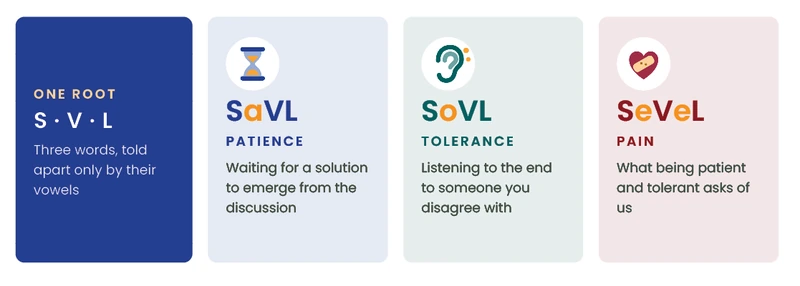
Here is how I believe they are related.
Respecting and interacting with someone who disagrees with you, and waiting for a solution to emerge from the discussion, requires PATIENCE.
But being patient is not enough.
You must also listen until the end to what someone you disagree with has to say. That requires TOLERANCE.
And being patient and tolerant while listening to someone you disagree with is PAINFUL. Especially for (P) and (E) styles. For (E)s, the pain is having to listen patiently to someone with whom you disagree. For (P)s, the pain is listening to something that doesn't produce immediate results.
A leader, if s/he is going to be an integrator (someone who creates a learning environment and practices mutual respect), must be trained to take pain and, as a result, be patient and tolerant.
That happens when we recognize the other party’s sovereignty. We do this by being patient enough to hear the other party to the end, tolerant of what we hear, and not immediately jumping to express our disagreements. During the discussion, avoid glancing at your watch or showing any pained facial expressions.
For that, self-discipline is required. There is no good communication without discipline.
Here is a short sample of how the Adizes Symbergetic™ Management methodology trains people to be patient, tolerant, and to handle pain.
The moment someone starts interrupting another person who is speaking, the more conscious and self-controlled person—even if not directly involved in the discussion—should immediately shout, “Hard Rules!” The parties must then comply.
THE PRACTICE
Hard Rules
Hard Rules: one person speaks, and no one may interrupt. When the speaker finishes and is the only one who knows they are finished, they pass the right to speak to the next person on their right. Notice: call the first person on the right even if that person raised his hand to speak last.
This requires (E) and (P) styles to wait for their turn to speak. That develops PATIENCE. In the meantime, as they wait their turn, they learn from others something they hadn’t considered, and it increases mutual respect. By not interfering with what others are saying, waiting their turn to speak, and learning something from others in the process, they develop TOLERANCE. And now here it is: how to reduce PAIN.

One cannot stop having pain by listening to someone who says things that you strongly disagree with. Since you cannot stop having pain, you need to learn how to control the pain.
One releases the pain by showing it, by speaking in high tones and interrupting the other person.
In Adizes, we free the pain not through the mouth but through the hands. In a meeting, you must have paper and pen. Write down how you feel because of the pain you have, like “This is nonsense... this is really upsetting me.” Get all your emotions out on paper, but never share that page. By writing how you feel, you free yourself from those feelings. Try it.
Also write down your questions, doubts, and disagreements about what is being said. Then present only questions as questions. When you finish with questions, present your doubts as questions too, and when that is done, you might present your disagreements. This time should not be as a question, but a presentation presented quietly and respectfully.
If you can communicate patiently, tolerate differences in arguments or conclusions, and express your pain in writing that no one will see, you can have positive, constructive communication.
Good luck. I hope this helps.

Ichak Adizes
Dr. Adizes is widely acknowledged as one of the world’s leading management experts. He has received 21 honorary doctorates and is the author of almost 30 books that have been translated into 36 languages. Dr. ... Read More
