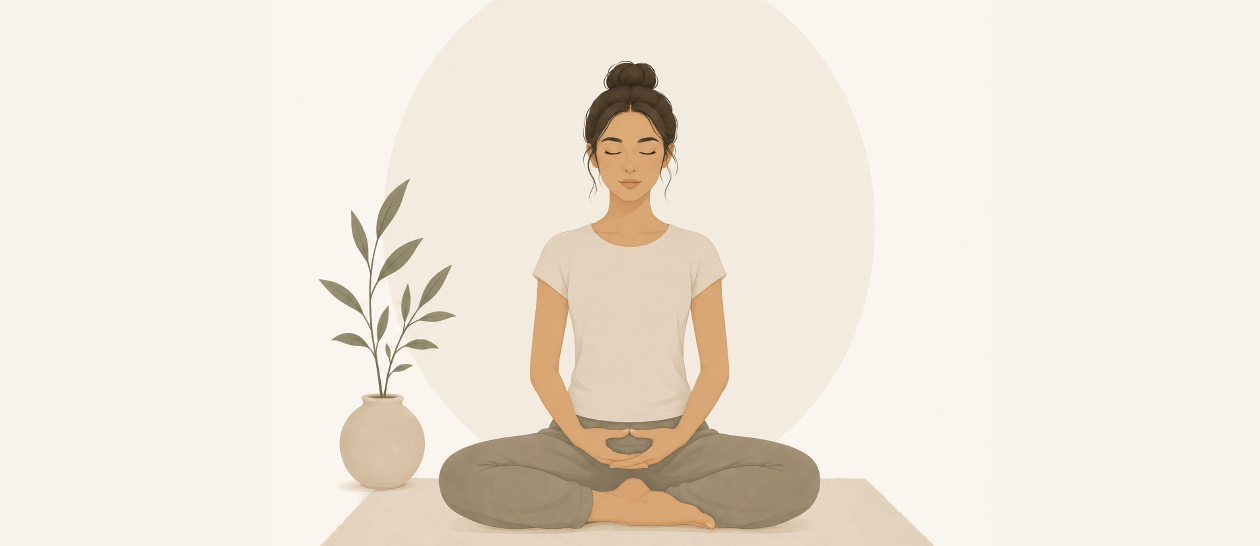
A yoga teacher reflects on how asana practice deepens when the pursuit of progress gives way to breath awareness, embodied presence, steadiness, ease, and conscious living.
BY VIDHYA S. VIJAYAN
When I first began asana practice, my body moved with ease. Flexibility was never a challenge for me. Most postures came naturally, and I found deep joy in exploring them. I would move from one asana to another with curiosity, trying, learning, and going deeper. There was excitement in discovering what the body could do, and over time, that naturally led me toward more advanced postures.
This felt like growth—like progress—and in many ways, it was. Yet, without realizing it, my practice slowly became centered around activity: doing more, going deeper, reaching the next posture.
Nothing in my body was hindering me. There was no discomfort forcing me to slow down. Everything felt perfectly smooth. Perhaps that is why I did not notice what my practice was lacking. I was moving through the asanas but not fully embodying them.
At that time, I knew how to assume a posture, hold it, and transition out of it. But I had not yet learned how to live in a posture with awareness, sensitivity, and breath. My attention was often on where I was going next rather than on what was unfolding in the present.
Looking back, I realize this pattern was not limited to yoga alone. Nor was I alone in this. Many of us live, moving from one task to another and from one achievement to the next, constantly progressing, but rarely allowing ourselves to fully inhabit the present moment. We become so focused on movement that we lose touch with presence.
The shift in my journey began when my teacher introduced me to the Krishnamacharya tradition. To be honest, the transition was not comfortable. For a period of time, I felt as though I had lost something. The certainty with which I had previously approached my practice and my teaching was now shaken. I had never experienced such a lack of confidence.
This new approach was asking me to unlearn what I thought I knew for sure. Not superficial things, but deeper assumptions and attitudes I had carried for years.
Adding more knowledge is easy; learning to see differently is a challenge!
I remained in that space of uncertainty for a long time. But gradually, instead of resisting it, I began to surrender. I allowed myself to become a student again. That is when the practice began to reveal its depth.
“Many of us live, moving from one task to another and from one achievement to the next, constantly progressing, but rarely allowing ourselves to fully inhabit the present moment.”
I began to understand what it means to truly breathe in an asana, not as a separate technique, but as something inseparable from the movement itself. I began to recognize the importance of preparation: how we must prepare not only the body but also the mind as we enter any posture. I discovered the value of pauses—the silent spaces between the movements where observation deepens and awareness becomes clearer.
Even the way I understood sequencing began to change. I learned how one posture prepares the body for the next, how counterposes restore balance, and how thoughtful progression creates steadiness and avoids strain.
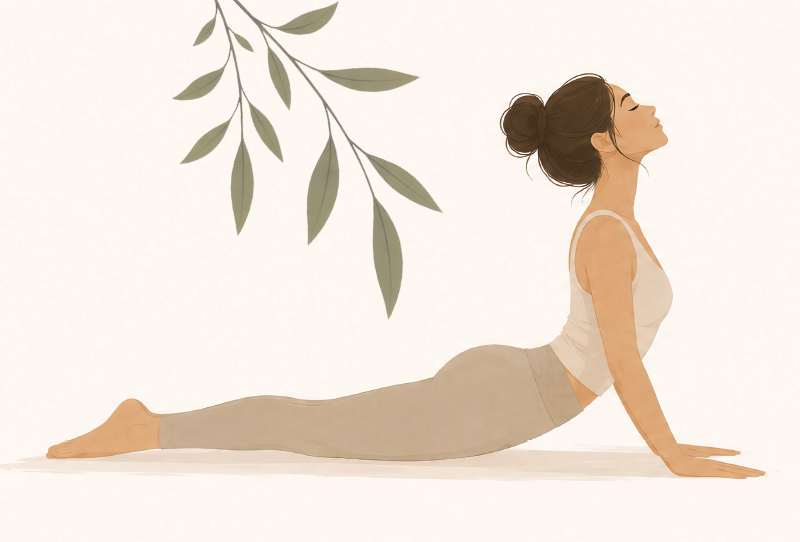
These were not mere technical learnings; they reflected a deeper intelligence intrinsic to the practice itself, supporting not only the body but also the mind and inner state.
The moment I began understanding the essence of this approach, it no longer felt as though I had to choose between what I had learned before and what I was learning now. Integration happened naturally. What I had learned earlier did not lose its value. Rather, my flexibility, familiarity with postures, and experience of movement all found a deeper foundation through my new awareness.
Gradually, Patanjali’s words, sthira sukham asanam [posture should be steady and comfortable], began revealing themselves to me in a new way.1
For years, I had understood this sutra in its simplest sense: an asana should feel steady and comfortable. But through my new understanding, I began to sense that Patanjali was pointing toward something far deeper than physical posture.
How often do we move through life with neither steadiness nor comfort, always rushing, reaching for what’s coming next, and carrying tension, even in moments of rest?
I began to understand that steadiness is not simply the ability to hold the body still. It is the ability to remain present within ourselves. I understood that comfort is not merely physical ease, but the sense of connection that arises when breath, attention, and awareness come together.
"Awareness changes the quality of everything. A complex asana may look refined from the outside, but without attention, it remains superficial. At the same time, even the simplest movement can become deeply transformative when approached with presence."
Over time, I began to experience this balance when I wasn’t on the mat. I found it in the way I spoke, the way I listened, the way I responded to uncertainty, and even in the way I held silence. To move through life with both steadiness and ease is itself a practice. Perhaps this is what asana practice was trying to teach me all along.
Awareness changes the quality of everything. A complex asana may look refined from the outside, but without attention, it remains superficial. At the same time, even the simplest movement can become deeply transformative when approached with presence.
This understanding extends far beyond yoga. In many areas of life, we are taught to value progress, achievement, speed, and outward growth. Rarely are we taught how to pause, observe, and fully experience what is happening within us. Yet without that awareness, even success can begin to feel empty.
Today, whether I practice a simple or an advanced posture, the question is no longer “How far can I go?” Instead, it is, “How present can I be here?”
That question continues to change my relationship with practice and with life. It suggests that the real purpose of practice may not be mastery. Perhaps it is learning how to be fully present in our own experience—even in our failures.
Asana practice is where this learning began, and I continue learning it each time I return to the mat, one breath at a time.
FROM THE HEARTFULNESS YOGA ACADEMY
Heartfulness Yoga Academy offers accredited, tradition-rooted programs that integrate asanas, pranayama, and Heartfulness Meditation with Yogic Transmission for a holistic approach to yoga.
yogaacademy.heartfulness.org
1 Patanjali, Yoga Sutra 2.46, translation adapted by the author.

Vidhya S. Vijayan
Vidhya S. Vijayan is a senior yoga teacher at Heartfulness Yoga Academy, rooted in the Krishnamacharya tradition, where her teaching emphasizes breath, awareness, and individualized practice. She conducts retreats, training, and wellness... Read More
