Voices of a New Generation:
Two Winning Essays from the 2025 Heartfulness Essay Event
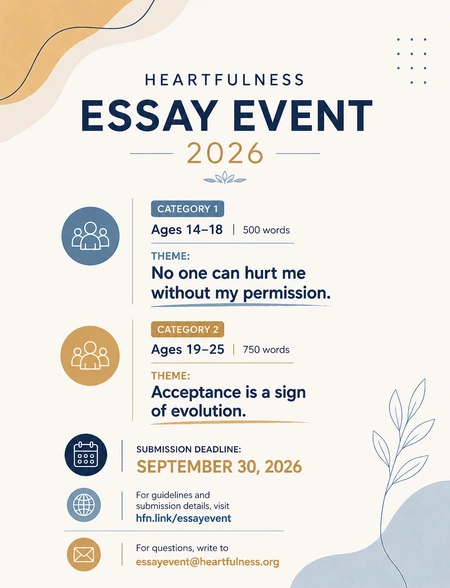
Each year, the Heartfulness Essay Event invites young people to reflect on questions that touch their lives and express their discoveries in their own words. In the following pages, we share two of the winning entries from 2025. As the 2026 event gets underway, we hope their voices will inspire others to take part. Entries for this year’s event are open to young people aged 14–25, with submissions due by September 30, 2026.

HEARTFULNESS ESSAY EVENT 2025
CATEGORY 1 WINNER | AGES 14–18
Individual Evolution Is Not Possible without the Support of Others
BINEET DWIVEDY
Delhi Public School, Nalco Nagar, Angul, Odisha
A lone tree, no matter how magnificent its trunk or expansive its canopy, is ultimately vulnerable. It stands against the relentless winds and scorching sun, its roots battling alone for sustenance in the unforgiving soil. But a forest, a collective of trees, thrives. Their roots intertwine, sharing nutrients and water. Their canopies form a protective shield, tempering the harshness of the elements. In this profound image lies the unshakeable truth: individual growth is not possible without the collective support of the community. This truth is woven into the very fabric of our being, a spiritual law as real as gravity. We are not designed to be isolated islands, but rather integral threads in a vast, vibrant tapestry. To believe we can ascend to greatness alone is a delusion born of ego. True greatness, the kind that resonates with the soul, is always a product of shared journeys and communal embraces.
I am reminded of my youth as an aspiring dancer. I had a gift: my legs could conjure up moves that could stir the depths of the audience’s heart. But I was plagued by a crippling fear of failure. I would practice graceful moves, only to crumble into a ruin of self-doubt. My talent was a bird in a cage of my own making. Then, I found my tribe. I joined a local dance group, a motley crew of dancers and dreamers, just like me. They didn’t just see my grooves; they saw my soul. They became my appreciation board, my critics, and my most fervent cheerleaders. When I faltered, they didn’t just offer platitudes; they shared their own stories of rejection and perseverance. When I finally performed on a small stage, shaking and pale, it wasn’t just my dance that filled the room. It was the collective energy of my community, a silent chorus of encouragement that lifted me, step by step, into my own power.
Today, my performances are not just my own; they’re a testament to the love and support that nurtured my genius.
This spiritual truth extends beyond creative pursuits. Think of the solitary student burning the midnight oil, wrestling with a complex problem. How often has a simple explanation from a peer, a shared cup of coffee in a library, or the quiet presence of a study group unlocked a door that felt impossibly locked? We are all interconnected. Our joys are amplified when shared; our sorrows are halved when borne by others. The individual spirit, when nourished by the collective heart, blossoms into a force of unimaginable beauty and strength. The lone tree may stand, but the forest endures. The collective provides the fertile soil, the shared sunlight, the protective canopy, allowing each individual tree to grow taller, stronger, and more beautiful than it ever could have alone. Our growth, our healing, our very becoming, is not an isolated act, but a sacred, communal dance. It is in the loving embrace of our community that we truly find ourselves.
HEARTFULNESS ESSAY EVENT 2025
CATEGORY 2 WINNER | AGES 19–25
Being in Tune with Nature Is a Prerequisite for Human Evolution
ANAND M.
Vasavi Jnana Peetha First Grade College, Bengaluru, Karnataka
When we think of human evolution, we often imagine the past—our ancestors gradually rising from primitive beings to the intelligent, complex species we are today. But evolution isn’t something that ended thousands of years ago; it is an ongoing process. The real question is: in which direction are we evolving now? Is it enough to develop faster technology, stronger economies, and smarter machines? Or is there something deeper required: a shift in our consciousness, values, and way of life? I strongly believe that being in tune with nature is not just desirable but a prerequisite for true human evolution.
This belief is not just theoretical for me. It’s rooted in personal experience.
I spent most of my life in a fast-paced urban environment, surrounded by concrete, pollution, and noise. Nature was something distant, a place we went to for vacation or a background for social media pictures. But that changed during a two-week stay at an eco-village nestled in the Western Ghats. What started as a volunteering trip ended up transforming the way I viewed life.
There, I saw people living in harmony with the Earth. They grew their own food, used solar energy, harvested rainwater, and minimized waste. Life was simple but full of meaning. Every small act—watering a plant, composting kitchen scraps, watching the sunset was done with mindfulness and respect for the natural world. For the first time, I felt a deep sense of peace and connection. I wasn’t escaping from the world; I was reconnecting with it.
That experience made me realize how disconnected modern society has become from nature, and how that disconnection is harming not only the planet but also our inner lives. We chase success, speed, and convenience, but in the process, we’ve forgotten something essential: that we are not separate from nature; we are nature.
Human evolution is not only about intelligence or innovation; it is about growing in awareness, compassion, and harmony, and nature is our greatest teacher in that journey.
Look around: everything in nature works in balance. Trees give more than they take. Rivers flow without greed. Animals live without destroying their environment. Nature operates through cooperation, regeneration, and cycles—principles we must relearn if we are to evolve consciously. When we live in tune with nature, we absorb these values intuitively.
Scientific studies have shown that being in nature improves our mental health, reduces stress, and boosts creativity. Even a walk in a park can reset our nervous system. This isn’t just coincidence; it’s a sign that we are biologically and psychologically designed to coexist with the natural world. To ignore this connection is to ignore a fundamental part of who we are.
Sadly, modern development often moves in the opposite direction. Forests are cleared for cities, rivers are polluted for industries, and the air we breathe is filled with toxins. We call this progress, but at what cost? Climate change, species extinction, natural disasters: these are not just environmental issues; they are signals that our way of life is out of balance.
If we continue to live against nature, we may survive technologically, but we will regress spiritually and emotionally. True evolution requires more than survival. It calls for wisdom. And wisdom comes from recognizing that the Earth is not a resource to exploit but a living system to honor and protect.
Being in tune with nature does not mean we have to abandon modern life. It means changing our relationship with the planet. It means designing cities with green spaces, developing clean energy, supporting sustainable agriculture, and adopting lifestyles that tread lightly on the Earth. It means listening, really listening to the rhythms of the natural world and aligning ourselves with them.
Since my time at the eco-village, I’ve made small but meaningful changes in my own life. I started composting, reduced plastic use, grew herbs on my balcony, and spent more time outdoors. More importantly, I began to slow down and pay attention to the sound of birds, the feeling of wind, the changing colors of the sky. These are simple things, but they have brought a sense of grounding and clarity that no screen or gadget ever could.
In the end, evolution is not just about where we go next as a species. It’s about how we go there. Will we become more mindful, compassionate, and wise? Or will we drift further from the very source that sustains us?
The answer, I believe, lies in nature.
Being in tune with nature is not a romantic ideal; it is a biological, emotional, and spiritual necessity. If humanity is to evolve meaningfully, not just in technology but in consciousness, we must return to the Earth, not as masters, but as humble students. Only by reconnecting with nature can we rediscover our true potential and take the next step in our evolutionary journey.

Gyaneshwar Sarin
With three decades of professional experience in the corporate sector, Gyaneshwar Sarin now works as a consultant. His association with Heartfulness goes back to 1980, and he volunteers his services as Director of Heartfulness School Pro... Read More
