Emerging Research from Bengaluru, India Offers Clues
What a study comparing novices, proficient meditators, and non-meditators tells us about well-being, stress, and the neuroscience of inner calm.
BY KRISHNAMURTHY JAYANNA
You’ve probably heard that meditation is good for you. Maybe a friend swears by it. But is there real science behind the claim?
A team of researchers at the National Institute of Mental Health and Neuro Sciences (NIMHANS), a premier research institution in Bengaluru, India, decided to find out. They studied practitioners of Heartfulness meditation, a technique with millions of followers worldwide, measuring not just how people felt after meditating but also what was happening in their brains. The results, published in Consciousness and Cognition, offer fascinating clues and raise questions as intriguing as the answers they provide.1
What Is Heartfulness Meditation?
In Heartfulness meditation, practitioners gently bring attention to the heart rather than monitoring thoughts, focusing on the breath, or scanning the body for tension. They then do nothing deliberately, assuming a passive, receptive role and allowing what the Heartfulness tradition calls Yogic Transmission to guide them toward deeper states of awareness. The practice relies on receptivity rather than effortful concentration. This passive quality is unusual among meditation techniques, and as we’ll see, it may help explain some of the study’s findings.
Who Was Studied?
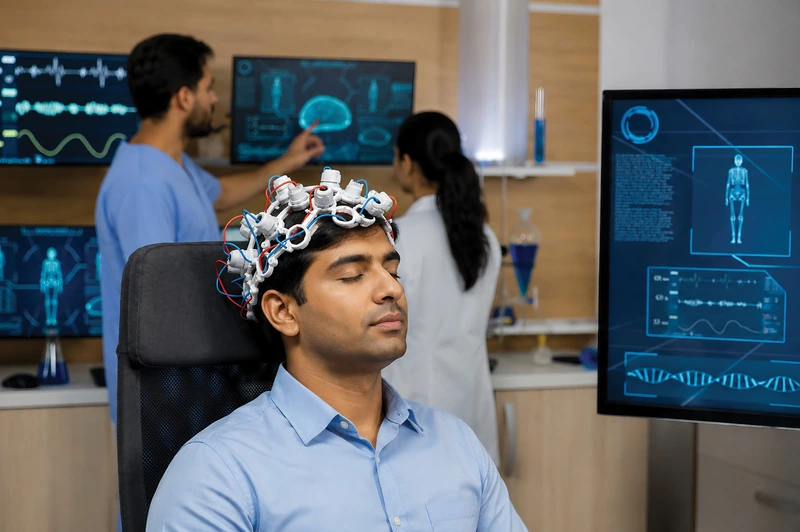
Researchers recruited three groups of men: proficient meditators (24 people, with an average of 18 years of experience), novice meditators (24 people, with between 5 and 16 months of practice), and non-meditators (15 people). All were college-educated and of similar socioeconomic backgrounds. NIMHANS researchers were blinded to the meditators’ proficiency levels and sociodemographic information during data collection. Participants underwent high-density electroencephalography (EEG) recording using 128 scalp sensors and completed questionnaires assessing stress, life satisfaction, emotional well-being, and mindfulness.
Proficient meditators scored
significantly higher on life satisfaction,
positive emotions, and general well-being
than both novice meditators and
non-meditators.
What Did They Find?
Well-Being, Emotions, and Life Satisfaction
Proficient meditators scored significantly higher on life satisfaction, positive emotions, and general well-being than both novice meditators and non-meditators. Interestingly, novice meditators reported significantly more negative emotions than both the proficient meditator group and non-meditating controls, and higher perceived stress than proficient meditators.
The researchers suggested many novice meditators may have started precisely because they were already struggling; higher distress may have been the reason they enrolled. The proficient meditator group reported greater life satisfaction than those who never meditated, suggesting a strongly upward trajectory. However, this needed to be correlated with other findings to gain a clearer picture.
The Meditating Brain: What EEG Revealed
All three groups showed measurable brain changes during meditation, including non-meditators who simply observed their breath. The EEG recordings revealed one notable group difference: proficient meditators showed higher occipital gamma activity during meditation than controls. This was notable because the occipital region (the back of the head) is primarily associated with visual processing, even though the participants’ eyes were closed.
Occipital gamma has been associated with both perceptual binding—the integration of separate streams of experience into a coherent whole—and heightened inner awareness. The researchers note a similar pattern in long-term Vipassana meditators, with the increase in gamma power strongest in the most advanced practitioners. The Heartfulness tradition also gives the occipital region particular spiritual significance: Ram Chandra of Shahjahanpur [Babuji] describes the occipital prominence at the back of the skull as corresponding to the ultimate spiritual reality toward which the practice leads.2
Meditative State: Novices Meditate Like Experts
Brain activity during meditation showed no statistically significant difference between novice and proficient groups on the measured EEG parameters. Within the Heartfulness framework, one possible interpretation is that Transmission may help beginners enter meditative states without years of practice. The study did not test Transmission independently, so it cannot identify it as the active ingredient. The occipital gamma difference found only in proficient meditators may be associated with long-term practice, although the cross-sectional design cannot show how it developed.
The Meditative State and the Meditative Trait: Two Different Things
The EEG recorded brain activity during meditation, while the questionnaires assessed broader aspects of daily well-being—how a person feels in daily life, at work, in relationships, and under pressure. That novice meditators showed similar brain patterns to proficient meditators during practice, yet still reported higher everyday stress, suggests that the meditative state and meditative trait are distinct. One may be accessible early; the other accumulates slowly. The calm of practice has not yet seeped into the rest of life, but in the proficient meditator group, it seems to have.
Beyond the Mind and Cognition: What Meditation Really Is
All three groups scored similarly on mindfulness—proficient meditators, novice meditators, and non-meditators alike. Heartfulness works on dimensions beyond conventional cognition, such as emotional regulation and deeper states of consciousness. Another insight is that mindfulness is perhaps less a destination than a transitory state, an early accessible state marking the beginning of a longer inward journey.
Heartfulness can be said to begin with the mind, since meditation starts by directing awareness to the heart. However, its stated deeper aspiration is to move beyond the mind, an outcome said to be achieved through the heart. In this tradition, true meditation is not about managing thoughts or sustaining focus. It is about accessing a deeper sense of being—states of consciousness beneath and beyond ordinary mental activity. The unique gamma-wave signature of proficient meditators may be a neural whisper of inner states that accumulate over years of going ever deeper.
True meditation, in this tradition, is not about
managing thoughts or sustaining focus.
It is about accessing a deeper sense of being—
states of consciousness beneath and
beyond ordinary mental activity.
Study Limitations
This was a cross-sectional pilot study—a snapshot in time—and its findings warrant further research. The authors recommended longitudinal, controlled research following novice meditators over time to distinguish effects associated with practice from preexisting differences between participants. They also called for tools and methods suited to the philosophy of the practice and for lived experience and phenomenology to be integrated with quantitative measurement. Such efforts are underway, including design and testing of a consciousness scale to capture deeper changes that occur over long periods of practice.3
What the Study Suggests
Despite its limitations, this research points in a consistent and meaningful direction. The differences associated with long-term Heartfulness practice are real and measurable: proficient meditators reported significantly greater well-being and showed a distinctive pattern of occipital gamma activity. The lack of significant EEG differences between novice and proficient meditators also suggests that the practice’s passive, receptive nature allows even beginners to access genuine meditative states early, while deeper transformations take years to establish.
The study also hints at something more fundamental: that profound meditation is not about controlling the mind, sustaining focus, or even achieving calm—but about moving gently beyond, toward the heart and the states of being that lie deep within.
FROM HEARTFULNESS RESEARCH
Heartfulness Research studies the effects of meditation from both neuroscientific and qualitative perspectives.
heartfulnessinstitute.org/research/
References:
- Sylapan, Bhuvnesh Sankar, Ajay Kumar Nair, Krishnamurthy Jayanna, Saketh Mallipeddi, Sunil Sathyanarayana, and Bindu M. Kutty. “Meditation, Well-Being and Cognition in Heartfulness Meditators – A Pilot Study.” Consciousness and Cognition 86 (November 2020): 103032.
- Ram Chandra of Shahjahanpur, “Central Region,” in Complete Works of Ram Chandra, vol. 1, 5th repr. (Kolkata: Spiritual Hierarchy Publication Trust, 2009), 164.
- Jia, Yuane, Margaret Schenkman, Hester O Connor, Krishnmurthy Jayanna, Rosalind Pearmain, Annelies Van’t Westeinde, and Kamlesh D. Patel. “Validation of the Awareness Atlas—A New Measure of the Manifestation of Consciousness.” Frontiers in Psychology 15 (2024): 1283980.

Krishnamurthy Jayanna
