
An exploration of ahimsa as a foundational principle of Ashtanga Yoga, through which we cultivate inner harmony, compassion, and kindness in thought, word, and action.
BHUSHAN BHUKTE
In a world where conflict is no longer distant—where violence enters our homes daily through the news—Patanjali’s first teaching takes on particular urgency. Ahimsa, often translated as nonviolence, is the first of the five yamas [ethical restraints] in Ashtanga Yoga. However, its true essence goes far beyond avoiding physical harm. Rather, ahimsa is a way of being, where one lives in complete harmony with oneself, others, and the universe. It is the cultivation of such inner balance that violence cannot arise at any level of activity—the main ones being manasa [thought], vacha [word], and karmana [action].
Understanding Ahimsa at a Deeper Level
Ahimsa, at its core, is not suppression of aggression but a transformation of consciousness. When the mind is disturbed by anger, greed, or insecurity, violence becomes inevitable. But when the mind is calm and content, compassion flows naturally. How, then, can there be violence?
Thus, ahimsa is not an external rule to be followed, but an inner state of being; it is not forced kindness, but a spontaneous flowering of compassion; it is not weakness, but strength held in natural restraint.
The Inner Roots of Violence
Yoga teaches that all external conflict begins within. Negative emotions such as anger, jealousy, fear, and excessive desire create internal imbalance.
This imbalance manifests as harmful speech, actions, and even self-destructive behavior.
In particular, parigraha [attachment and accumulation] fuels insecurity and competition, thereby disturbing ahimsa. When we hold on tightly, we begin to fear loss, and that fear often expresses itself as aggression.
Ahimsa as a State of the Heart: Thought, Word, and Action
Ahimsa is not the mere absence of harm; it is the presence of sensitivity.
To truly practice ahimsa, we must refine ourselves at all levels of activity:
- Manasa [thought]: Avoiding judgment, hatred, and negativity; cultivating empathy
- Vacha [word]: Speaking truthfully, yet gently; words should heal, not hurt
- Karmana [action]: Acting with responsibility toward oneself, others, society, and nature.
Even subtle actions, such as self-criticism, gossip, and overconsumption, are forms of violence.
Ahimsa in My Life
In our world today, violence is often subtle and normalized: stressful competition, environmental negligence, or emotional insensitivity.
Ahimsa starts at home and is more necessary than ever. It is a guiding principle for sustainable and compassionate living, shifting us from selfish acquisition to selfless contribution. For this, I found support and guidance in my daily yoga practice.
Cultivating Ahimsa through Yoga
Where can I start? Ahimsa develops through conscious and regular practice, ironing out the complexities within:
- Asanas [postures]—gentle practice helps us develop awareness, aligning action, breath, and mind. It helps us practice pausing before we act.
- Pranayama [breathwork]—helps us calm the mind and develop conscious intent.
- Dhyana [meditation]—when we meditate on the heart, we develop sensitivity, love, and compassion.
Supportive Yogic Practices: Asana for Ahimsa and Inner Harmony
The cultivation of ahimsa is supported by gentle, introspective, and heart-centered asanas that calm the nervous system and expand awareness.

Padmasana
[Lotus pose]
Symbolizes purity and stability,
aiding higher consciousness.

Marjariasana–bitilasana
[Cat–cow]
Releases emotional tension and
harmonizes breath with movement.

Uttanasana
[Forward bend]
Promotes humility, surrender,
and introspection.

Setu bandhasana
[Bridge pose]
Opens the heart, fostering compassion and
emotional balance.

Gomukhasana
[Cow face pose]
Helps release deep-seated emotional
patterns and inner conflict.

Yoga mudra
Encourages the surrender of ego and
deep inner reflection.
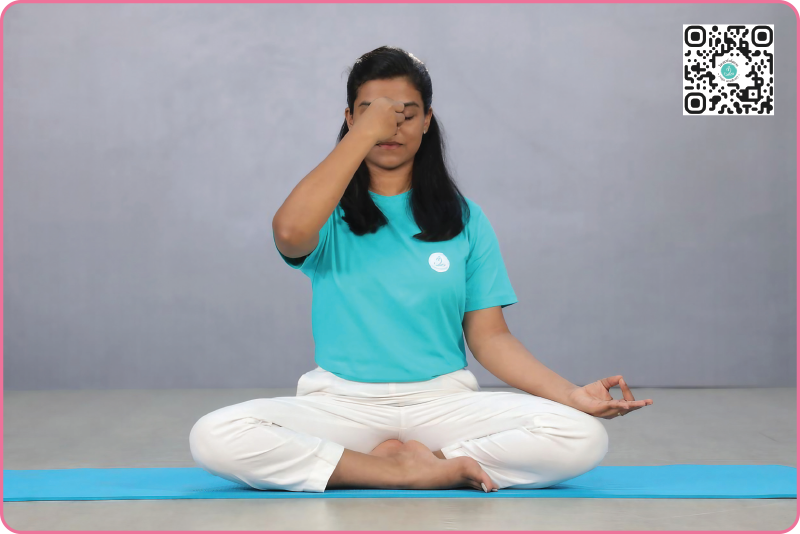
Try these asanas, along with Nadi Shuddhi Pranayama. Scan the QR code above for guided practice. Feel how it affects your inner state.
Ahimsa is not merely a moral principle; it is a state of evolved consciousness. It is the foundation of Ashtanga Yoga and develops through its practice. Through dedicated practice, our thoughts are transformed, our words are refined, our actions purified. Through this inner harmony, we begin to live in true alignment with ourselves and the world around us.
So do not ask yourself, “Is my yoga practice improving?” Ask instead:
Is there peace in my thoughts?
Is there kindness in my responses?
Am I moving, however slowly, toward ahimsa?
In truth, ahimsa is more than a principle of Yoga; it is the very fragrance of an awakened consciousness.
FROM THE HEARTFULNESS YOGA ACADEMY
Heartfulness Yoga Academy offers accredited, tradition-rooted programs that integrate asanas, pranayama, and Heartfulness Meditation with Yogic Transmission for a holistic approach to yoga.
yogaacademy.heartfulness.org

Bhushan Bhukte
Bhushan is a certified yoga teacher with over 12 years of experience. He develops Yoga Certification Board–aligned teaching materials and therapeutic yoga modules for various health conditions. At the Heartful... Read More
